
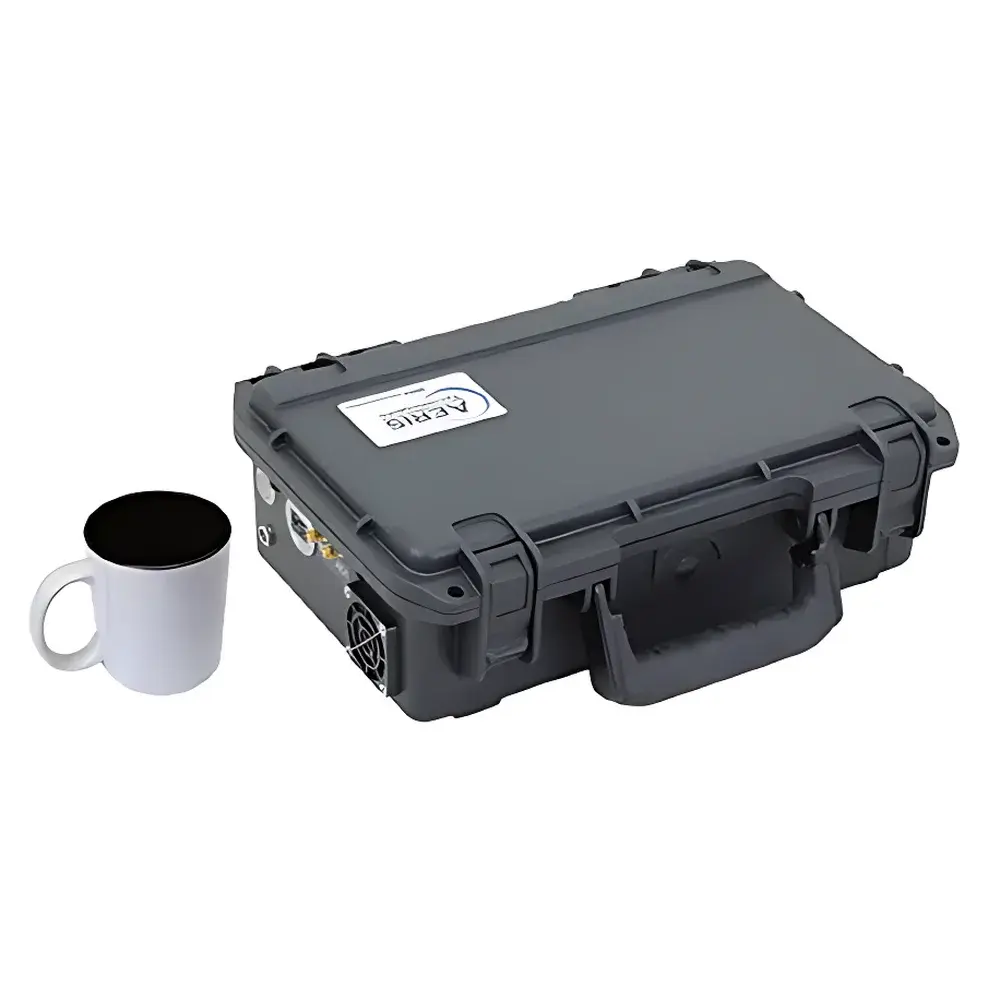
Aeris MIRA Pico OCS Trace Gas Analyzer
| Origin | USA |
|---|---|
| Manufacturer Type | Authorized Distributor |
| Origin Category | Imported |
| Model | MIRA PICO OCS |
| Pricing | Upon Request |
Overview
The Aeris MIRA Pico OCS Trace Gas Analyzer is a field-deployable, battery-powered optical gas analyzer engineered for high-precision, real-time measurement of carbonyl sulfide (OCS) in ambient air and controlled enclosure environments. It employs tunable diode laser absorption spectroscopy (TDLAS) in the mid-infrared (MIR) spectral region—specifically targeting the fundamental vibrational–rotational absorption band of OCS near 4.87 µm—where molecular absorption cross-sections are orders of magnitude stronger than in the near-infrared. This physical principle enables sub-part-per-trillion (ppt) detection limits with exceptional selectivity, free from spectral interferences common in complex gas matrices. Unlike cryogenically cooled or vacuum-pumped Fourier-transform infrared (FTIR) systems, the MIRA Pico integrates a proprietary “folded-path” multi-pass optical cell (60 mL volume, >13 m effective path length) within a sealed, alignment-free optical bench. The absence of high-reflectivity mirrors eliminates sensitivity to particulate contamination and thermal drift, ensuring long-term stability without routine optical maintenance. Designed for ecological flux studies—including soil–atmosphere exchange via dynamic chambers and eddy covariance-compatible deployments—the instrument delivers laboratory-grade metrology in a form factor smaller than a standard lunchbox (29.2 × 20.3 × 9.5 cm), enabling previously impractical in situ OCS monitoring.
Key Features
- Real-time OCS quantification with 1–2 Hz data output and <35 ppt (1σ, 1-min average) sensitivity, improvable to <10 ppt via configurable signal averaging
- Integrated, maintenance-free MIR laser sensor engine with factory-calibrated zero-point auto-correction and user-definable calibration intervals
- Ultra-low power consumption: 15 W nominal; powered by internal rechargeable Li-ion battery (6 h runtime) or external 12 V DC / 110–220 V AC input
- Compact, ruggedized chassis weighing only 2.75 kg (including battery and built-in sampling pump)
- Onboard GPS module (optional) for georeferenced data logging in .kml format, compatible with Google Earth and regional GNSS constellations
- Dual communication interfaces: embedded Wi-Fi (802.11 b/g/n) and RS-232 serial port; optional analog voltage output (0–5 V or 4–20 mA)
- 32 GB internal flash memory (expandable) with timestamped, metadata-rich binary and CSV export capabilities
Sample Compatibility & Compliance
The MIRA Pico OCS is validated for continuous operation across ambient temperature (10–40 °C) and relative humidity (10–95% RH, non-condensing) conditions typical of terrestrial field sites—including tidal wetlands, agricultural soils, and forest canopies. Its linear dynamic range spans <1 ppt to 100 ppm OCS, supporting both background atmospheric profiling (sub-500 ppt) and elevated concentration measurements in chamber-based flux experiments. The analyzer meets ISO 17025-aligned traceability requirements through NIST-traceable calibration gas protocols and documented uncertainty budgets per measurement cycle. While not certified for regulatory compliance under EPA Method TO-15 or EN 14662, its performance characteristics align with research-grade instrumentation referenced in peer-reviewed OCS flux literature (e.g., Nature Geoscience, Global Biogeochemical Cycles). Data integrity adheres to GLP principles: all configuration changes, calibration events, and environmental metadata are immutably logged with UTC timestamps.
Software & Data Management
Instrument control, data visualization, and remote diagnostics are managed via Aeris’ web-based interface accessible through any modern browser over Wi-Fi or Ethernet. No proprietary software installation is required. Raw absorbance spectra, concentration time series, and diagnostic parameters (laser current/temperature, cell pressure, detector gain) are stored synchronously. Export formats include IEEE-compliant CSV (with SI units and uncertainty flags) and binary HDF5 for MATLAB/Python post-processing. Firmware updates are delivered over-the-air (OTA) with SHA-256 signature verification. For integration into automated networks, the device supports Modbus TCP and MQTT protocols—enabling seamless ingestion into SCADA platforms or cloud-based environmental data lakes. Audit trails record all user actions and system events in accordance with FDA 21 CFR Part 11 principles (electronic signatures, role-based access control, and tamper-evident logs available upon request).
Applications
- Soil-atmosphere OCS flux quantification using dynamic closed-chamber systems
- Long-term ambient OCS monitoring in coastal marshes, peatlands, and urban-rural gradients
- Calibration and validation of satellite-based OCS retrievals (e.g., TROPOMI, GeoCARB)
- Photosynthetic activity proxy studies correlating OCS drawdown with CO2 assimilation rates
- Industrial stack monitoring where OCS serves as a tracer for sulfur processing efficiency
- Mobile platform deployment (UAV-mounted, vehicle-integrated, or backpack-operated) for spatial mapping
FAQ
What is the minimum detectable OCS concentration under field conditions?
The 1σ noise-equivalent concentration is ≤35 ppt over a 60-second integration period; extended averaging (15 min) reduces this to <10 ppt, assuming stable thermal and pressure conditions.
Does the instrument require external calibration gases during operation?
No—zero-point correction is performed automatically using a patented internal reference path; span calibration with certified OCS standards is recommended every 30–90 days depending on application criticality.
Can the MIRA Pico OCS operate unattended for weeks?
Yes—when connected to an external power source and configured with scheduled data upload via Wi-Fi or cellular modem, it supports fully autonomous operation with remote health monitoring.
Is the optical path susceptible to dust or moisture fouling?
No—the folded-path cell is hermetically sealed and contains no exposed optics; inlet filtration (standard 2.5 µm particulate + hydrophobic membrane) protects the sample stream without degrading response time.
How does the MIRA Pico compare to quantum cascade laser (QCL) or photoacoustic spectrometer (PAS) OCS analyzers?
Unlike QCL systems requiring thermoelectric cooling and PAS instruments limited by acoustic noise floor, the MIRA Pico achieves comparable sensitivity with lower power demand, higher immunity to vibration, and no moving parts—making it uniquely suited for battery-operated, long-duration field campaigns.
Related Products







