
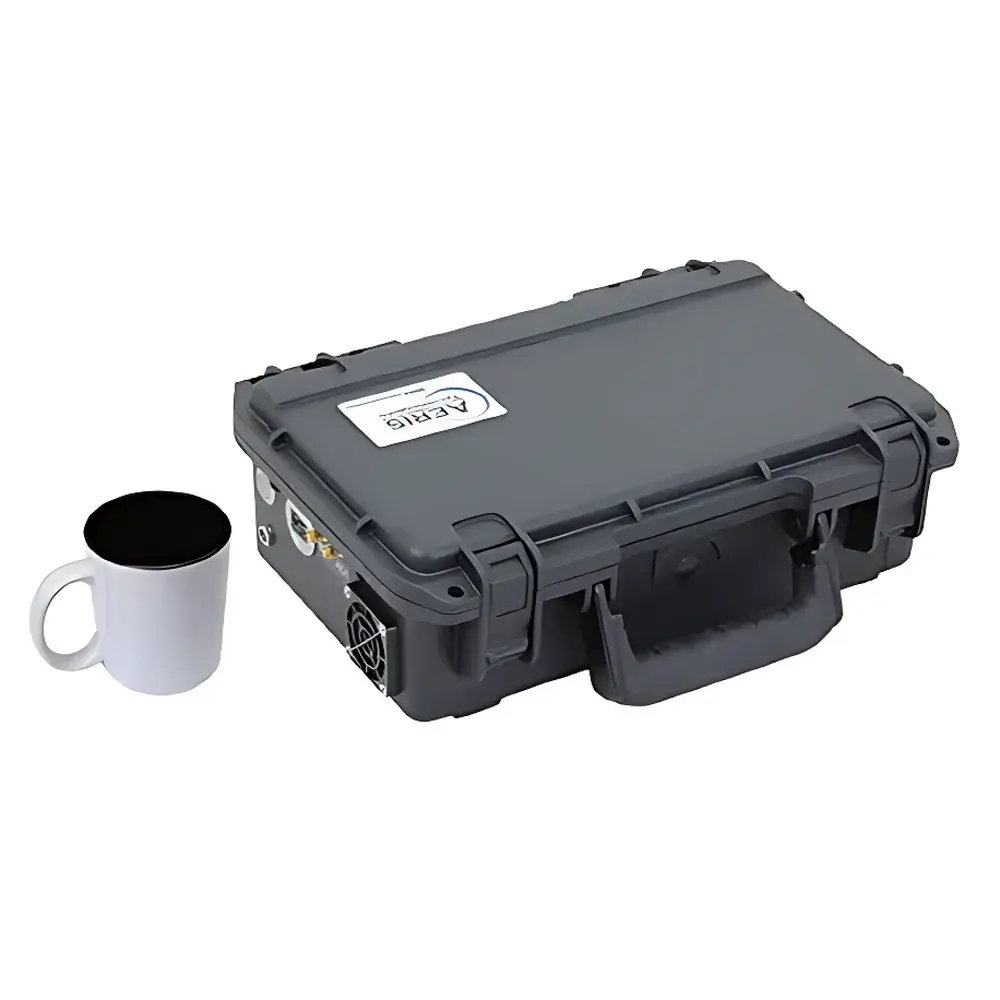
Aeris MIRA ULTRA N2O CO Analyzer
| Origin | USA |
|---|---|
| Manufacturer Type | Authorized Distributor |
| Origin Category | Imported |
| Model | MIRA ULTRA N2O CO |
| Pricing | Available Upon Request |
Overview
The Aeris MIRA ULTRA N2O CO Analyzer is a field-deployable, high-precision dual-gas analyzer engineered for real-time, quantitative measurement of nitrous oxide (N₂O) and carbon monoxide (CO) in ambient air and emission plumes. It employs Aeris’ proprietary mid-infrared (MIR) tunable diode laser absorption spectroscopy (TDLAS) platform with integrated optical folding technology—enabling an effective absorption path length exceeding 13 meters within a compact 60 mL multi-pass cell. This architecture leverages the strong fundamental vibrational absorption bands of N₂O and CO in the MIR region (typically 10–100× stronger than near-infrared overtones), delivering exceptional specificity, linearity, and immunity to spectral interference from H₂O and other common atmospheric constituents. The system operates on the principle of direct absorption spectroscopy, measuring concentration via Beer–Lambert law-based quantification of wavelength-specific attenuation. Its thermally stabilized optical core—maintained at precise temperature and pressure conditions—ensures long-term baseline stability and sub-ppb drift performance, eliminating reliance on frequent external calibration gases.
Key Features
- Real-time dual-species detection: Simultaneous quantification of N₂O and CO at 1–2 Hz data acquisition rate
- Ultra-high sensitivity: 500 ppt/s noise-equivalent detection limit (NEDL) for both N₂O and CO; sub-100 ppt precision achievable via signal averaging (e.g., <30 ppt N₂O at ~3-minute averaging)
- Differential sampling architecture: Two programmable sample inlets support autonomous zeroing, calibration cycling, or true differential mode—enabling drift correction without external zero gas generators
- Catalytic zero-air module: Integrated, long-life CO scrubber used as “zero port” for CO measurements, removing slow instrumental drift and elevating accuracy from ppb- to ppt-level
- Robust environmental operation: Rated for 10–35°C and 10–95% RH (non-condensing); sensor core remains stable up to 40°C, suitable for humid field deployments
- Low-power, portable design: 20 W nominal operating power; includes internal 6-hour rechargeable battery; dimensions: 14.5″ W × 12″ D × 7″ H; total weight: 6 kg (with battery and pump)
- Onboard connectivity: Built-in Wi-Fi, USB, RS-232; optional analog output (0–5 V or 4–20 mA); 32 GB internal storage (expandable)
- Rapid readiness: Short warm-up time (<60 min) enables immediate deployment in mobile or UAV-mounted configurations
Sample Compatibility & Compliance
The MIRA ULTRA is validated for continuous monitoring of ambient air, stack emissions, soil flux chambers, and fugitive release plumes. Its MIR-TDLAS methodology conforms to foundational principles outlined in EPA Method TO-11A (for CO) and ASTM D6348 (for trace gas analysis by optical absorption). While not pre-certified as a regulatory compliance monitor under 40 CFR Part 53 or EN 14625, its performance characteristics—including documented <1 ppb 24-hour drift for N₂O and CO, linear response across 1 ppb–500 ppm, and demonstrated GLP-aligned data integrity—support use in research-grade monitoring programs aligned with IPCC Tier 2/3 reporting, USGS flux studies, and EPA-approved ambient network validation protocols. All firmware and data logging routines are designed to support audit-ready metadata tagging (timestamp, GPS coordinates, pressure/temperature compensation flags), facilitating traceability required under ISO/IEC 17025-accredited laboratory practices.
Software & Data Management
The analyzer ships with Aeris ControlSuite™ v4.x—a cross-platform application supporting instrument configuration, real-time visualization, automated zero/calibration scheduling, and differential measurement scripting. Raw spectral data (absorbance vs. wavenumber) and processed concentration time series (N₂O, CO, H₂O, T, P) are logged with full metadata in CSV and NetCDF-4 formats. The software implements timestamp-synchronized GPS geotagging (when optional GNSS module is installed), enabling spatial mapping of emission plumes (“plume mapping”) for mobile surveys. Data export supports direct integration with Python-based analysis pipelines (via included API) and third-party platforms including MATLAB, R, and QGIS. Firmware updates preserve data continuity and include cryptographic signature verification. Audit trails record all user-initiated parameter changes, zero events, and calibration actions—meeting documentation requirements for GLP and internally governed QA/QC workflows.
Applications
- Atmospheric science: High-temporal-resolution N₂O and CO profiling in boundary layer studies, aircraft/UAV campaigns, and tall-tower networks
- Soil biogeochemistry: In situ quantification of nitrification/denitrification fluxes using dynamic chamber coupling
- Urban air quality: Mobile mapping of CO hotspots correlated with traffic density and combustion sources
- Industrial monitoring: Fugitive methane co-emission screening (via CO as tracer), landfill gas characterization, and biogas upgrading verification
- Regulatory support: Supplemental validation of reference-grade analyzers in ambient monitoring stations (e.g., CASTNet, IMPROVE)
- Climate research: Long-term trend analysis in remote sites where power, size, and maintenance constraints preclude traditional CRDS or GC-MS systems
FAQ
Does the MIRA ULTRA require external zero gas or calibration standards?
No. Its differential architecture uses an internal catalytic CO scrubber as a zero reference and supports automated zero cycles without external gas cylinders or zero-air generators.
Can it operate unattended for extended periods?
Yes. With external DC power or periodic battery swaps, it supports continuous operation; drift is typically <1 ppb over 24 hours, extending calibration intervals to weeks under stable conditions.
Is water vapor cross-sensitivity corrected in real time?
Yes. H₂O is co-measured at 1 kHz and used dynamically to correct N₂O and CO absorption lines via built-in spectroscopic modeling—no post-processing required.
What GPS accuracy is achieved with the optional module?
Sub-3 meter CEP (Circular Error Probable) with SBAS augmentation; raw NMEA 0183 output supports RTK upgrade paths.
How is data integrity ensured during power interruptions?
Non-volatile memory retains configuration and last 72 hours of buffered data; file writes are atomic and journal-protected to prevent corruption.







