
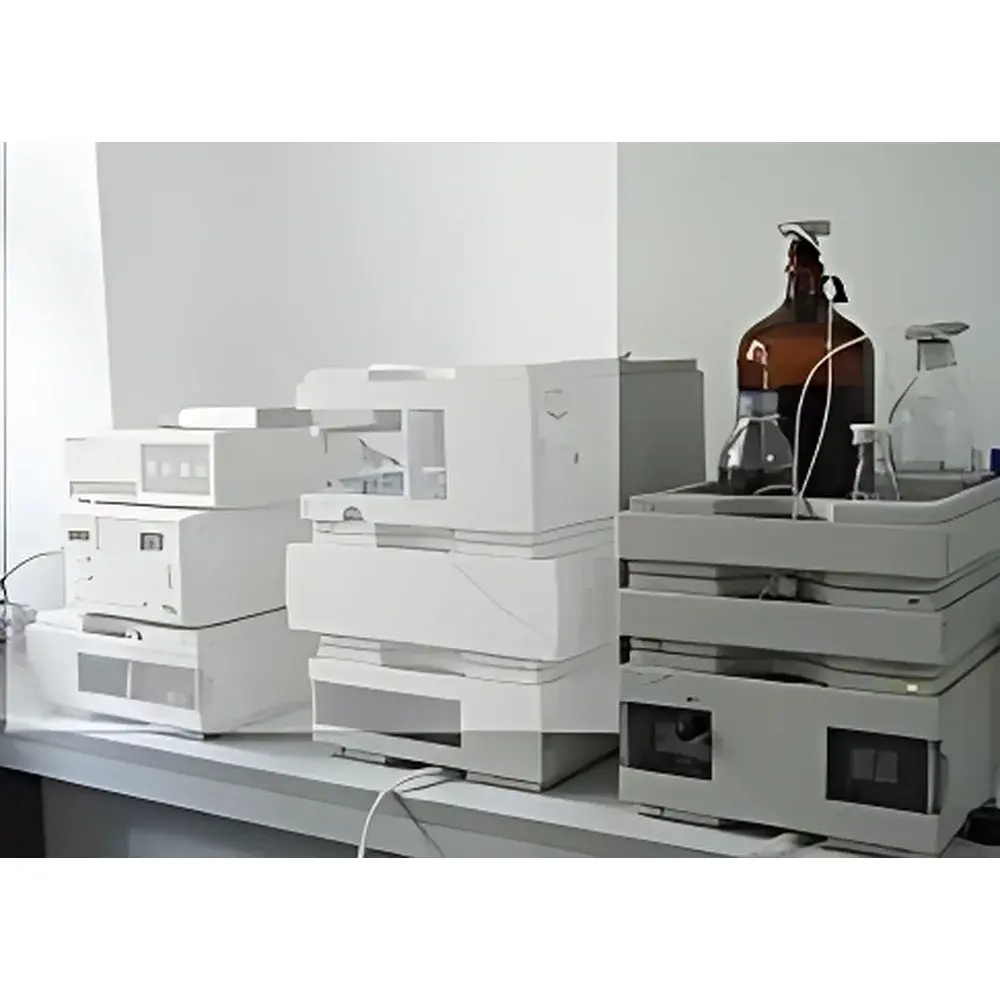
Agilent 1100 Series Used High-Performance Liquid Chromatograph (HPLC) System
| Brand | Agilent Technologies |
|---|---|
| Origin | USA |
| Model | Agilent 1100 |
| Instrument Type | Conventional HPLC System |
| Flow Rate Range | 0.001–10 mL/min |
| Maximum Pressure | Up to 400 bar (typical for 1100 series) |
| Autosampler Capacity | 100 positions |
| Injection Volume Range | 0.1–100 µL |
| Column Oven Temperature Range | –10 °C to 80 °C |
| UV-Vis Wavelength Range | 190–950 nm |
| Data Acquisition Rate | 50 Hz |
| Detector Options | VWD, DAD, MWD, RID, FLR |
| Pump Configurations | Quaternary (G1311A), Binary (G1312A), Isocratic (G1310A) |
| Degasser Types | G1322A (membrane), G1379A (micro-vacuum) |
| Column Compartment | G1316A |
Overview
The Agilent 1100 Series is a modular, high-reliability high-performance liquid chromatography (HPLC) platform engineered for precision separation, quantitation, and qualitative analysis of small- to medium-molecular-weight compounds in pharmaceutical, environmental, food safety, and academic research laboratories. Built upon proven quaternary solvent delivery architecture and robust low-dead-volume fluidic design, the system operates on classical reversed-phase, normal-phase, ion-exchange, and size-exclusion chromatographic principles. Its modular configuration supports flexible method development and regulatory-compliant deployment — particularly where legacy method transfer, cost-effective instrument revalidation, or long-term operational continuity are critical. As a pre-1200 generation platform, the 1100 series remains widely referenced in pharmacopoeial monographs (e.g., USP , EP 2.2.46) and retains full compatibility with validated SOPs across GLP and GMP environments.
Key Features
- Modular architecture enabling customizable configurations: quaternary pump (G1311A), binary pump (G1312A), or isocratic pump (G1310A) — all supporting gradient programming with ≤0.1% RSD flow precision at 1 mL/min.
- High-stability autosamplers: G1329A/G1313A standard tray-based unit (100-position capacity, 0.1–100 µL injection range) and G1367A microplate-compatible autosampler with reduced carryover (<0.005%) and temperature-controlled sample compartment (4–40 °C).
- Thermostatically controlled column compartment (G1316A) maintaining ±0.15 °C stability across –10 °C to 80 °C — essential for retention time reproducibility and method robustness.
- UV-Vis detection flexibility: G1314A variable-wavelength detector (190–950 nm, 50 Hz acquisition), G1315A diode array detector (DAD) with spectral resolution down to 1.2 nm, and G1365A multi-wavelength detector for simultaneous multi-analyte monitoring.
- Dedicated detectors for non-UV-absorbing analytes: G1362A refractive index detector (RID) for carbohydrates and polymers; G1321A fluorescence detector (FLR) with programmable excitation/emission wavelengths and high signal-to-noise ratio (>3000:1).
- Integrated degassing: G1322A helium-membrane or G1379A vacuum-microdegasser ensuring baseline stability and minimizing bubble-induced pressure fluctuations.
Sample Compatibility & Compliance
The Agilent 1100 Series accommodates a broad range of sample matrices — including aqueous buffers, organic solvents (acetonitrile, methanol), viscous mobile phases, and partially filtered biological extracts — provided they meet standard HPLC column inlet specifications (≤0.45 µm filtration recommended). All modules comply with IEC 61010-1 safety standards and electromagnetic compatibility (EMC) directives (EN 61326-1). While not natively 21 CFR Part 11–certified, the system supports audit-trail-enabled data acquisition when paired with compliant software (e.g., ChemStation Rev. A.10.02 or later with appropriate security settings), meeting ALCOA+ data integrity requirements under FDA, EMA, and PMDA inspection frameworks. It remains routinely accepted in ISO/IEC 17025-accredited testing labs for routine QC release testing.
Software & Data Management
Control and data processing are executed via Agilent ChemStation software (Windows XP/Vista/7 compatible), offering method editor, sequence scheduler, real-time chromatogram display, peak integration (with manual override), calibration curve generation (linear, quadratic, weighted), and report templating. Raw data (.ch files) are stored in vendor-proprietary format but exportable to ASCII, CSV, or PDF. ChemStation supports electronic signatures, user-level access control (admin/operator/analyst roles), and configurable audit trails — fulfilling core elements of data governance per Annex 11 and WHO TRS 996. Backups adhere to 3-2-1 policy recommendations (three copies, two media types, one offsite), and raw data retention aligns with internal SOPs or regulatory timelines (e.g., minimum 2 years post-approval for pharmaceutical submissions).
Applications
- Pharmaceutical QC: Assay, related substances, dissolution testing per USP/EP monographs using C18 columns and buffered mobile phases.
- Environmental analysis: PAHs, pesticides, and endocrine disruptors in water/soil extracts using reversed-phase or HILIC separations.
- Food & beverage: Preservative quantification (sorbates, benzoates), vitamin profiling (B-complex, C, E), and mycotoxin screening (aflatoxins, ochratoxin A).
- Academic research: Natural product isolation tracking, polymer molecular weight distribution (via SEC), and chiral separation using polysaccharide-based columns.
- Biotechnology support: Peptide purity assessment, excipient analysis, and residual solvent determination in drug substance batches.
FAQ
Is the Agilent 1100 Series compatible with modern LIMS or ELN systems?
Yes — via ChemStation’s OLE/COM interface or ASCII export functionality, enabling bidirectional data exchange with validated laboratory informatics platforms.
Can this used system be qualified under current GMP requirements?
Absolutely — IQ/OQ/PQ protocols are publicly available from Agilent and third-party vendors; requalification follows standard ASTM E2500 and ISO/IEC 17025 guidelines.
What maintenance intervals are recommended for optimal performance?
Pump seals every 6–12 months (depending on solvent aggressiveness), autosampler needle wash every 100 injections, and detector lamp replacement every 1,500–2,000 hours.
Does the system support column switching or heart-cutting 2D-LC configurations?
Yes — using optional valve modules (e.g., G1317A) and ChemStation’s advanced timing event scripting.
Are spare parts and service support still available?
Agilent maintains an active legacy parts inventory through authorized distributors; certified field engineers provide remote diagnostics and on-site preventive maintenance globally.
Related Products





