
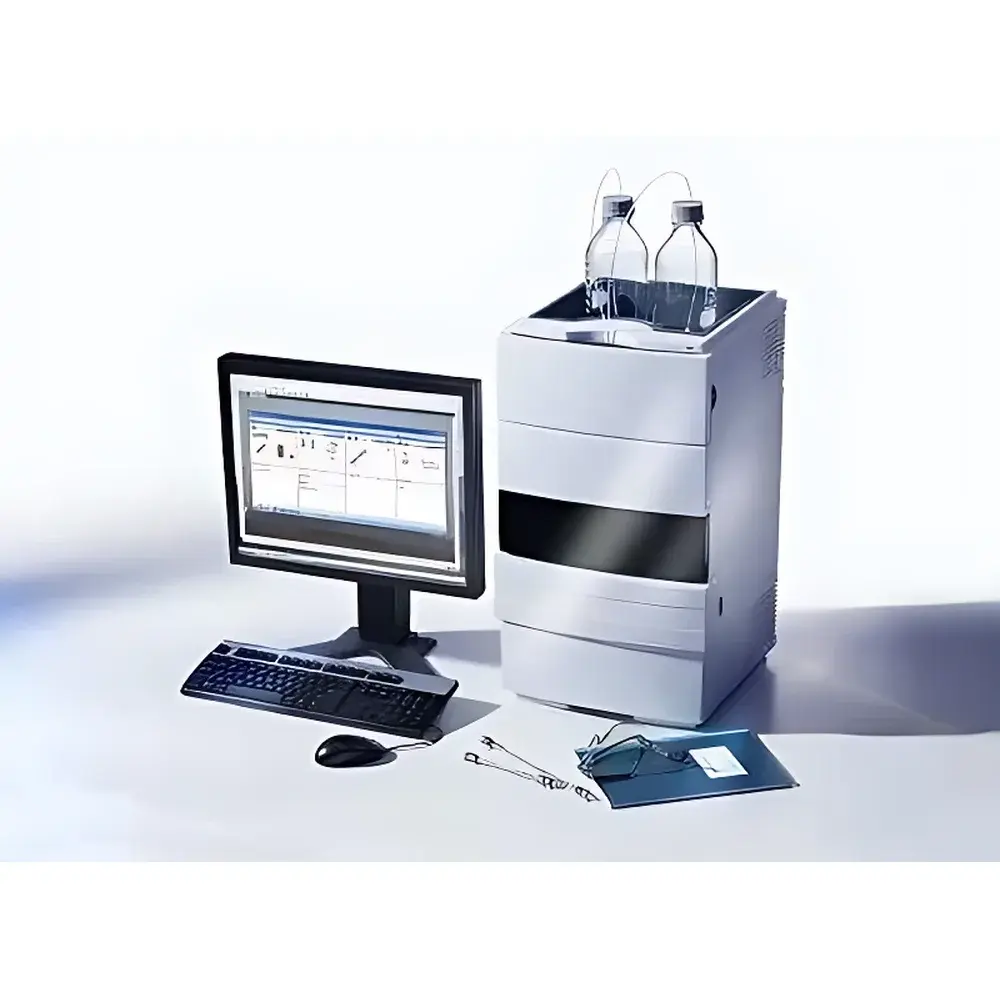
Agilent 1120 Compact LC System
| Brand | Agilent Technologies |
|---|---|
| Origin | USA |
| Model | 1120 |
| Instrument Type | Conventional High-Performance Liquid Chromatograph (HPLC) |
| Flow Rate Range | 0.001–10.0 mL/min (0.001 mL/min increments) |
| Maximum Pressure | 600 bar |
| Injection Volume Range | 0.1–100 µL (0.1 µL increments) |
| Autosampler Capacity | 100 × 2 mL vials, or 2 × 40-position half-trays (2 mL), or 15 × 6 mL vials |
| Column Oven Temperature Range | Ambient +10 °C to 60 °C (±0.15 °C stability) |
| UV/VIS Wavelength Range | 190–600 nm |
| Detector Noise | ±7.5 × 10⁻⁶ AU |
| Data Acquisition Rate | 80 Hz (UV/VIS), 74 Hz (fluorescence) |
| Flow Precision | ≤0.07% RSD |
| Injection Precision | <0.25% RSD (5–100 µL), <1% RSD (1–5 µL) |
Overview
The Agilent 1120 Compact LC System is a robust, entry-level high-performance liquid chromatography platform engineered for routine analytical laboratories requiring reliable, reproducible separations with minimal operational complexity. Based on proven Agilent HPLC architecture and compliant with core ISO/IEC 17025 and ASTM E2653-21 guidelines for chromatographic system validation, the 1120 employs dual-piston reciprocating pump technology with active solvent compressibility compensation to deliver precise gradient formation and isocratic elution across a wide flow range. Its modular design supports five pre-configured system bundles—spanning manual injection to automated sampling, ambient to thermostatically controlled column environments, and single-wavelength UV detection—enabling seamless alignment with QC/QA workflows in pharmaceutical, food safety, environmental, and academic settings. The system operates under standard GxP-compliant conditions and integrates natively with OpenLab CDS software for audit-trail-enabled data acquisition and reporting.
Key Features
- Compact, space-efficient benchtop footprint optimized for shared lab environments and limited fume hood access
- Dual-piston high-pressure pump with real-time solvent compressibility correction ensures <0.07% RSD flow precision across 0.001–10.0 mL/min range
- Variable-wavelength UV/VIS detector (VWD) with 190–600 nm spectral coverage, low-noise optical path (<±7.5 × 10⁻⁶ AU), and 80 Hz data collection rate for high-resolution peak tracking
- Thermostatically controlled column oven maintaining ±0.15 °C stability from ambient +10 °C to 60 °C—critical for retention time reproducibility and method transfer
- Autosampler with 100-position 2 mL vial capacity (or configurable 80-position half-tray or 15 × 6 mL vial option), delivering <0.25% RSD injection precision for volumes ≥5 µL
- Integrated system control via Agilent OpenLab CDS software, supporting 21 CFR Part 11-compliant electronic signatures, user role management, and secure audit trails
Sample Compatibility & Compliance
The Agilent 1120 accommodates standard 3.9–4.6 mm ID analytical columns (up to 250 mm length) and is compatible with reversed-phase (C18, C8), normal-phase, HILIC, and ion-exchange chemistries. It meets essential regulatory expectations for routine testing: validated per USP , ICH Q2(R2), and ASTM D7592-20 for HPLC system suitability; supports GLP/GMP documentation requirements through OpenLab’s electronic record integrity features—including full audit trail logging of method parameters, sequence edits, and calibration events. All hardware components are CE-marked and RoHS-compliant; the VWD detector satisfies photometric accuracy criteria outlined in ISO 17025 Clause 5.9 for spectrophotometric detection.
Software & Data Management
Controlled exclusively through Agilent OpenLab Chromatography Data System (CDS) v2.x or later, the 1120 enables centralized instrument scheduling, sequence building, real-time monitoring, and automated report generation. Raw data files (.D format) are stored with embedded metadata (instrument configuration, method version, operator ID, timestamp). Software features include peak integration using tangent skim and valley-to-valley algorithms, system suitability calculation per USP standards, and customizable PDF/Excel export templates aligned with internal SOPs. Audit trail functionality records all user-initiated changes—including parameter overrides, reprocessing actions, and result approvals—with immutable timestamps and digital signature enforcement per FDA 21 CFR Part 11 Subpart B.
Applications
The Agilent 1120 is routinely deployed in applications demanding consistent, traceable quantitation and identification under non-GLP or moderate-GxP conditions. These include assay of active pharmaceutical ingredients (APIs) and related substances per ICH Q5C guidelines; residual solvent analysis in drug products (USP ); pesticide screening in agricultural commodities (AOAC 2007.01); organic acid profiling in fermented foods (AOAC 978.10); and environmental contaminant screening (e.g., PAHs, phenols) per EPA Method 8330B. Its gradient capability and thermal column control make it suitable for method development in early-stage formulation support and stability-indicating assays where robustness—not ultra-high resolution—is the primary objective.
FAQ
Is the Agilent 1120 compatible with mass spectrometry detectors?
No—the 1120 is designed as a standalone UV/VIS-based HPLC platform and does not support direct LC-MS coupling due to its fixed flow-path architecture and lack of MS interface hardware or software drivers.
Can the column oven temperature be set below ambient?
No—the oven operates from ambient +10 °C to 60 °C; sub-ambient cooling is not supported. For low-temperature applications, external chillers or alternative column ovens must be integrated separately.
What is the minimum dwell volume for gradient delay characterization?
The system’s nominal dwell volume is approximately 600 µL when configured with standard 0.17 mm ID tubing and VWD flow cell; exact values require empirical measurement per ASTM E2653-21 Annex A2.
Does the 1120 support multi-wavelength scanning or spectral library matching?
No—the VWD is a single-wavelength or fixed-wavelength switching detector; full-spectrum PDA functionality is not available on this platform.
Are column switching valves or post-column derivatization modules supported?
Not natively—the 1120 lacks built-in valve drive electronics or auxiliary pump ports; such configurations require third-party hardware integration and custom method scripting outside OpenLab CDS scope.



