
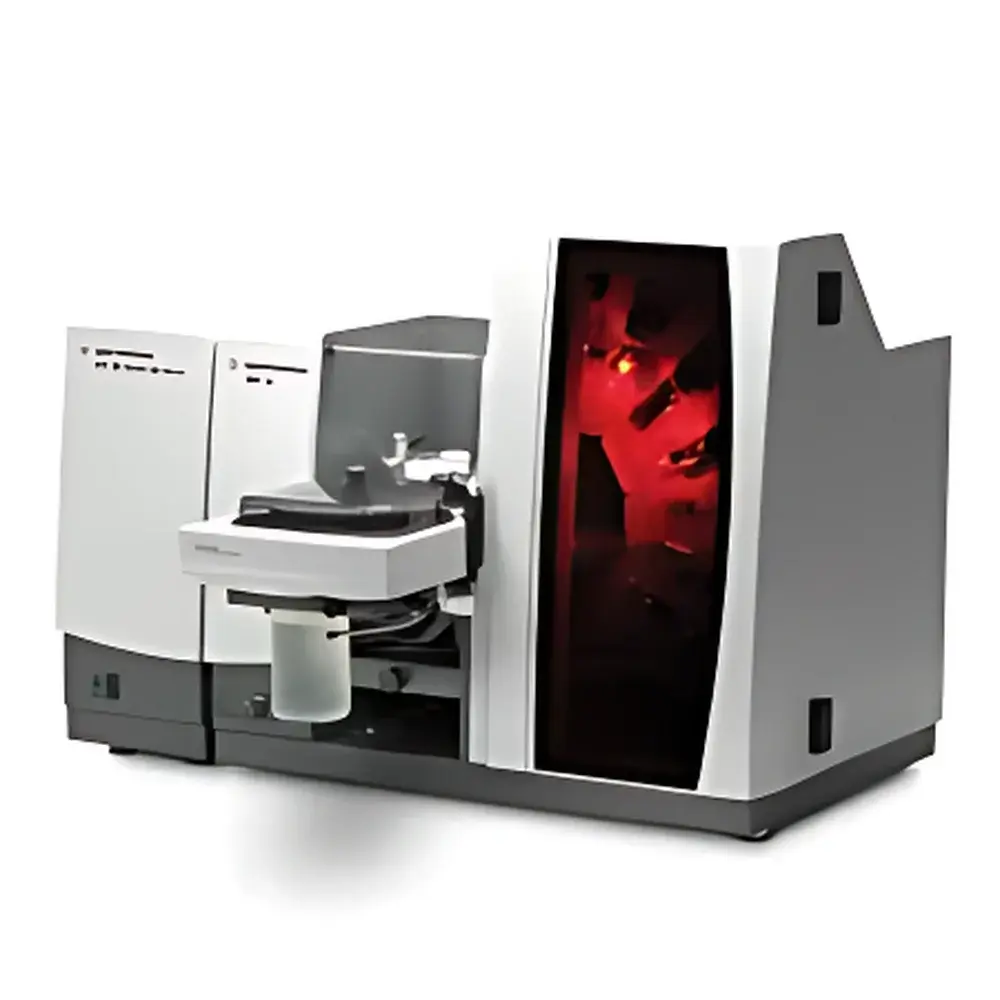
Agilent 280Z GFAA Zeeman Graphite Furnace Atomic Absorption Spectrometer
| Brand | Agilent Technologies |
|---|---|
| Origin | Imported |
| Manufacturer Type | Original Equipment Manufacturer (OEM) |
| Model | 280Z GFAA |
| Instrument Type | Graphite Furnace Atomic Absorption Spectrometer |
| Optical System | Dual-Beam |
| Background Correction | Zeeman Effect |
| Atomizer | GTA 120 Zeeman Graphite Furnace |
| Light Source Configuration | Up to 8 Fixed-Lamp Positions |
| Detector | Photomultiplier Tube (PMT) |
| Calibration Method | Polynomial Interpolation |
| Software Platform | Windows-Based Worksheet Interface |
| Optional Hydride Generation Compatibility | VGA Adapter Available |
| Temperature Control Architecture | Isothermal Zone Graphite Furnace Design |
| Lamp Technology | UltrAA Hollow Cathode Lamps (AC-Modulated) |
Overview
The Agilent 280Z GFAA Zeeman Graphite Furnace Atomic Absorption Spectrometer is a high-performance analytical platform engineered for ultra-trace elemental quantification in complex matrices. It operates on the fundamental principle of atomic absorption spectroscopy (AAS), where ground-state atoms in a graphite furnace absorb characteristic radiation from element-specific hollow cathode lamps. The instrument integrates AC-modulated Zeeman background correction—a physically robust, non-spectral method that separates analyte absorption from broadband and structured molecular background by applying a time-varying magnetic field across the graphite tube. This eliminates reliance on deuterium or continuum-source correction, delivering inherently higher accuracy and lower detection limits—particularly critical for applications requiring sub-ppt (ng/L) sensitivity in environmental, clinical, pharmaceutical, and food safety laboratories.
Key Features
- Zeeman-Enhanced Detection Limits: Equipped with AC-modulated UltrAA lamps and a precision-controlled magnetic field (0.1–0.8 T, digitally stabilized during measurement), the system achieves exceptional signal-to-noise ratios without external power conditioning.
- GTA 120 Graphite Furnace Atomizer: Features an isothermal temperature zone design ensuring uniform thermal distribution across the graphite surface, minimizing analyte loss and maximizing atomization efficiency for reproducible ppb-level performance.
- Dual-Beam Optical Architecture: Compensates for source intensity drift and lamp aging in real time, improving long-term measurement stability and reducing recalibration frequency.
- 8-Position Fixed-Lamp Carousel: Enables rapid sequential analysis of multi-element workflows without manual lamp swapping—optimized for routine QA/QC and regulatory compliance testing.
- Advanced Calibration Algorithms: Implements polynomial interpolation (not linear approximation) for calibration curve fitting, improving accuracy by up to 11× compared to legacy linear methods—especially vital for wide-dynamic-range calibrations spanning 3–4 orders of magnitude.
- SRM Wizard & Tube-Cam Integration: Guides users through empirical method development—including optimal drying, ashing, and atomization temperatures; chemical modifier selection; and sample volume optimization—based on certified reference materials (SRMs) and real-time furnace emission monitoring.
Sample Compatibility & Compliance
The 280Z GFAA supports liquid samples (aqueous and organic), digested biological tissues, acid-leached soils, and diluted clinical specimens (e.g., serum, urine). With optional VGA hydride generation adapter, it extends capability to hydride-forming elements (As, Se, Sb, Bi, Te, Pb, Sn), enabling orthogonal verification of GFAA results and matrix interference assessment. The system complies with ASTM D396, ISO 11885, USP , and EPA Methods 200.9 and 7060. Full audit trail, electronic signature support, and 21 CFR Part 11–compliant software modules are available for GLP/GMP environments.
Software & Data Management
Controlled via a Windows-based worksheet interface, the software provides intuitive method setup, real-time spectral visualization, automated peak integration, and customizable reporting templates. All instrument parameters—including magnetic field strength, ramp profiles, gas flow timing, and background correction status—are logged with timestamps and user IDs. Raw data files adhere to ASTM E1382-compliant formats, ensuring interoperability with LIMS and enterprise analytics platforms. Secure user role management (Administrator, Analyst, Reviewer) enforces procedural integrity across multi-shift operations.
Applications
- Environmental monitoring: Pb, Cd, Ni, and Cr quantification in drinking water per EPA 200.9
- Clinical toxicology: Blood lead level (BLL) testing per CLIA and CAP requirements
- Pharmaceutical impurity profiling: Catalyst residue analysis (e.g., Pd, Pt, Rh) in APIs per ICH Q2(R2)
- Food safety: As speciation support via hydride-GFAA coupling; Cd in rice flour per ISO 17294-2
- Geochemical research: Rare earth element (REE) analysis in low-volume rock digests
FAQ
Does the 280Z GFAA require external magnetic power supplies?
No—the instrument integrates a solid-state, digitally regulated electromagnet driver that maintains field stability independent of line voltage fluctuations.
Can the system be upgraded to support hydride generation?
Yes—via the optional VGA adapter kit, which interfaces seamlessly with the GTA 120 furnace and existing software workflow.
Is the software compliant with FDA 21 CFR Part 11?
Yes—when configured with electronic signatures, audit trail logging, and role-based access control, it meets full Part 11 requirements for regulated laboratories.
What graphite tube types are supported?
Standard pyrolytic-coated, integrated-platform, and end-capped tubes compatible with Agilent’s GTA 120 specifications—including OEM and qualified third-party alternatives.
How is background correction validated during operation?
Real-time Zeeman signal splitting is monitored via dual-channel photomultiplier detection; background absorbance is calculated from the π- and σ-components of the split spectrum, with automatic rejection of non-Zeeman artifacts.






