
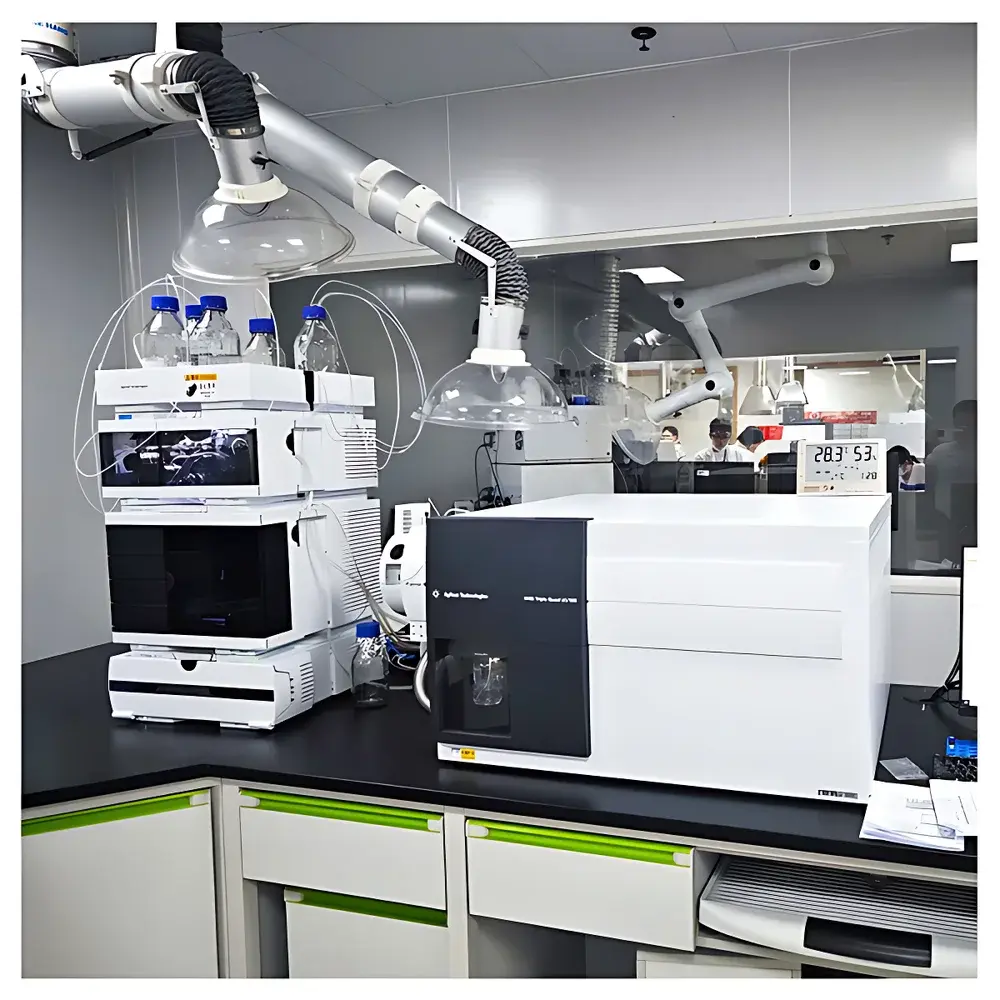
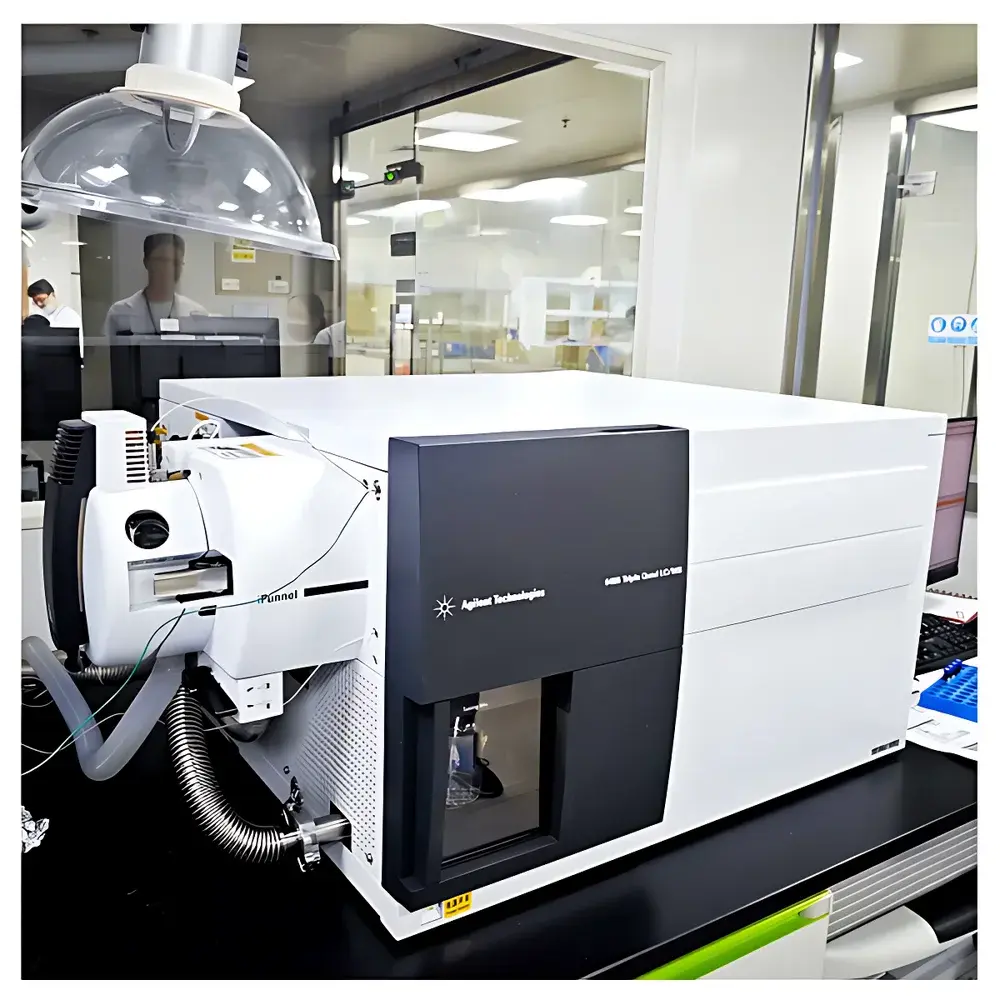
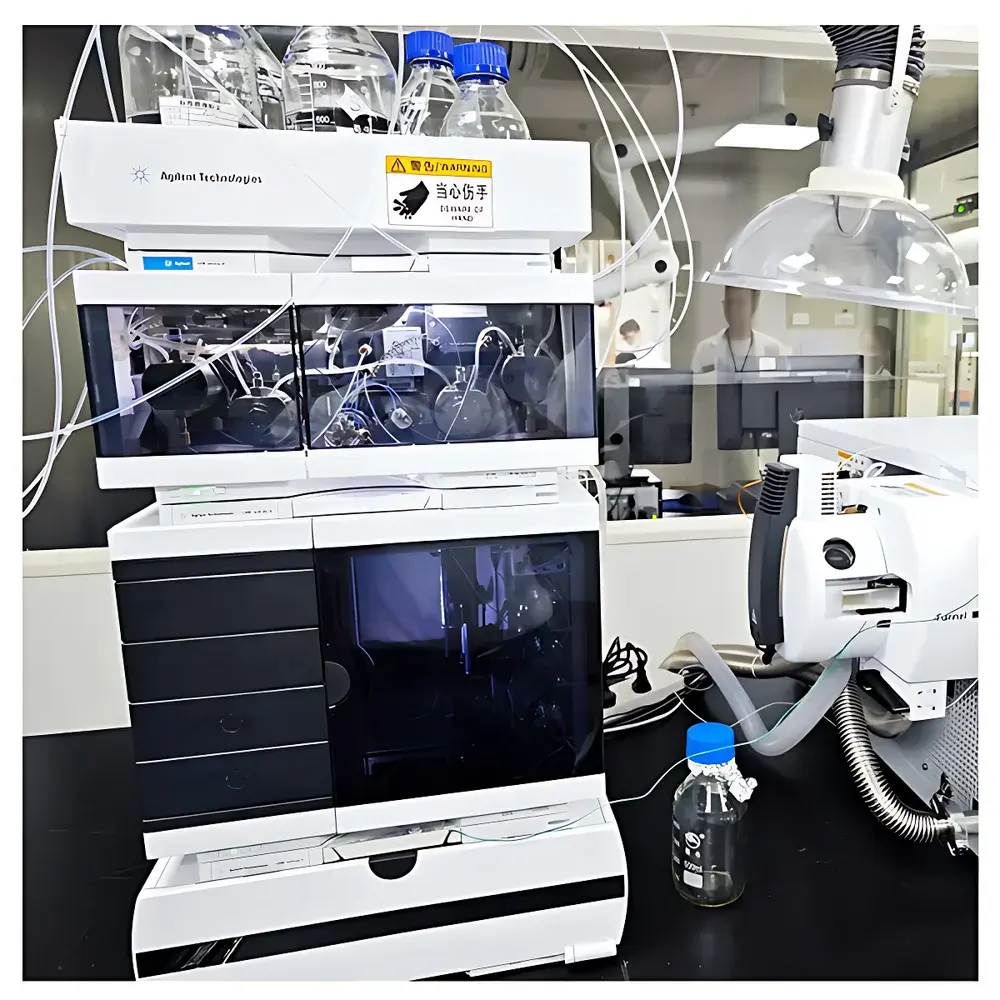
Agilent 6495 Triple Quadrupole Liquid Chromatography Mass Spectrometer
| Brand | Agilent Technologies |
|---|---|
| Origin | Malaysia |
| Instrument Type | Triple Quadrupole (TQ) |
| Model | 6495 |
| Mass Range | m/z 5–3000 |
| Resolution (FWHM) | 0.4–2.5 Da |
| MRM Transition Rate | 700 transitions/s |
| Minimum MRM Dwell Time | 0.5 ms |
| Polarity Switching Speed | <25 ms |
| Collision Cell Clean Time | <1 ms |
| Ion Sources | ESI, APCI, Dual ESI/APCI, NanoESI |
| Vacuum Pump Option | Edwards nXL200i oil-free dry pump |
| Dimensions (W×D×H) | 91.5 × 77.3 × 47.5 cm |
Overview
The Agilent 6495 Triple Quadrupole LC/MS system is a high-performance, targeted quantitative mass spectrometry platform engineered for robustness, reproducibility, and regulatory readiness in demanding analytical environments. Built upon a mature triple quadrupole architecture, it employs collision-induced dissociation (CID) in the central quadrupole (Q2) to generate characteristic fragment ions from selected precursor ions isolated in Q1—enabling highly selective multiple reaction monitoring (MRM) detection. This principle underpins its exceptional specificity in complex matrices, making it ideal for regulated bioanalysis, clinical research, environmental screening, and food safety applications where trace-level quantification of small molecules, peptides, lipids, and metabolites is required. The system integrates hardware innovations—including fourth-generation iFunnel ion optics, intelligent vacuum management, and reflexive data-driven workflows—with software-controlled method optimization to deliver consistent performance across instrument lifecycles and laboratories.
Key Features
- iFunnel 4.0 ion optics: Enhances electrospray ionization (ESI) ion transmission efficiency by capturing a broader angular distribution of the ESI plume, resulting in improved signal-to-noise ratios and lower limits of detection without compromising dynamic range.
- SWARM automated tuning: Leverages multivariate AI-driven optimization to determine optimal RF/DC voltages, collision energies, and dwell times for each MRM transition—reducing manual method development time and improving inter-laboratory reproducibility.
- VacShield rapid source cleaning: Enables on-the-fly removal of matrix deposits from the ion source region without breaking vacuum or interrupting analysis sequences—minimizing instrument downtime and preserving calibration stability.
- Intelligent Reflex workflow: Supports data-dependent re-injection of samples flagged during acquisition for confirmation or extended characterization, enabling adaptive decision-making within single-run protocols.
- Early Maintenance Feedback (EMF): Provides real-time status visualization of LC/MS subsystems—including pump pressure, column temperature, detector voltage, and vacuum integrity—to support predictive maintenance planning and GLP/GMP-compliant instrument qualification.
- Edwards nXL200i oil-free dry pump: Reduces power consumption and heat dissipation by >50% compared to conventional turbomolecular-pump systems, supporting sustainable lab operations and stable vacuum performance over extended duty cycles.
Sample Compatibility & Compliance
The 6495 accommodates diverse sample introduction formats—including standard-flow HPLC (0.2–2 mL/min), microflow, and nanoflow (50–500 nL/min) configurations—via interchangeable ion sources (ESI, APCI, dual-mode ESI/APCI, and NanoESI). Its wide mass range (m/z 5–3000) supports analysis of small molecules (e.g., pesticides, PFAS, pharmaceuticals), medium-weight metabolites and lipids, and enzymatically digested peptides. The system meets key regulatory requirements for validated workflows: full audit trail support in MassHunter v12+, compliance with FDA 21 CFR Part 11 electronic records/signatures, and alignment with ISO/IEC 17025 and ICH M10 guidelines for bioanalytical method validation. Routine operation adheres to ASTM D7622 (petroleum biomarkers), USP (validation of compendial methods), and CLSI EP26-A (mass spectrometry-based clinical assays).
Software & Data Management
Controlled exclusively through Agilent MassHunter Workstation (v12 or later), the 6495 supports seamless method transfer between Agilent LC/MS platforms—including 6470, 6490, and 6495 models—via standardized method templates and shared compound libraries. The Compound Optimization workflow allows users to rapidly add new analytes to existing methods and auto-generate optimized MRM transitions using empirical fragmentation patterns. All acquisition parameters—including dwell time, collision energy ramping, and polarity switching—are stored as metadata with raw data files (.d format), ensuring full traceability. Data processing leverages Quantitative Analysis and Qualitative Analysis modules with customizable reporting templates compatible with LIMS integration via Agilent OpenLab CDS or third-party middleware.
Applications
- Targeted metabolomics & lipidomics: Quantifies >200 lipid classes in plasma within 15-min gradients at sub-pg/mL sensitivity—enabling population-scale studies linking lipid species to disease phenotypes and metabolic pathways.
- Quantitative proteomics: Delivers ng/mL-level detection of signature peptides in plasma digests using standard-flow LC, with performance comparable to nano-LC systems when coupled to Evosep One for high-throughput cohort analysis.
- Environmental & food safety testing: Achieves low-ppt detection of PFAS, mycotoxins, and pesticide residues in complex food extracts and wastewater matrices—validated per EU SANTE/11312/2021 and EPA Method 1694.
- Pharmaceutical bioanalysis: Supports PK/PD studies with precision <15% CV across 3–4 log linear dynamic ranges—fully compliant with FDA Guidance for Industry (2022) on bioanalytical method validation.
FAQ
What is the difference between IDL and traditional S/N-based sensitivity metrics?
Instrument Detection Limit (IDL) is a statistically derived value based on repeated injections of low-concentration standards, representing the lowest concentration reliably distinguished from background noise with defined confidence (typically 99%). Unlike single-injection S/N ratios, IDL accounts for run-to-run variability and is endorsed by regulatory agencies including the US FDA and EMA for method validation.
Can the 6495 be used for untargeted analysis?
While optimized for targeted MRM quantitation, the system supports full-scan and product-ion scan modes for structural elucidation. However, for comprehensive untargeted profiling, Agilent recommends pairing with Q-TOF platforms (e.g., 6545XT) due to superior mass accuracy and dynamic range in discovery workflows.
Is remote monitoring supported?
Yes—MassHunter Remote Access enables secure, browser-based oversight of instrument status, queue management, and real-time data review via corporate networks or VPN, facilitating multi-site lab coordination and 24/7 operational continuity.
How does VacShield reduce maintenance frequency?
VacShield uses localized heating and gas-assisted desorption to volatilize non-volatile matrix residues directly from the ion source interface, eliminating the need for frequent source disassembly and solvent cleaning—extending mean time between maintenance (MTBM) by up to 3× in high-throughput labs.
Does the system support isotopic dilution quantification?
Yes—the 6495 fully supports stable isotope-labeled internal standards (SIL-IS) in MRM mode, with dedicated calibration curve fitting algorithms in MassHunter Quantitative Analysis that correct for differential ionization efficiency and matrix effects.




