
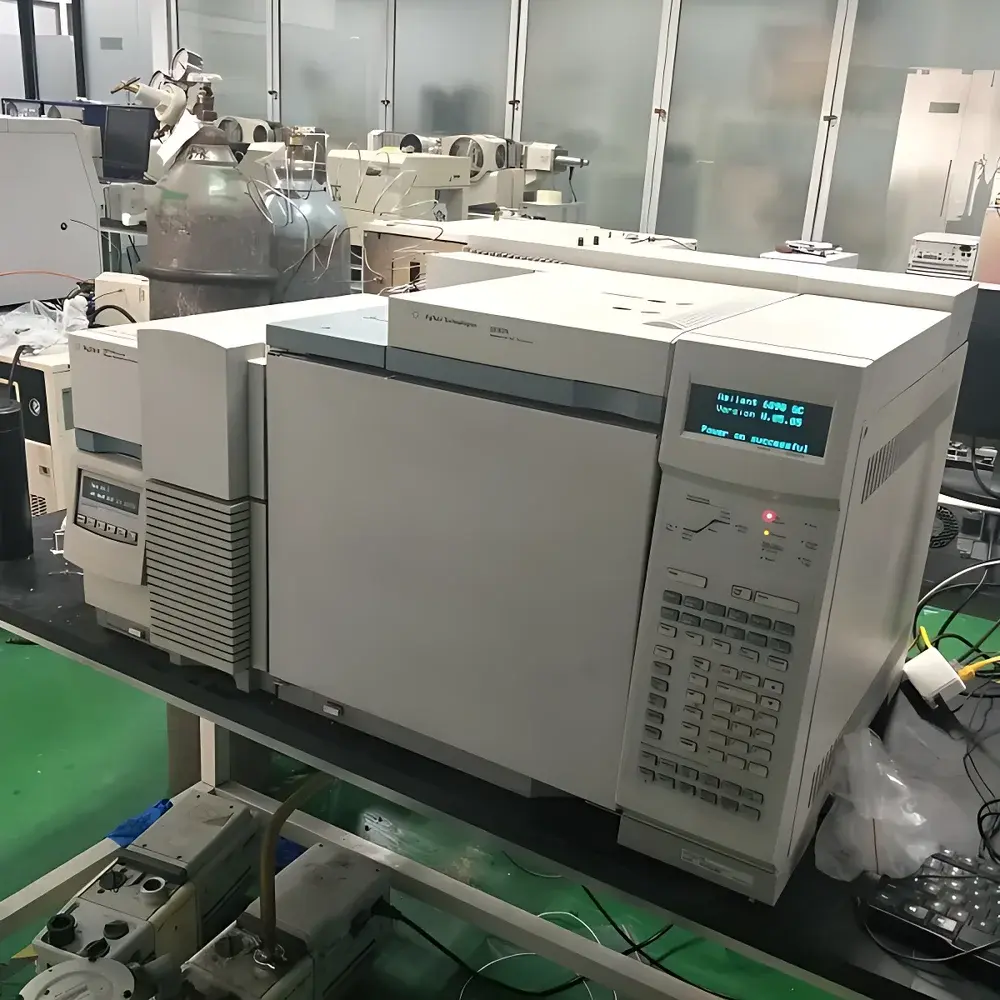
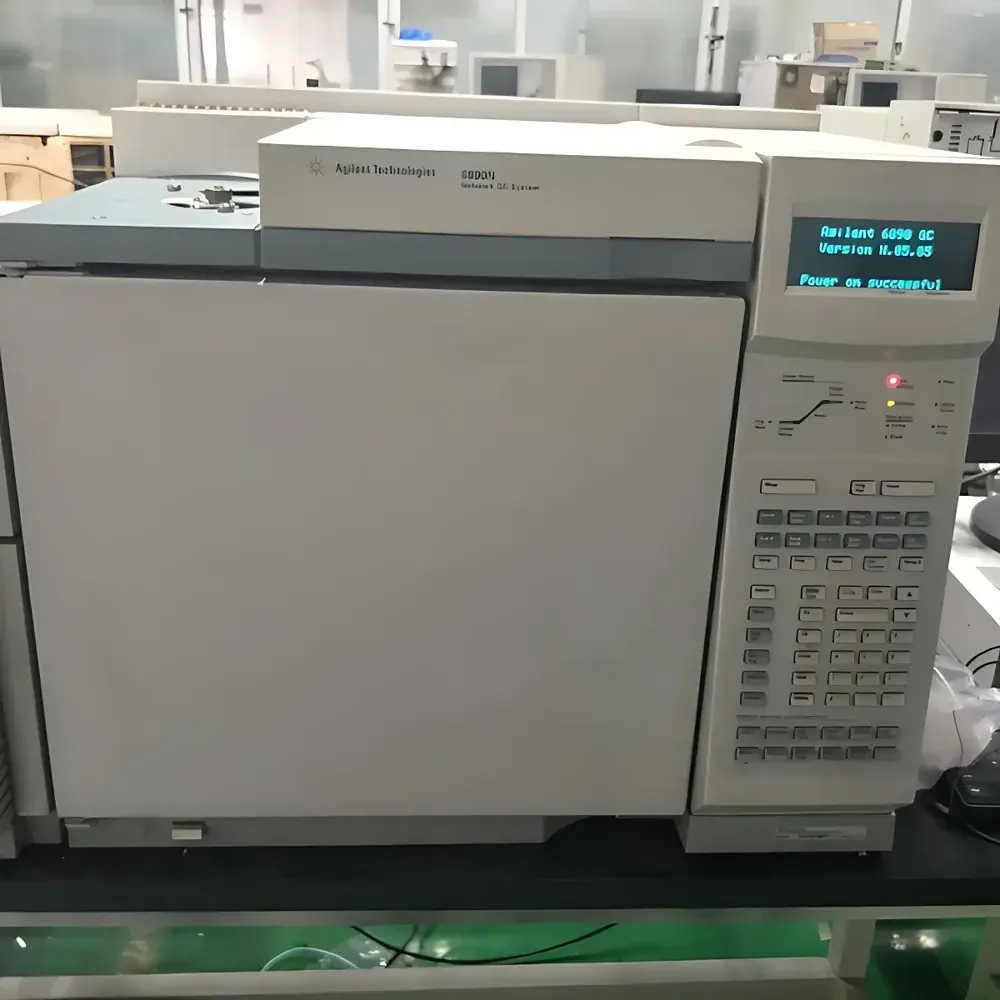
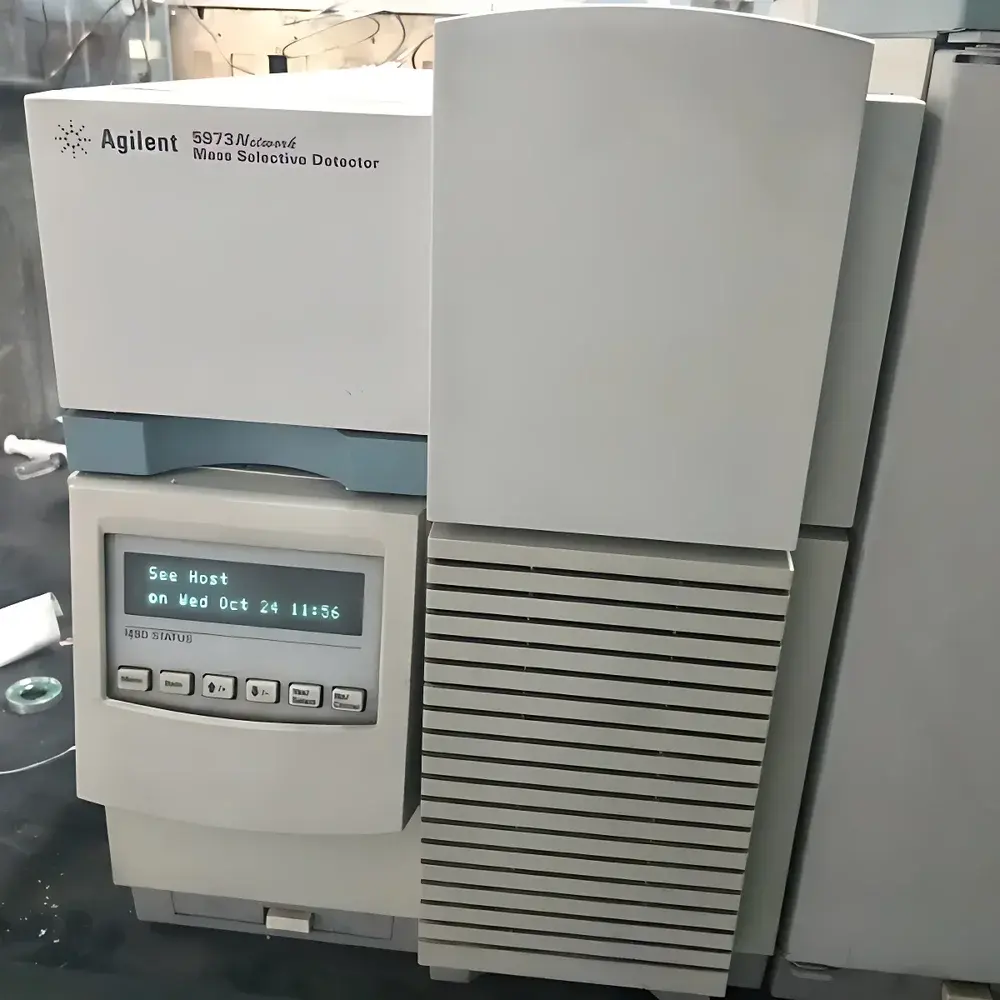
Agilent 6890N-5973N Gas Chromatography-Mass Spectrometry System (Used)
| Brand | Agilent Technologies |
|---|---|
| Origin | USA |
| Model | GCMS 6890N-5973N |
| Instrument Type | Ion Trap Mass Spectrometer |
| Chromatography Type | Conventional GC-MS |
| Mass Range | 1–1000 amu |
| Resolution | 1000–2000 (FWHM at m/z 272) |
| Sensitivity | >300:1 (S/N, EI mode, 1 pg octafluoronaphthalene, m/z 272) |
| Scan Speed | 15,000 u/s |
| Ionization Modes | Electron Impact (EI), Chemical Ionization (CI), Negative Chemical Ionization (NCI) |
| Injector Types | Split/Splitless and Programmable Temperature Vaporizing (PTV) inlets |
| Oven Temperature Range | Ambient to 400 °C |
| Mass Accuracy | ±0.1 u |
| Library | NIST 2008 Mass Spectral Library |
Overview
The Agilent 6890N-5973N Gas Chromatography-Mass Spectrometry (GC-MS) system is a robust, high-performance benchtop analytical platform engineered for precise separation, detection, and structural identification of volatile and semi-volatile organic compounds. This used but fully refurbished configuration integrates the Agilent 6890N gas chromatograph—featuring dual independent oven zones, precision electronic pressure control (EPC), and support for up to three detectors—with the Agilent 5973N mass selective detector (MSD), a quadrupole-based mass spectrometer optimized for routine qualitative and quantitative analysis. The system operates on electron impact (EI) ionization as the primary mode, with optional CI and NCI capabilities enabled via interchangeable ion sources. Its mass range spans 1.6–800 amu with unit mass resolution and ±0.1 u mass accuracy, enabling reliable library matching and compound confirmation per ASTM E260, ISO 17025, and USP guidelines.
Key Features
- Agilent 6890N GC: Dual-zone programmable temperature oven (ambient to 400 °C), EPC-controlled split/splitless and PTV inlets, compatibility with capillary columns up to 100 m length
- Agilent 5973N MSD: Quadrupole mass analyzer with high-transmission ion optics, electron multiplier detector, and bake-out capability for extended vacuum stability
- Ion source options: Standard EI source (G1050-60100), optional CI source (G1051-60100), and NCI source (G1052-60100) for enhanced selectivity in trace analysis
- Scan modes: Full-scan (SCAN), selected ion monitoring (SIM), and tune/autotune functions for rapid method development and calibration verification
- Vacuum system: 215 L/s turbomolecular pump paired with 15 m³/h two-stage rotary vane mechanical pump (E2M15), achieving base pressure <5×10⁻⁶ Torr
- Integrated software: Agilent ChemStation G1701DA (Rev. D.03.00 or later) with full GLP-compliant audit trail, instrument control, data acquisition, and reporting modules
Sample Compatibility & Compliance
The 6890N-5973N accommodates a broad spectrum of sample matrices—including food extracts, environmental water/soil extracts, pharmaceutical intermediates, and forensic biological fluids—following appropriate sample preparation (e.g., liquid-liquid extraction, solid-phase extraction, or derivatization). It complies with key regulatory frameworks for analytical validation: methods developed on this platform meet FDA 21 CFR Part 11 requirements when deployed with validated ChemStation configurations, support ISO/IEC 17025 accreditation documentation, and align with EPA Methods 8270D (semivolatile organics) and 8082A (PCBs). All hardware components—including the DB-5ms fused-silica column (30 m × 0.25 mm ID × 0.25 µm film) and 7683B autosampler—meet Agilent’s original equipment specifications and undergo functional verification prior to delivery.
Software & Data Management
Data acquisition, processing, and reporting are managed through Agilent ChemStation G1701DA software, which provides intuitive method building, real-time spectral display, automated peak integration, and NIST 2008 mass spectral library searching (with probability-based hit ranking and retention index filtering). The software supports multi-level user access control, electronic signatures, and full audit trail logging per 21 CFR Part 11 Annex 11 requirements. Raw data files (.D format) are stored in a structured directory hierarchy; processed results can be exported to CSV, PDF, or XML formats for LIMS integration. Optional ChemStation Quantitative Analysis (QA) module enables multi-level calibration curves, internal standard correction, and QC sample tracking across batch sequences.
Applications
This GC-MS system is routinely deployed in quality control laboratories for residue analysis (e.g., pesticide screening in fruits per EN 15662, veterinary drug residues in meat per EU 2021/808), impurity profiling in active pharmaceutical ingredients (APIs), flavor and fragrance component characterization, and environmental contaminant quantification (e.g., PAHs in soil, chlorinated hydrocarbons in groundwater). Its demonstrated sensitivity—1 pg octafluoronaphthalene yielding S/N ≥20:1 (EI), and 1 pg under NCI yielding S/N ≥500:1—makes it suitable for low-level target analyte quantification in complex matrices. Structural elucidation is supported by reproducible EI fragmentation patterns and retention time indexing against certified reference standards.
FAQ
Is this system compliant with 21 CFR Part 11 for regulated environments?
Yes—when configured with ChemStation G1701DA D.03.00 or later, enabled audit trail, and validated user access controls, the system meets electronic record and signature requirements.
What maintenance history is available for this used unit?
Each unit undergoes full functional testing, including vacuum integrity checks, mass calibration verification, source cleaning, and detector gain optimization; full service logs and calibration certificates are provided.
Can the system be upgraded to support newer software versions?
ChemStation D.03.x is the final supported version for the 5973N; migration to OpenLab CDS requires hardware replacement and is not feasible for this legacy platform.
Are original consumables and spare parts still available?
Agilent continues to supply EI sources, tuning standards (e.g., PFTBA), septa, liner kits, and DB-5ms columns; third-party compatible alternatives are also widely available and qualified.
Does the system include IQ/OQ documentation?
A standardized Installation Qualification (IQ) and Operational Qualification (OQ) protocol package is included, customizable for site-specific validation requirements.
Related Products





