
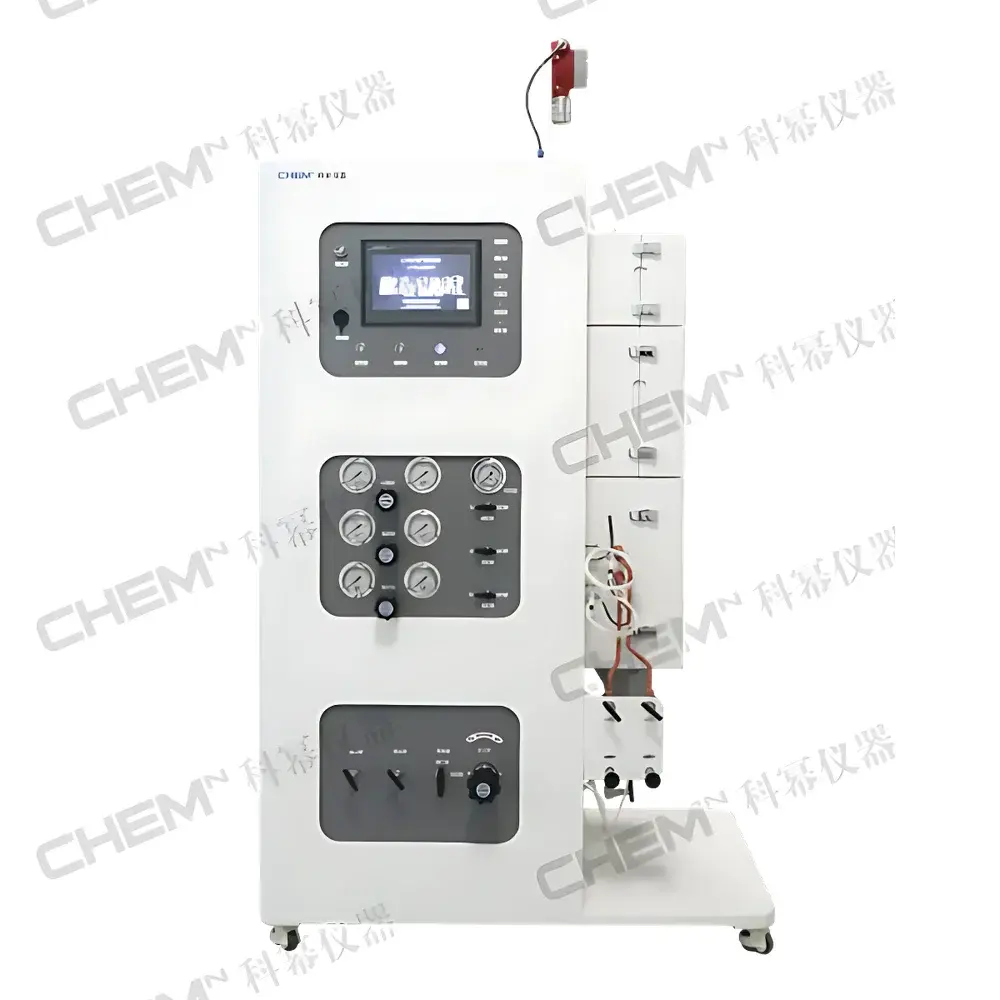
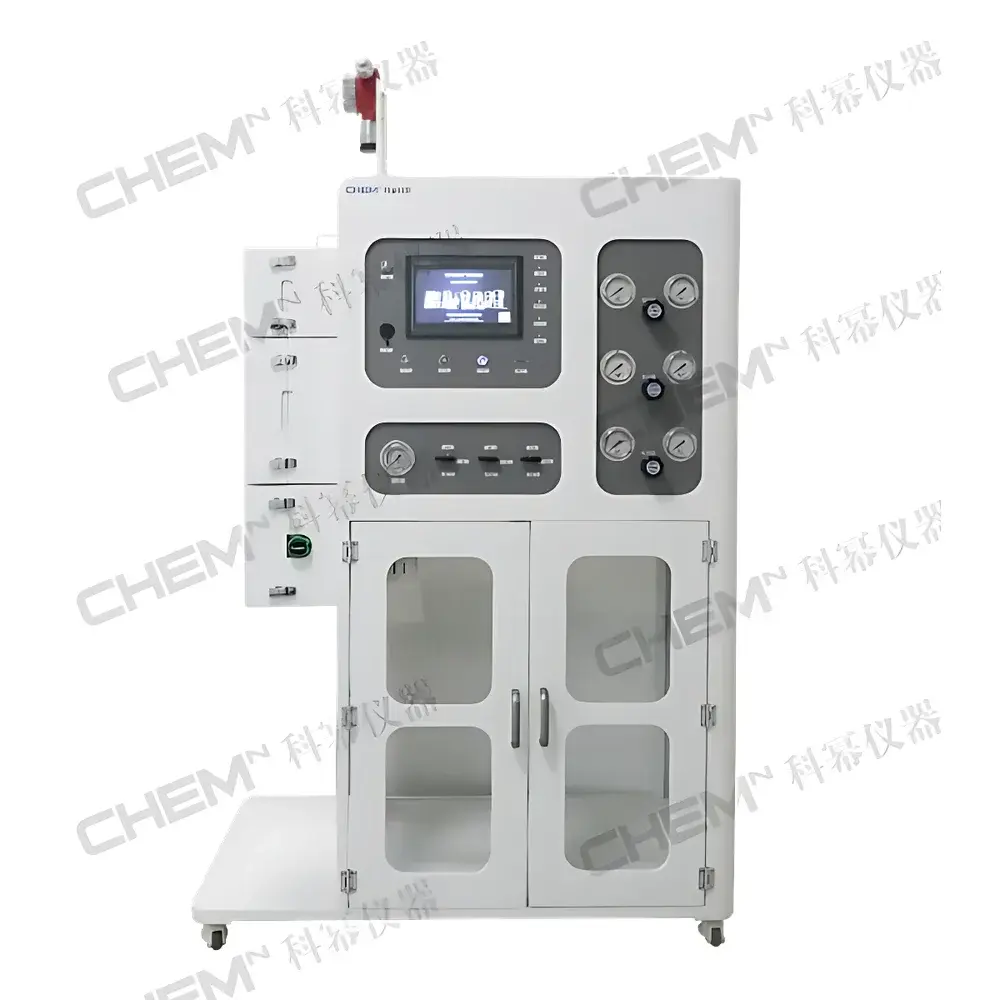
Ahkemi CFRF-FT-L0G3 Fixed-Bed Fischer-Tropsch Synthesis Reactor
| Brand | Ahkemi |
|---|---|
| Origin | Anhui, China |
| Model | CFRF-FT-L0G3 |
| Maximum Operating Pressure | 10 MPa |
| Maximum Operating Temperature | 600 °C |
| Catalyst Bed Volume | 0.5–5 mL |
| Heating Zone Length | 240 mm |
| ±2 °C Isothermal Zone Length | 50 mm |
Overview
The Ahkemi CFRF-FT-L0G3 Fixed-Bed Fischer-Tropsch Synthesis Reactor is a precision-engineered laboratory-scale catalytic evaluation system designed for kinetic studies, catalyst screening, and process optimization under industrially relevant conditions. It operates on the principle of continuous-flow heterogeneous catalysis in a fixed-bed configuration, where gaseous syngas (CO + H₂) passes through a thermally stabilized catalyst bed to produce hydrocarbons via surface-mediated chain growth mechanisms. The reactor supports operation up to 10 MPa and 600 °C—parameters aligned with commercial low-temperature Fischer–Tropsch (LTFT) and high-temperature Fischer–Tropsch (HTFT) process windows. Its compact, floor-standing architecture integrates thermal management, pressure regulation, and real-time process monitoring into a single unit, enabling reproducible reaction data acquisition under strict isothermal and isobaric control.
Key Features
- High-integrity stainless-steel reactor tube with Inconel 600 heating jacket and dual-zone PID-controlled furnace, delivering a stable ±2 °C isothermal zone over 50 mm—critical for eliminating axial temperature gradients during kinetic measurements.
- Integrated back-pressure regulation with pre-heated gas lines and insulated transfer path to GC inlet, minimizing condensation of C₅⁺ liquid products and preserving sample integrity for online gas chromatographic analysis.
- Dual-stage safety interlock system: primary alarm triggers audible/visual alerts; secondary alarm automatically cuts power to heaters and closes solenoid inlet valves upon exceeding user-defined thresholds for temperature or pressure—fully compliant with IEC 61508 SIL 2 functional safety principles.
- Modular frame design includes dedicated mounting rails and cable management pathways for seamless integration of third-party analytical instruments—including GC, MS, or FTIR—within the same footprint.
- Web-enabled remote operation via embedded industrial controller: real-time parameter logging, setpoint adjustment, and event-triggered data export accessible from laptop, tablet, or smartphone using standard HTTPS interface—no proprietary software required.
- Low dead-volume manifold assembly (< 0.8 mL total internal volume) ensures rapid response to feed composition changes and improves time-resolved selectivity tracking during transient experiments.
Sample Compatibility & Compliance
The CFRF-FT-L0G3 accommodates powdered, pelletized, or extruded catalysts within the 0.5–5 mL bed volume range, supporting both metal (e.g., Fe, Co, Ru-based) and supported oxide formulations. All wetted parts conform to ASTM A269 TP316L specifications. The system meets mechanical design requirements per ASME BPVC Section VIII Div. 1 (2023 Edition) for pressure boundary components rated to 10 MPa. Temperature and pressure sensors are NIST-traceable and calibrated per ISO/IEC 17025 procedures. Data acquisition and remote control functionality support audit trails and electronic signatures compatible with GLP and GMP environments—fully traceable session logs align with FDA 21 CFR Part 11 requirements when deployed with validated authentication protocols.
Software & Data Management
The reactor is controlled via an embedded Linux-based industrial PLC running a web-hosted HMI. All operational parameters—including temperature profiles, pressure readings, mass flow rates, and alarm states—are timestamped and stored locally on an encrypted SD card (16 GB minimum). Data export is supported in CSV and HDF5 formats, with optional OPC UA server integration for enterprise-level SCADA connectivity. Built-in trend visualization allows overlay of up to eight variables across configurable time axes. Session logs include operator ID, start/stop timestamps, calibration history, and safety event records—structured to satisfy internal QA documentation standards and external regulatory audits.
Applications
- Kinetic modeling of CO hydrogenation pathways on transition-metal catalysts under realistic partial pressures and residence times.
- Deactivation studies including sintering, coking, and sulfur poisoning under accelerated aging protocols.
- Comparison of catalyst performance metrics (e.g., CO conversion, CH₄ selectivity, C₅⁺ yield, chain growth probability α) across multiple formulations in identical hardware.
- Process intensification evaluation—e.g., heat integration feasibility, pressure swing effects on product distribution, or co-feeding of CO₂/H₂O for carbon efficiency analysis.
- Technology readiness level (TRL) advancement from TRL 3 (proof-of-concept) to TRL 4 (lab-scale validation) for novel F–T catalyst systems prior to pilot-scale testing.
FAQ
What is the maximum allowable catalyst bed height for uniform flow distribution?
For optimal radial flow uniformity and minimal channeling, the recommended catalyst bed aspect ratio (height/diameter) is 3:1. With the standard 12 mm ID reactor tube, this corresponds to a maximum effective bed height of ~36 mm—equivalent to ~4.2 mL volume for typical catalyst densities (0.8–1.2 g/mL).
Can the system be configured for liquid-phase co-feed (e.g., water or alcohols)?
Yes—optional vaporizer modules with pre-heated injection ports (up to 400 °C) and corrosion-resistant Hastelloy C-276 tubing are available for controlled co-feeding of volatile organics or aqueous solutions.
Is third-party GC integration supported out-of-the-box?
The system provides standardized ¼” Swagelok fittings and a thermally insulated GC transfer line (maintained at 220 °C) with pressure-tight connections. GC vendor-specific interface kits (Agilent, Shimadzu, Thermo) are available as accessories.
How frequently must safety interlocks be certified?
Per ISO 13849-1, functional safety verification is recommended every 12 months or after 500 operational cycles—whichever occurs first. Calibration certificates for pressure transducers and thermocouples should be renewed annually.
Does the controller support custom scripting for automated ramp-hold-cool sequences?
Yes—the embedded controller accepts Python 3.9 scripts via secure SSH access, enabling fully programmable temperature/pressure profiles, conditional logic, and external trigger inputs (e.g., GC signal synchronization).
Related Products



