
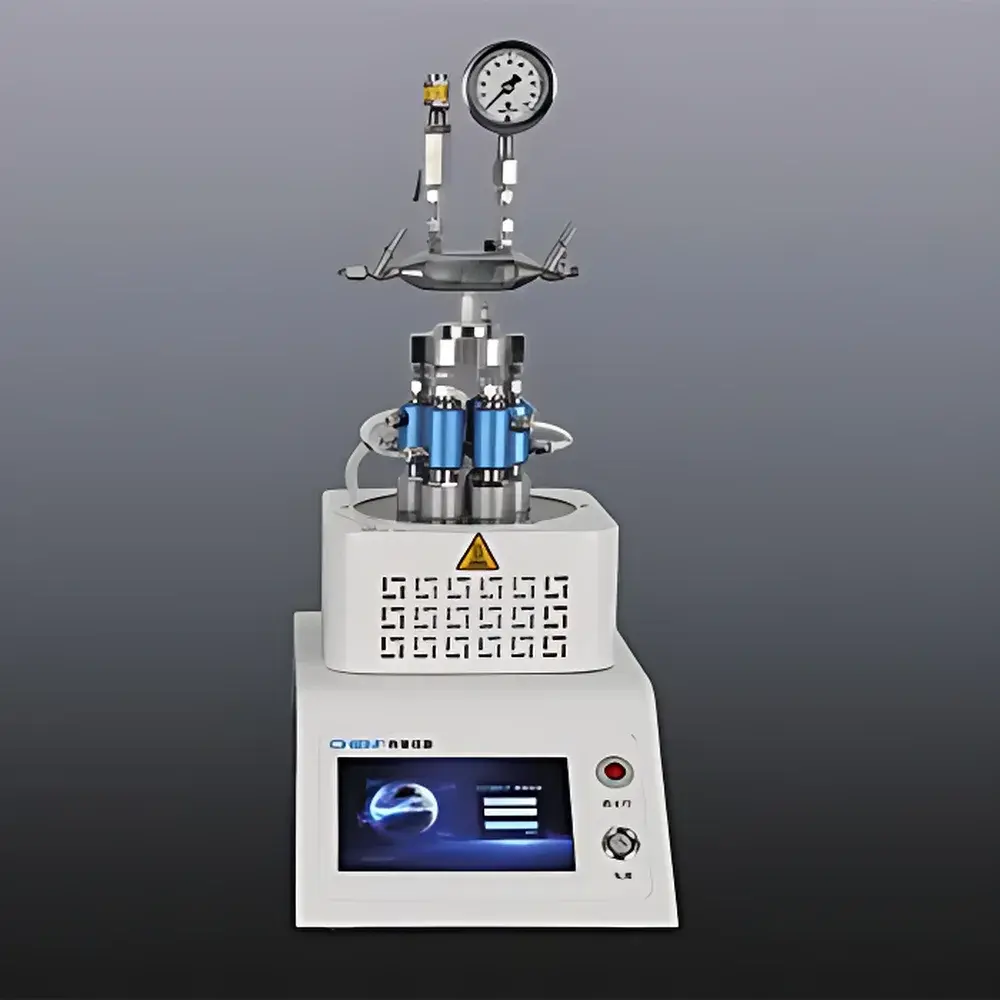
Ahkemi NS6-20D Six-Station Magnetic Stirring High-Pressure Reactor
| Brand | Ahkemi |
|---|---|
| Origin | Anhui, China |
| Model | NS6-20D |
| Vessel Capacity | 10 mL & 20 mL per station |
| Construction Material | Stainless Steel (316L grade typical) |
| Maximum Operating Pressure | 103 bar |
| Vacuum Capability | Up to 10⁻³ mbar (note: “103bar” in source is a typographical error |
| Control Interface | 7-inch HD capacitive touchscreen |
| Data Export | USB port for CSV log export (temperature, stirring speed, time stamps) |
| Heating Method | Integrated electric heating mantle with PID control |
| Stirring Mechanism | Internal magnetic coupling drive per vessel |
| Vessel Configuration | Monolithic six-reactor block with independent sealing and pressure containment |
| Opening Mechanism | Quick-release clamp-style flange with torque-indicating fasteners |
| Compliance | Designed per ASME BPVC Section VIII Div. 1 guidelines for Class I pressure equipment (consult local regulatory interpretation) |
Overview
The Ahkemi NS6-20D is a six-station, magnetically stirred high-pressure reaction system engineered for parallel synthesis under controlled thermal and mechanical conditions. It operates on the principle of magnetic coupling—where an external rotating magnet array induces synchronous rotation of PTFE- or glass-coated stir bars inside sealed stainless-steel vessels—eliminating dynamic seals and enabling true leak-tight operation at elevated pressures. Each of the six independently controllable reactors features a monolithic, CNC-machined 316L stainless-steel body with integrated heating elements and precision-machined sealing surfaces. The system is rated for continuous operation up to 103 bar (15,000 psi) and temperatures up to 250 °C, making it suitable for demanding heterogeneous catalysis, hydrogenation, and reductive amination workflows where reproducibility across multiple reaction conditions is critical.
Key Features
- Six independent reaction stations housed in a single, structurally unified reactor block—minimizes footprint while ensuring uniform thermal distribution and mechanical stability.
- High-integrity magnetic drive system with rare-earth NdFeB magnets and optimized gap geometry, delivering consistent torque transmission up to 103 bar without seal degradation or lubricant contamination.
- 7-inch high-resolution capacitive touchscreen interface with intuitive, icon-driven UI—supports real-time monitoring of temperature, stirring speed (0–1200 rpm), ramp/soak profiles, and pressure status (when paired with optional transducers).
- Integrated PID-controlled heating mantles with dual-sensor feedback per station—enabling ±0.5 °C temperature accuracy and <1 °C inter-vessel deviation under steady-state conditions.
- Quick-clamp flange design with calibrated torque indicators—ensures repeatable gasket compression and eliminates cross-threading risk during repeated assembly/disassembly cycles.
- USB data logging interface compliant with FAT (Factory Acceptance Test) protocols—exports timestamped CSV files containing temperature setpoint/actual, RPM, elapsed time, and alarm events for audit-ready documentation.
Sample Compatibility & Compliance
The NS6-20D accommodates liquid, slurry, and gas–liquid–solid multiphase systems—including catalyst slurries (e.g., Pd/C, Raney Ni), hydrogen donors (e.g., ammonium formate), and volatile solvents (THF, MeOH, EtOAc). Vessels are compatible with standard 10 mL and 20 mL internal volume configurations, with optional quartz liners for UV-transparent photochemical studies. All wetted parts meet ASTM A240 and EN 10088 standards for austenitic stainless steel. While not certified as ASME-stamped equipment out-of-the-box, the design adheres to ASME BPVC Section VIII Division 1 principles for pressure boundary integrity, and supports integration with third-party pressure relief devices meeting ISO 4126-1 requirements. For GLP/GMP environments, optional firmware upgrades enable 21 CFR Part 11-compliant electronic signatures and audit trail generation.
Software & Data Management
The embedded control firmware supports both manual operation and programmable multi-step sequences (up to 99 segments per station). Data is stored locally in non-volatile memory and exported via USB mass-storage mode—no proprietary software required. CSV output conforms to ISO/IEC 17025 Annex A.3 data integrity guidelines, with unique file naming (e.g., “NS6-20D_20240521_142247.csv”) and embedded metadata (firmware version, calibration date, operator ID field). Optional PC-based LabVIEW-compatible drivers and Python API libraries are available for automated batch processing and LIMS integration.
Applications
- Parallel screening of heterogeneous catalysts under identical H₂ pressure and thermal profiles—critical for structure–activity relationship (SAR) studies in pharmaceutical intermediate synthesis.
- Debenzylation reactions requiring inert atmosphere and precise stoichiometric H₂ dosing.
- Pyridine ring saturation and selective nitro-group reduction under mild conditions.
- Hydrogenolysis of C–O and C–N bonds in complex natural product derivatization.
- Method development for continuous-flow precursor synthesis prior to scale-up in fixed-bed reactors.
FAQ
What is the maximum safe operating temperature for the NS6-20D?
The system is rated for continuous operation up to 250 °C with standard 316L vessels and fluoropolymer O-rings. Higher temperatures require optional Inconel 718 vessels and metal-C-seal configurations.
Can individual reactors be operated at different pressures simultaneously?
No—pressure is equalized across all six vessels via a common manifold. Independent pressure control requires retrofitting with six isolated pressure regulators and vent valves (custom configuration available upon request).
Is the touchscreen interface compatible with networked lab infrastructure?
The base unit lacks Ethernet/WiFi, but RS-485 Modbus RTU output is available as an optional module for SCADA integration and centralized monitoring.
How often does the magnetic coupling require maintenance?
Under normal use (≤103 bar, ≤250 °C), the magnetic drive assembly is maintenance-free for ≥5,000 operational hours. Visual inspection of magnet housing integrity is recommended annually per ISO 5840-3.
Does the system support inert gas purging prior to pressurization?
Yes—integrated gas inlet/outlet ports with needle valves allow three-cycle vacuum/nitrogen purge sequences before final pressurization with H₂ or other process gases.
Related Products



