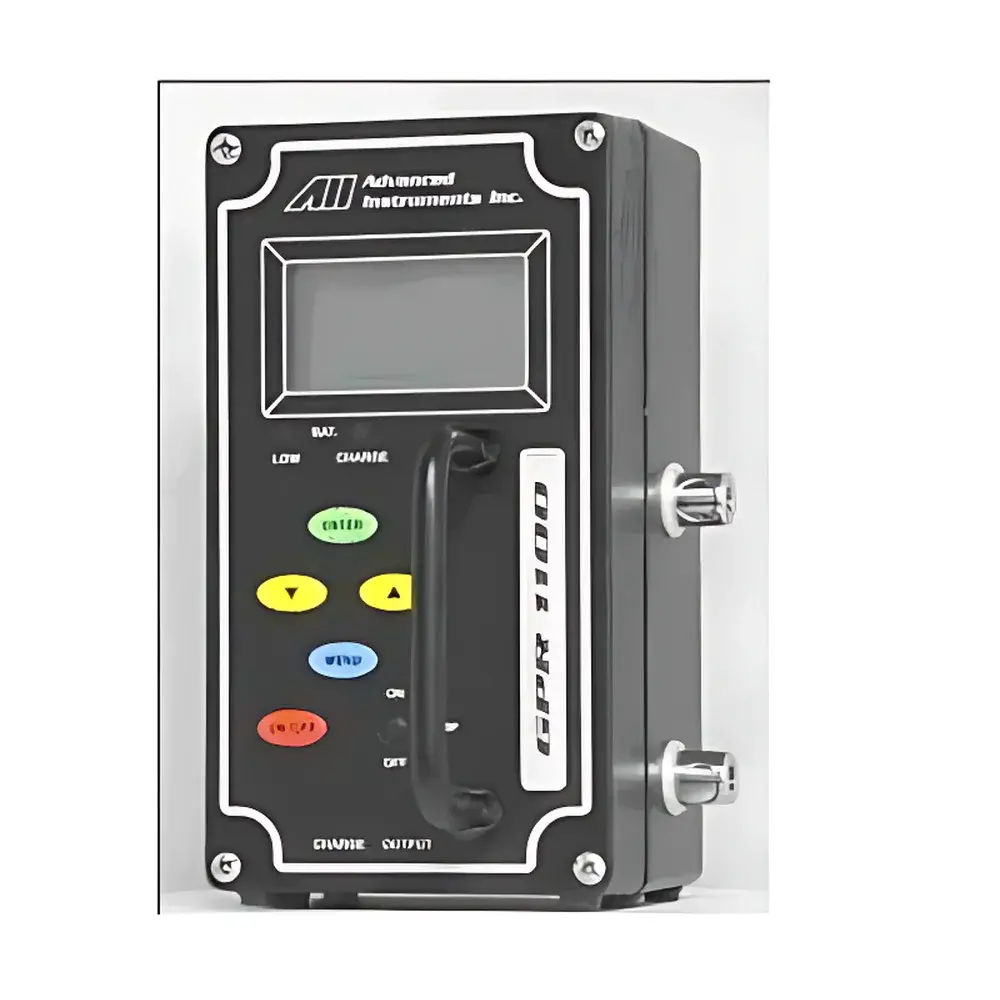
AII GPR-1100 Portable PPM-Grade Oxygen Analyzer
| Brand | AII |
|---|---|
| Origin | USA |
| Model | GPR-1100 |
| Sensor Type | Electrochemical (Galvanic) |
| Measurement Principle | Partial Pressure of O₂ via Fuel-Cell-Based Amperometry |
| Accuracy | <1% of Full Scale (FS) |
| Sensitivity | <0.5% FS |
| Response Time (t₉₀) | <10 s (typical, under optimal flow & sampling conditions) |
| Recovery Time to <10 ppm | <60 s |
| Operating Temperature Range | 5–45°C (GPR sensor) |
| Pressure Range | 5–30 psig inlet |
| Flow Rate Recommendation | 2 SCFH (0.5–5 SCFH acceptable) |
| Output Signal | 0–1 V DC analog |
| Enclosure Rating | NEMA 4X / IP66 |
| Intrinsic Safety Certification | UL/CSA Class I, Div 1, Groups A, B, C, D |
| Compliance | CE Marked, ISO 9001 Quality System Certified |
| Battery Life | ~60 days continuous operation (rechargeable sealed lead-acid) |
| Sensor Lifetime | 24 months at 25°C / 1 atm (GPR-12-333), field-replaceable |
| Wetted Materials | 316 Stainless Steel |
| Calibration | Zero & span with certified N₂-balanced O₂ standards (80% of selected range recommended) |
| Temperature Compensation | Built-in digital compensation |
| Display | Graphical LED, 0.01 resolution, real-time ambient T/P readout |
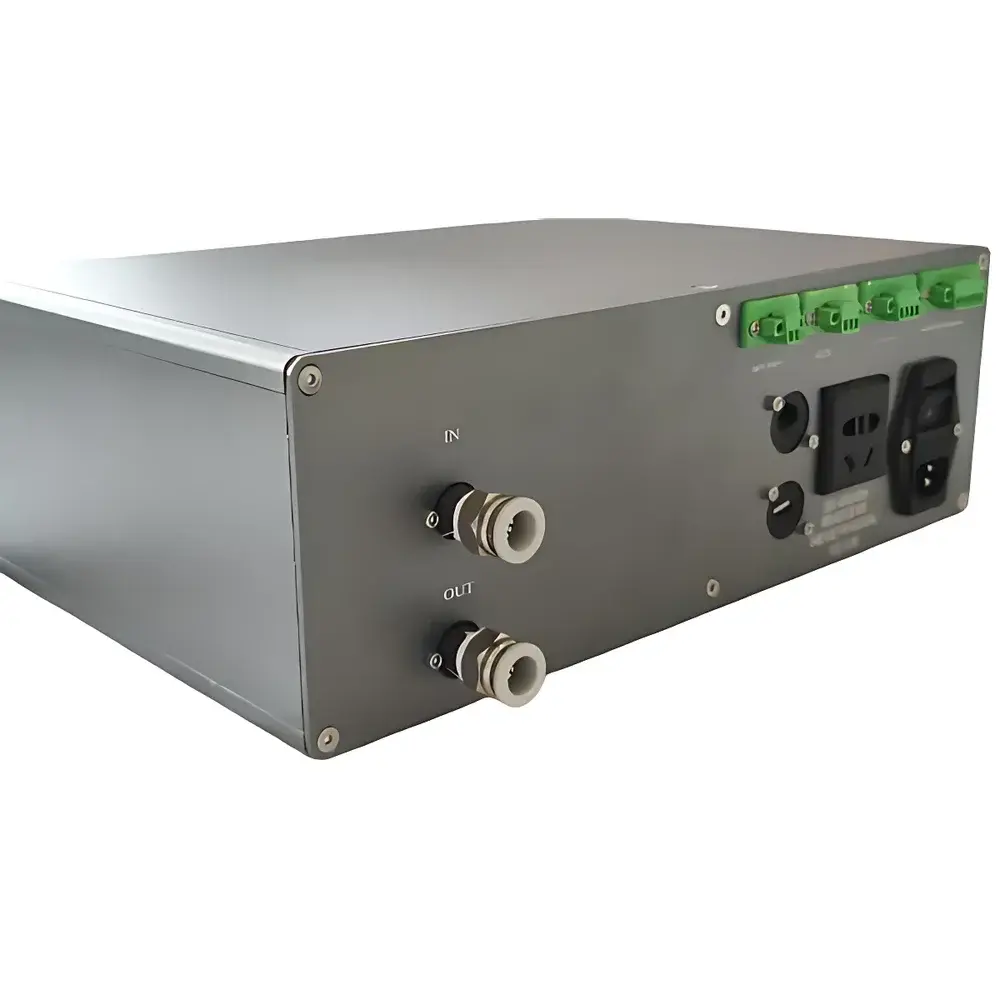
| Input Connection | 1/8" quick-disconnect (included) |
Overview
The AII GPR-1100 Portable PPM-Grade Oxygen Analyzer is an intrinsically safe, field-deployable electrochemical analyzer engineered for high-fidelity measurement of oxygen partial pressure across a broad dynamic range—from 200 ppb to 100% O₂—within inert, reducing, acidic (e.g., CO₂-rich), and mixed gas streams. Its core sensing element is a maintenance-free, galvanic fuel-cell-type sensor (model GPR-12-333), in which molecular oxygen acts as the electrochemical reactant. Oxygen diffuses through a selective membrane and undergoes catalytic reduction at the cathode, generating a linear, temperature-compensated current proportional to its partial pressure. This amperometric principle ensures inherent linearity across all five standard ranges (0–10 ppm, 0–100 ppm, 0–1%, 0–25%, 0–100%), eliminating need for range-specific calibration curves. Unlike paramagnetic or zirconia-based analyzers, the GPR-1100 requires no external power for sensor operation—only for signal conditioning and display—and delivers stable output without drift over its 24-month service life under nominal conditions (25°C, 1 atm, <1000 ppm average O₂ exposure).
Key Features
- Intrinsically safe design certified to UL/CSA Class I, Division 1, Groups A, B, C, D—approved for deployment in hazardous locations without explosion-proof enclosures.
- Five factory-configurable measurement ranges with automatic or manual range selection; no hardware modification required for range switching.
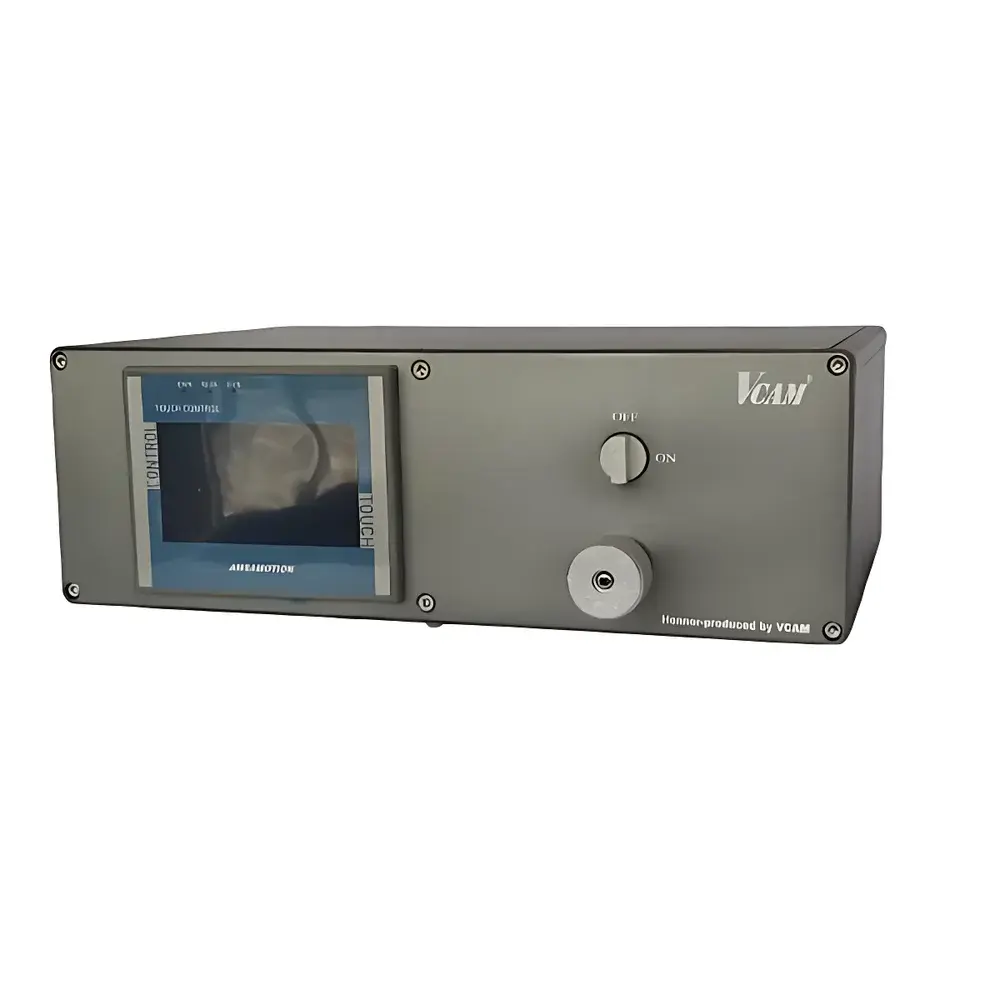
- NEMA 4X/IP66-rated aluminum enclosure (8 lb, 9″ × 4″ × 3″) featuring patented gasketed construction, waterproof keypad, and graphical LED display with 0.01 resolution.
- Digital microprocessor-based signal processing: three-stage filtering (low-frequency noise rejection, high-frequency attenuation, and real-time temperature compensation) ensures stability and repeatability.
- 0–1 V DC analog output for integration with data loggers, PLCs, or SCADA systems; compatible with standard chart recorders and acquisition hardware.
- Rechargeable sealed lead-acid battery supporting ~60 days of continuous operation; LED low-battery warning provides 72-hour advance notice; full recharge in 8–10 hours via 9 V AC adapter.
- All wetted parts constructed from ASTM A240 316 stainless steel—resistant to corrosion in CO₂, H₂, He, N₂, Ar, and synthetic gas mixtures.
Sample Compatibility & Compliance
The GPR-1100 is validated for use in non-condensing, particle-free gas streams with dew point ≤ –20°C. It operates reliably in helium, hydrogen, nitrogen, argon, carbon dioxide, and custom blends—including those containing trace acid gases—without cross-sensitivity or poisoning. Sensor performance complies with ISO 8573-1:2010 (Class 4 particulate, Class 3 moisture) when used with appropriate inlet filtration. The analyzer meets EU CE marking requirements per Directive 2014/34/EU (ATEX) and 2014/30/EU (EMC). While not FDA 21 CFR Part 11–compliant out-of-the-box (lacking audit trail and electronic signature functionality), its analog output and stable calibration protocol support integration into GLP/GMP environments when paired with compliant data acquisition systems. Calibration traceability is maintained using NIST-traceable, nitrogen-balanced O₂ standards (e.g., Air Liquide CertiGas® or Linde CalGas®).
Software & Data Management
The GPR-1100 operates as a standalone instrument with embedded firmware only—no proprietary PC software or drivers required. All configuration (range selection, zero/span calibration, backlight timeout) is executed via the front-panel membrane keypad and menu-driven interface. The 0–1 V analog output enables direct connection to third-party data acquisition platforms (e.g., National Instruments LabVIEW, Campbell Scientific CR series, or Siemens Desigo CC). For long-term trending, users may interface the output with ISO/IEC 17025-accredited logging systems that provide timestamped, temperature-compensated records meeting ASTM D6299 and ISO 17025 documentation requirements. Firmware updates are not field-upgradable; revision control is managed through AII’s certified manufacturing release process.
Applications
- Verification of inerting efficacy in semiconductor fabrication gloveboxes and vacuum chamber purges.
- Monitoring residual O₂ in cryogenic liquid storage tanks (LN₂, LHe) and transfer lines.
- Quality assurance during high-purity gas cylinder filling (e.g., UHP N₂, Ar, He) per CGA G-4.1 and ISO 8573-8.
- In-process verification of deoxygenation in pharmaceutical nitrogen blanketing (USP <1207>, EP 2.2.47).
- Leak detection in modified-atmosphere packaging (MAP) lines via headspace O₂ analysis.
- Field validation of oxygen scavenger performance in polymer film barrier testing (ASTM F1307).
- Safety monitoring in confined-space entry operations where CO₂ displacement risks hypoxia.
FAQ
What calibration standards are required?
Two-point calibration is recommended: zero gas (certified nitrogen or argon, <10 ppb O₂) and span gas (N₂-balanced O₂ at ~80% of the selected full-scale range). Standards must be traceable to NIST or equivalent national metrology institute.
Can the GPR-1100 measure oxygen in high-CO₂ streams such as biogas or beverage carbonation lines?
Yes—the GPR-12-333 sensor is chemically resistant to CO₂ concentrations up to 100% and exhibits no measurable interference or baseline shift under sustained exposure.
Is temperature compensation automatic?
Yes. An integrated thermistor continuously monitors ambient temperature, and the microprocessor applies real-time correction to the sensor output using a stored polynomial algorithm.
What is the minimum detectable level in the 0–10 ppm range?
The practical lower limit of quantitation (LLOQ) is 200 ppb, defined as signal ≥10× RMS noise at 0 ppm background; sensitivity is specified as <0.5% of full scale.
How often should calibration be performed?
AII recommends quarterly calibration for routine QC applications; more frequent calibration (e.g., daily pre-use check) is advised in critical GMP environments or after exposure to extreme thermal cycling or mechanical shock.