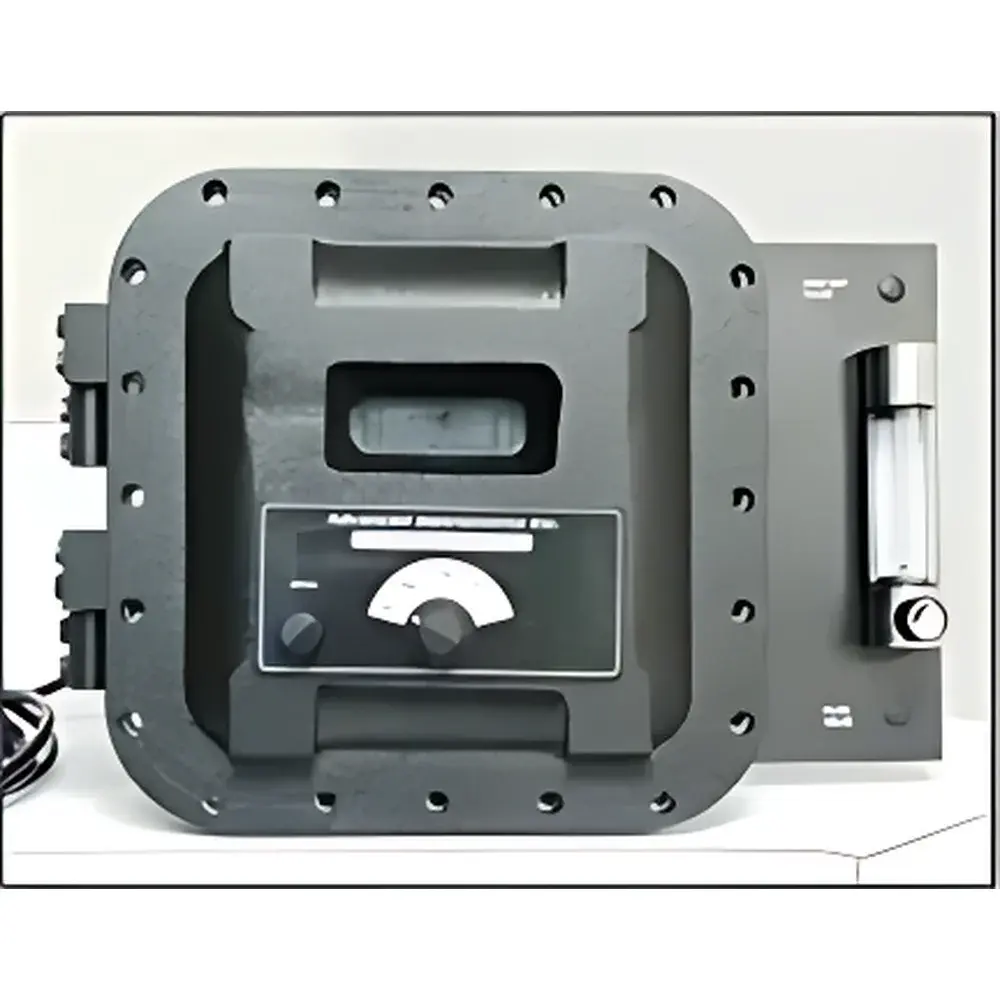
AII GPR-18 Intrinsically Safe Micro-Oxygen Analyzer
| Brand | AII |
|---|---|
| Origin | USA |
| Model | GPR-18 |
| Measurement Principle | Electrochemical Sensor |
| Range | 0–10 / 100 / 1000 ppm, 0–1% / 25% O₂ |
| Resolution | 0.1% of full scale |
| Accuracy | ±1% of full scale (at 25°C, 1 atm) |
| Linearity | R² > 0.995 |
| T₉₀ Response Time | ≤10 s |
| Recovery Time | ≤60 min (from air to 10 ppm) |
| Sensor Lifetime | 24 months |
| Certifications | CE, FM Class I Division 1 Groups B, C, D, CSA, ISO 9001 |
| Display | 3½-digit LED |
| Analog Outputs | 0–1 V DC and 4–20 mA |
| Power Supply | 220 V AC @ 50 Hz |
| Alarm Outputs | Two user-adjustable relay outputs + fault alarm |
| Sample Flow Rate | 1–5 SCFH (recommended: 2 SCFH ≈ 1 L/min) |
| Operating Temperature | 5–45°C with automatic temperature compensation |
| Operating Pressure | 5–100 psig |
| Enclosure | Anodized aluminum, NEMA 4/7 rated |
| Dimensions | 12" × 11.5" × 10.5" (305 × 292 × 267 mm) |
| Weight | 40 lb (18.1 kg) |
| Sample Compatibility | H₂, hydrocarbons, process gases, acid gases containing CO₂ (specify at order) |
Overview
The AII GPR-18 Intrinsically Safe Micro-Oxygen Analyzer is a field-mounted, explosion-proof analytical instrument engineered for continuous, real-time measurement of trace and percent-level oxygen concentrations in hazardous industrial environments. Utilizing a high-stability, galvanic electrochemical sensor, the GPR-18 delivers repeatable, low-drift performance across multiple calibrated ranges—from sub-ppm detection (0–10 ppm) up to ambient air-equivalent levels (0–25% O₂). Its design adheres to rigorous safety standards for Class I, Division 1, Groups B, C, and D locations—making it suitable for deployment in petrochemical refineries, syngas processing units, hydrogen purification trains, steel annealing atmospheres, and power generation flue gas monitoring systems where combustible or reactive process streams are present. Unlike optical or paramagnetic methods, the electrochemical principle provides inherent selectivity for O₂ without cross-sensitivity to CO₂ or hydrocarbon vapors—critical when analyzing acid gas streams or hydrogen-rich mixtures.
Key Features
- Intrinsically safe architecture certified to FM and CSA standards for Class I, Division 1, Groups B, C, D—enabling direct installation in Zone 1 hazardous areas without external barriers.
- Dual-range capability: factory-configurable or field-selectable spans including 0–10 ppm, 0–100 ppm, 0–1000 ppm, 0–1% O₂, and 0–25% O₂—supporting both ultra-trace purity verification and bulk oxygen monitoring.
- Integrated sample conditioning system featuring a precision mass flow controller, adjustable needle valve, inlet/outlet stainless steel 1/8″ NPT fittings, and visual flow indicator—ensuring consistent, pressure-compensated delivery to the sensor cell.
- Onboard temperature compensation (5–45°C) and pressure tolerance (5–100 psig) minimize environmental drift; linearization algorithm ensures R² > 0.995 across full scale.
- Dual analog outputs (0–1 V DC and isolated 4–20 mA) support connection to DCS, PLC, or data historians; two programmable relay outputs provide fail-safe alarm signaling for high/low O₂ thresholds and sensor fault conditions.
- NEMA 4/7-rated anodized aluminum enclosure resists corrosion, dust ingress, and temporary water immersion—validated for outdoor or semi-outdoor mounting in refinery or utility service environments.
Sample Compatibility & Compliance
The GPR-18 is validated for use with reducing and acidic process gases—including hydrogen (H₂), methane, ethylene, ammonia, synthesis gas, and CO₂-containing sour gas streams—provided gas composition and contaminants (e.g., H₂S > 5 ppm, Cl₂, SO₂) are declared at time of order to ensure sensor compatibility and longevity. It complies with ISO 9001 quality management requirements and carries CE marking per EU Directive 2014/34/EU (ATEX). While not FDA 21 CFR Part 11-certified (as it lacks audit-trail software functionality), its hardware-level calibration stability and documented sensor lifetime (24 months) support GLP-aligned operational qualification protocols in regulated manufacturing settings.
Software & Data Management
The GPR-18 operates as a standalone, microprocessor-controlled analyzer with no embedded firmware-based configuration interface. All calibration and alarm setpoints are adjusted via front-panel potentiometers and DIP switches—ensuring deterministic behavior and eliminating cybersecurity attack surfaces. Calibration is performed using certified 80% full-scale span gas (e.g., 800 ppm O₂ in N₂); zero adjustment requires inert gas (e.g., <0.1 ppm O₂ grade N₂ or Ar). Output signals are hardwired and do not require protocol translation, simplifying integration into legacy control systems. For documentation traceability, users maintain manual calibration logs per ASTM D6299 and ISO/IEC 17025 guidelines.
Applications
- Petrochemical: Monitoring oxygen breakthrough in hydrogenation reactors, PSA tail-gas streams, and catalyst regeneration purge lines.
- Steel & Metal Processing: Verifying inert atmosphere integrity during continuous annealing furnace operations and hot-dip galvanizing lines.
- Power Generation: Measuring residual O₂ in boiler feedwater deaerators and flue gas recirculation (FGR) loops to optimize combustion efficiency.
- Chemical Synthesis: Ensuring oxygen-free conditions in monomer storage tanks (e.g., vinyl chloride, styrene) and polymerization reactor purge cycles.
- Electronics Grade Gas Production: Final purity verification of ultra-high-purity nitrogen and argon used in semiconductor fabrication tool purging.
FAQ
What is the recommended calibration frequency?
AII recommends quarterly calibration using traceable standard gases; however, critical applications (e.g., hydrogen purity assurance) may require monthly verification per internal QA procedures.
Can the GPR-18 measure oxygen in 100% hydrogen?
Yes—provided the sensor variant is specified for H₂ service at time of order; standard cells exhibit accelerated consumption in pure H₂, so H₂-compatible electrodes with extended electrolyte life are supplied upon request.
Is temperature compensation automatic?
Yes—the internal thermistor continuously adjusts signal gain and offset across the 5–45°C operating range, eliminating need for external temperature input or manual correction.
Does the unit support HART or digital communication?
No—the GPR-18 is analog-only; for smart diagnostics and remote configuration, consider the AII GPR-28 series with HART-enabled transmitter options.
What maintenance is required beyond calibration?
Annual inspection of sample line integrity, filter replacement (if installed upstream), and verification of flow rate (2 SCFH) using the built-in rotameter; no sensor cleaning or electrolyte refills are required during its 24-month service life.
Related Products