
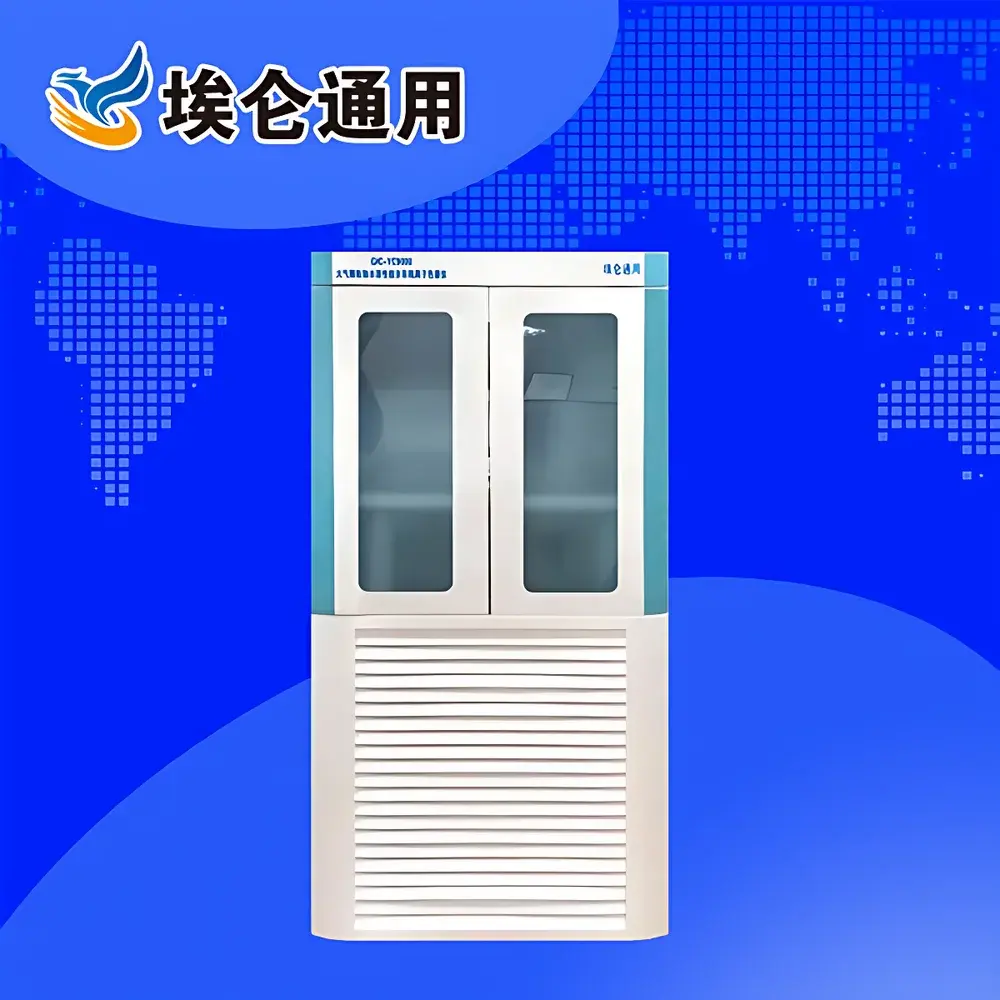
Ailun GIC-YC9000 Online Aerosol and Gaseous Pollutant Ion Chromatography System
| Brand | Ailun (Qingdao Ailun) |
|---|---|
| Origin | Shandong, China |
| Model | GIC-YC9000 |
| Instrument Type | Online Aerosol and Gaseous Ion Analyzer |
| Liquid Sampling Resolution | 0.01 mL |
| Gas Absorption Efficiency | ≥98.2% |
| Aerosol Collection Efficiency | ≥99.1% |
| Measured Species | F⁻, Cl⁻, NO₃⁻, NO₂⁻, SO₄²⁻, Na⁺, NH₄⁺, K⁺, Mg²⁺, Ca²⁺, HF, HCl, HNO₂, HNO₃, SO₂, NH₃ |
Overview
The Ailun GIC-YC9000 is an integrated online analytical system engineered for simultaneous, real-time quantification of water-soluble ionic species in both ambient aerosols and gaseous precursors. It operates on a dual-path collection principle grounded in wet impaction and diffusion-based phase separation: gaseous pollutants are selectively absorbed into deionized water via a high-efficiency rotating wet diffusion scrubber, while size-resolved aerosol particles are grown in a humidified condensation growth chamber and subsequently captured by an inertial impactor or electrostatic precipitator. The resulting aqueous extracts—containing dissociated anions and cations—are automatically delivered to a high-sensitivity ion chromatograph (IC) equipped with suppressed conductivity detection. This architecture enables trace-level (sub-ppq to low-ppt) measurement of key atmospheric constituents without manual intervention, fulfilling the stringent requirements of long-term unattended operation in regulatory monitoring networks and atmospheric science field campaigns.
Key Features
- Dual-phase automated sampling: Independent, parallel acquisition of gaseous and particulate phases with time-synchronized analysis cycles (standard intervals: 30–120 min)
- High-fidelity phase separation: Rotating wet diffusion scrubber achieves ≥98.2% absorption efficiency for acidic and basic gases (HF, HCl, HNO₃, NH₃, SO₂) under variable RH (30–90%) and flow conditions (10–30 L/min)
- Enhanced aerosol capture: Condensation particle growth chamber coupled with a low-pressure-drop impactor ensures ≥99.1% collection efficiency for PM₂.₅-bound ions across a 0.05–2.5 µm aerodynamic diameter range
- Precision liquid handling: Gravimetrically calibrated peristaltic delivery system with 0.01 mL volumetric resolution; real-time liquid volume tracking generates 4-hour trend plots for process diagnostics
- Robust IC configuration: Dual-column, gradient-elution ion chromatograph with chemical suppression and digital conductivity detection; compatible with EPA Method IO-3.2 and ISO 10109 for soluble ionic speciation
- Environmental resilience: Designed for outdoor deployment (IP55-rated enclosure); operational temperature range: −20 °C to +45 °C; humidity tolerance: 10–95% RH non-condensing
Sample Compatibility & Compliance
The GIC-YC9000 is validated for ambient air matrices including urban, rural, coastal, and mountain background sites. It complies with core methodological frameworks for aerosol chemical characterization, including U.S. EPA OTM-37 (Online Aerosol Speciation Monitor), Chinese HJ 657–2013 (Ambient Air—Determination of Water-Soluble Ions in Particulate Matter), and EU Directive 2008/50/EC Annex IX (PM chemical composition monitoring). All data acquisition, calibration logging, and instrument status reporting conform to GLP-compliant audit trail requirements. Optional 21 CFR Part 11–compliant software modules support electronic signatures and user-access controls for regulated environmental laboratories.
Software & Data Management
The embedded Ailun IC-Link Control Suite provides full remote supervision via Ethernet or 4G LTE. Real-time chromatograms, peak integration reports, and QC metrics (e.g., retention time stability ±0.02 min, peak area RSD <3% over 24 h) are logged in SQLite databases with automatic backup. Raw IC data export supports .cdf (NetCDF) and .csv formats for interoperability with atmospheric modeling platforms (e.g., CMAQ, WRF-Chem). Calibration curves are generated using multi-point standard additions; drift correction is applied via internal standard co-injection (e.g., Br⁻ for anion channel, Li⁺ for cation channel). System health dashboards monitor scrubber liquid level, pump status, column backpressure, and detector baseline noise in real time.
Applications
- Regulatory ambient air monitoring: Continuous compliance reporting for PM₂.₅ water-soluble ion fractions (e.g., NO₃⁻/SO₄²⁻/NH₄⁺ molar ratios) in national air quality networks
- Super-site atmospheric chemistry: Source apportionment studies integrating GIC-YC9000 data with AMS, ACSM, and gas-phase analyzers to resolve secondary aerosol formation pathways
- Haze mechanism research: Time-resolved speciation during pollution episodes to identify dominant neutralization processes (e.g., NH₃ availability vs. HNO₃ partitioning)
- Process emission verification: Stack testing support for industrial facilities subject to flue gas desulfurization (FGD) or selective catalytic reduction (SCR) compliance
- Climate-relevant aerosol property derivation: Input for hygroscopicity parameterization (κ-Köhler theory) and radiative forcing calculations
FAQ
What sample volume is required for reliable quantification of sub-ppq-level ions?
Typical aqueous extract volumes range from 5–20 mL per cycle; detection limits are optimized at 10 mL injection volume, achieving 0.05 ng/m³ (for Cl⁻) and 0.12 ng/m³ (for NH₄⁺) at 1-hour averaging.
Can the system operate unattended for extended periods?
Yes—fully autonomous operation for up to 30 days is supported with optional 20-L reagent reservoirs, scheduled self-cleaning protocols, and remote fault diagnostics.
Is the IC module serviceable in the field?
All chromatographic components—including columns, suppressors, and detectors—are hot-swappable with pre-aligned fittings; no tools or calibration recalibration required after replacement.
How is calibration traceability maintained?
Primary standards are NIST-traceable (SRM 2783 for aerosol ions, SRM 3193 for gaseous acid gases); daily bracketing with certified reference materials ensures ongoing metrological integrity.
Does the system meet international data reporting standards?
Data output conforms to AQMesh, EEA AirBase, and WMO GAW metadata schemas; timestamping uses GPS-synchronized NTP servers with millisecond precision.
Related Products







