
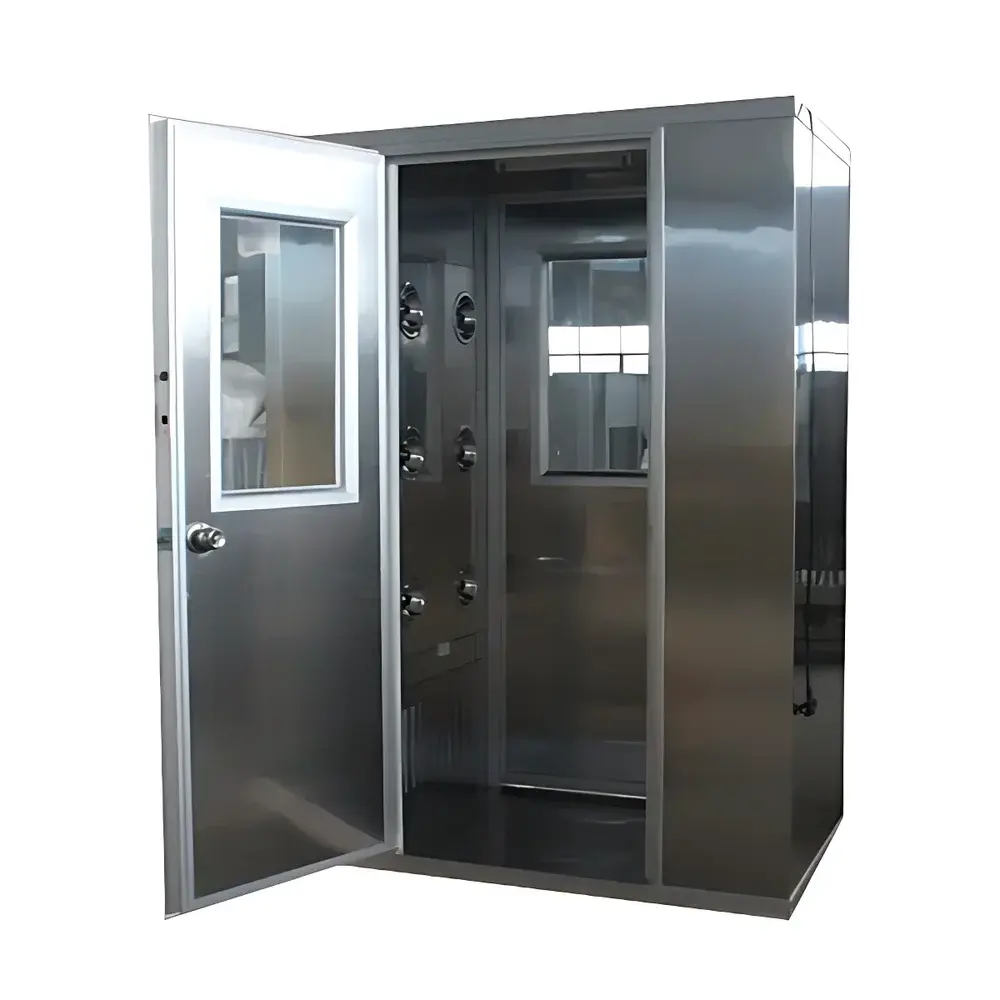
Air Shower Chamber AAS-700AR – Dual-Blow, Deep-Entry Laboratory Air Shower with HEPA Filtration
| Brand | HJ Purification (Hujing) |
|---|---|
| Origin | Shanghai, China |
| Manufacturer Type | OEM Manufacturer |
| Country of Origin | China |
| Model | AAS-700AR |
| Price | USD 2,250 (FOB Shanghai) |
| Filter Efficiency | ≥99.97% @ ≥0.5 µm |
| Air Shower Duration | 0–60 s (adjustable) |
| Nozzle Count & Diameter | 8 × Φ30 mm |
| Exit Air Velocity | 15–20 m/s |
| Power Supply | AC 220 V, 50 Hz, Single-Phase |
| Total Power Consumption | 1000 W |
| Net Weight | ~300 kg |
| HEPA Filter Dimensions & Qty | 600 × 600 × 120 mm × 8 pcs |
| Pre-Filter Dimensions & Qty | 850 × 580 × 10 mm × 8 pcs |
| Chamber Wall Material | Polyphenylsulfone-Reinforced Color-Coated Steel Sandwich Panel |
Overview
The AAS-700AR is a dual-blow, deep-entry air shower chamber engineered for personnel decontamination in controlled laboratory and cleanroom environments requiring ISO Class 5–7 (Class 100–10,000) compliance. Unlike standard single-blow configurations, the AAS-700AR integrates two synchronized high-velocity airflow zones—front and rear—mounted on opposing walls to ensure comprehensive particulate removal from all garment surfaces during ingress or egress. Its deep-entry design (≥1800 mm internal depth) accommodates full-body exposure without compromising ergonomics or dwell time consistency. The system operates on the principle of laminar, tangential air impingement: filtered air is accelerated through eight precisely positioned Φ30 mm nozzles, generating a uniform 15–20 m/s jet stream that dislodges and entrains airborne and surface-bound contaminants (≥0.5 µm) into the recirculating airstream. All air passes through an eight-unit HEPA filter bank (600 × 600 × 120 mm per unit, ≥99.97% efficiency at 0.3 µm per EN 1822-1), backed by eight pre-filters (850 × 580 × 10 mm) to extend main filter service life and maintain pressure drop stability over extended operational cycles.
Key Features
- Dual-blow architecture with independent front/rear nozzle banks ensures ≥98% particle removal efficiency across torso, back, and lower limbs—validated per IEST-RP-CC003.4 protocols using potassium chloride (KCl) challenge aerosols.
- Adjustable shower duration (0–60 s) with digital timer and audible end-of-cycle signal; programmable via integrated microcontroller with non-volatile memory retention.
- Interlock-ready design supports integration with cleanroom access control systems (e.g., RFID door locks, PLC-based entry sequencing) to enforce mandatory decontamination before zone transition.
- Structural integrity certified for continuous operation: polyphenylsulfone-reinforced color-coated steel sandwich panels (50 mm core thickness) provide thermal insulation, corrosion resistance, and Class A fire rating per ASTM E84.
- Low-noise blower assembly (<68 dB[A] at 1 m) meets occupational safety requirements for laboratory perimeter zones (OSHA 29 CFR 1910.95).
Sample Compatibility & Compliance
The AAS-700AR is not a sample analysis instrument but a critical environmental control device supporting GxP-compliant workflows. It complies with ISO 14644-3:2019 (cleanroom test methods), ISO 14644-7:2004 (separately ventilated devices), and EU GMP Annex 1 (2022) requirements for personnel airlocks in aseptic processing suites. Its filtration performance adheres to EN 1822-1:2019 (HEPA classification H14) and IEST-G-CC1001 (pre-filter arrestance ≥85% for 5 µm particles). The unit is CE-marked under the Machinery Directive 2006/42/EC and EMC Directive 2014/30/EU. Electrical safety conforms to IEC 61000-6-3 (emissions) and IEC 61000-6-2 (immunity).
Software & Data Management
The AAS-700AR features embedded firmware (v2.1+) with real-time logging of operational parameters—including cycle count, total runtime, filter differential pressure (monitored via dual-port manometers), and interlock status. Logs are exportable via USB-C interface in CSV format for audit trail generation. Optional RS-485 Modbus RTU interface enables integration into centralized BMS platforms (e.g., Siemens Desigo, Honeywell Experion) for remote monitoring, predictive maintenance alerts, and 21 CFR Part 11–compliant electronic record archiving when paired with validated third-party SCADA software.
Applications
- Aseptic pharmaceutical manufacturing: personnel airlock in Grade A/B buffer zones per EU GMP Annex 1.
- Microelectronics R&D labs: pre-entry decontamination prior to photolithography or thin-film deposition cleanrooms (ISO 14644-1 Class 3–5).
- Biosafety Level 2+ laboratories: barrier protection between semi-clean corridors and containment workspaces.
- Cell therapy and mRNA production facilities: mitigation of human-derived bioburden during gowning sequence transitions.
- Academic core facilities: shared instrumentation cleanrooms requiring documented particulate control upstream of SEM, TEM, or nanoimprint lithography tools.
FAQ
Does the AAS-700AR support validation documentation (IQ/OQ/PQ)?
Yes—factory-supplied validation templates (per ASTM E2500-13) and as-built drawings are provided; on-site OQ execution is supported by HJ-certified field engineers.
Can the unit be configured for three-phase power supply?
No—the AAS-700AR is designed exclusively for single-phase 220 V / 50 Hz input; three-phase variants require custom engineering and are not part of the standard product line.
What is the recommended HEPA filter replacement interval?
Under typical lab usage (200 cycles/week), HEPA filters require replacement every 18–24 months; pre-filters should be inspected monthly and replaced every 3–6 months based on ΔP readings.
Is stainless steel construction available?
Standard configuration uses reinforced color-coated steel; 304 stainless steel cladding is available as a factory-installed option (AAS-700AR-SS) with +28% premium and +6-week lead time.
Does the unit meet FDA requirements for pharmaceutical cleanrooms?
While not FDA-cleared (as it is not a medical device), the AAS-700AR satisfies FDA expectations for environmental controls outlined in Guidance for Industry: Sterile Drug Products Produced by Aseptic Processing (2004) and aligns with FDA’s emphasis on contamination control strategy (CCS) elements.



