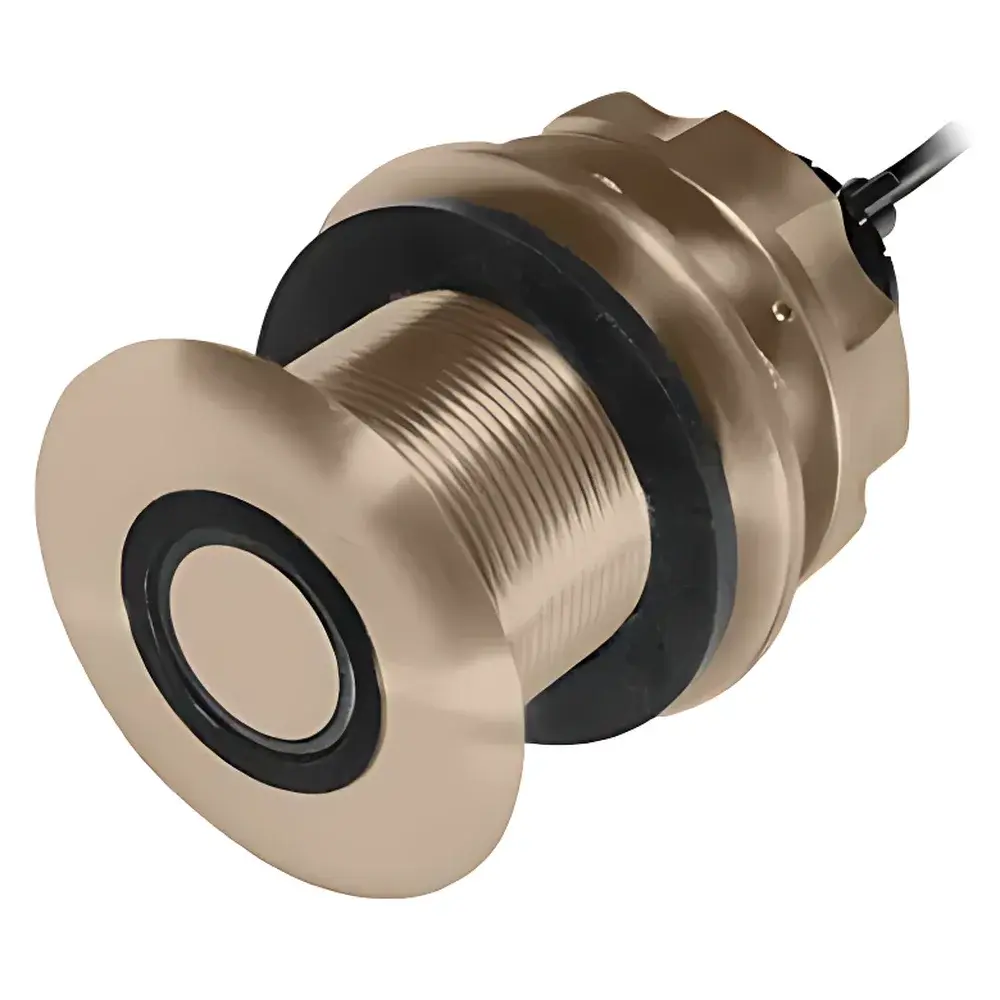
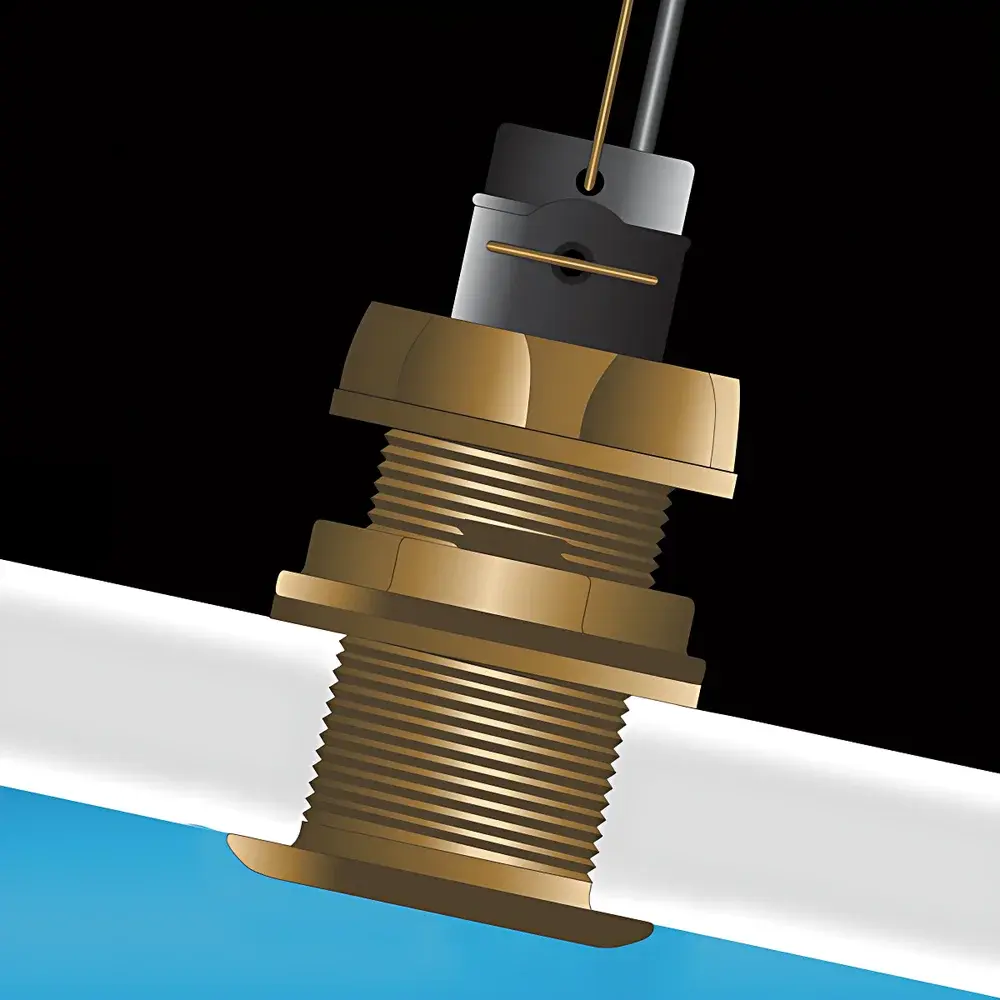
Airmar B17-HP High-Performance Smart Water Temperature Sensor
| Brand | Airmar |
|---|---|
| Origin | USA |
| Model | B17-HP |
| Temperature Accuracy | ±0.3°C |
| Temperature Resolution | 0.01°C |
| Response Time Constant | 5 s |
| Operating Temperature Range | 0–30°C |
| Supply Voltage | 6–28 VDC |
| Max Current Draw | 30 mA |
| Output Protocols | NMEA 0183 / NMEA 2000® |
| Output Sentence | YXMTW (NMEA 0183), PGN 130310 (NMEA 2000®) |
| Mounting Hole Diameter | 51 mm |
| Housing Material Options | Bronze, Stainless Steel, Plastic |
| Profile Height | 5 mm |
| Cable Length (Max) | 100 m |
| Weight | 1.3 kg |
Overview
The Airmar B17-HP High-Performance Smart Water Temperature Sensor is an engineered marine-grade thermistor-based measurement device designed for real-time, high-fidelity seawater temperature acquisition in dynamic aquatic environments. Utilizing a precision-calibrated, fast-response thermistor embedded within a low-profile bronze sensing surface (25.4 mm diameter), the B17-HP delivers rapid thermal equilibration with a documented time constant of 5 seconds—enabling detection of subtle thermal gradients associated with tidal fronts, upwelling zones, and thermocline boundaries. Its measurement principle relies on the predictable resistance–temperature relationship of a Class A platinum-equivalent thermistor, calibrated traceably to NIST-traceable standards. The sensor operates exclusively within the 0–30°C range, optimized for coastal, estuarine, and inland water applications where biological activity and fish behavior correlate strongly with sub-degree thermal variation. Unlike generic RTD or thermocouple solutions, the B17-HP integrates signal conditioning and protocol-specific digital encoding directly at the transducer level—eliminating external analog-to-digital conversion errors and ensuring end-to-end metrological integrity from probe tip to display or logging system.
Key Features
- High-accuracy temperature measurement with ±0.3°C (±0.17°F) absolute accuracy across the full operating range, validated per ASTM E230/E230M calibration practices.
- Ultra-fast thermal response: 5-second time constant ensures fidelity in high-speed vessel transit or turbulent flow conditions.
- Modular insertion design—fits seamlessly into any standard 51 mm (2″) Airmar transducer housing without modification, supporting field-replaceable upgrades.
- Low-drag hydrodynamic profile: only 5 mm protrusion beyond hull surface minimizes cavitation risk and drag-induced vibration artifacts.
- Dual-protocol digital output options: configurable for NMEA 0183 (YXMTW sentence) or NMEA 2000® (PGN 130310), enabling direct integration with chartplotters, multifunction displays (MFDs), VMS systems, and data loggers compliant with IEC 61162-1/2 and ISO 11898-2.
- Housing material flexibility: available in marine-grade bronze (standard), 316 stainless steel (for high-chloride or abrasion-prone deployments), or UV-stabilized polymer (for cost-sensitive auxiliary installations).
Sample Compatibility & Compliance
The B17-HP is intended for continuous immersion in natural freshwater, brackish, and saltwater environments. It is not rated for pressurized, heated, or chemically aggressive industrial process streams. Its construction complies with UL 1072 marine electrical equipment requirements and meets IP68 ingress protection when installed with OEM-specified gasketing and cable glands. All electronic assemblies conform to FCC Part 15 Subpart B and CE EMC Directive 2014/30/EU. While not certified under FDA 21 CFR Part 11, its deterministic digital output and fixed update interval (1 Hz) support audit-ready data capture when paired with GLP/GMP-compliant logging infrastructure. No calibration certificate is shipped standard; however, optional factory calibration documentation (with uncertainty budget per ISO/IEC 17025) is available upon request.
Software & Data Management
The sensor outputs time-synchronized, unprocessed temperature values as ASCII-encoded decimal degrees Celsius (NMEA 0183) or binary-scaled fixed-point values (NMEA 2000®). No onboard memory or firmware-upgradable logic is present—ensuring deterministic latency and eliminating drift-inducing software variables. When integrated into NMEA 2000® networks, it publishes on the shared bus without requiring dedicated polling, supporting multi-sink architectures (e.g., simultaneous feed to autopilot, sonar, and cloud telemetry gateway). Raw data streams are compatible with industry-standard marine data analysis platforms including MaxSea TimeZero, OpenCPN (via NMEA plugin), and custom Python/MATLAB ingestion pipelines using serial or CAN bus interfaces. Timestamp alignment relies on host-system clock synchronization; no internal RTC is included.
Applications
- Recreational and commercial fisheries: identification of thermal edges—such as tidal mixing zones, river plumes, and cold-water intrusions—that concentrate pelagic species including tuna, marlin, and striped bass.
- Scientific limnology and oceanographic surveying: high-temporal-resolution profiling aboard small research vessels or autonomous surface vehicles (ASVs) where minimal hydrodynamic disturbance is critical.
- Marine aquaculture monitoring: real-time verification of intake water temperature compliance against species-specific thermal tolerance thresholds (e.g., salmonid farming).
- Vessel performance optimization: correlation of hull skin temperature with engine cooling efficiency and antifouling coating integrity over extended deployment cycles.
- Regulatory monitoring: support for NOAA Fisheries observer programs and EU ICES reporting requirements where temperature metadata must accompany catch logs.
FAQ
Is the B17-HP suitable for deep-water deployment?
No. The sensor is rated for continuous operation at depths up to 10 meters (33 feet) only. Its pressure housing is not designed for hydrostatic loads beyond this threshold.
Can the output resolution be increased beyond 0.01°C?
No. The sensor’s native resolution is fixed at 0.01°C per NMEA specification. Higher apparent resolution via interpolation introduces non-physical artifacts and violates metrological best practices.
Does the B17-HP require periodic recalibration?
While long-term stability exceeds 0.05°C/year under normal marine exposure, Airmar recommends verification against a traceable reference standard every 24 months for mission-critical applications.
Is the cable shielded and twisted-pair?
Yes. The standard 100 m cable uses tinned-copper twisted-pair conductors with overall aluminum-polyester foil + tinned-braid shielding, meeting MIL-STD-1344A test method 2003.1 for marine EMI resilience.
Can the B17-HP be powered from a 12V lithium battery bank?
Yes. Its 6–28 VDC input range accommodates nominal 12V and 24V marine battery systems, including LiFePO₄ configurations with variable resting voltage profiles.