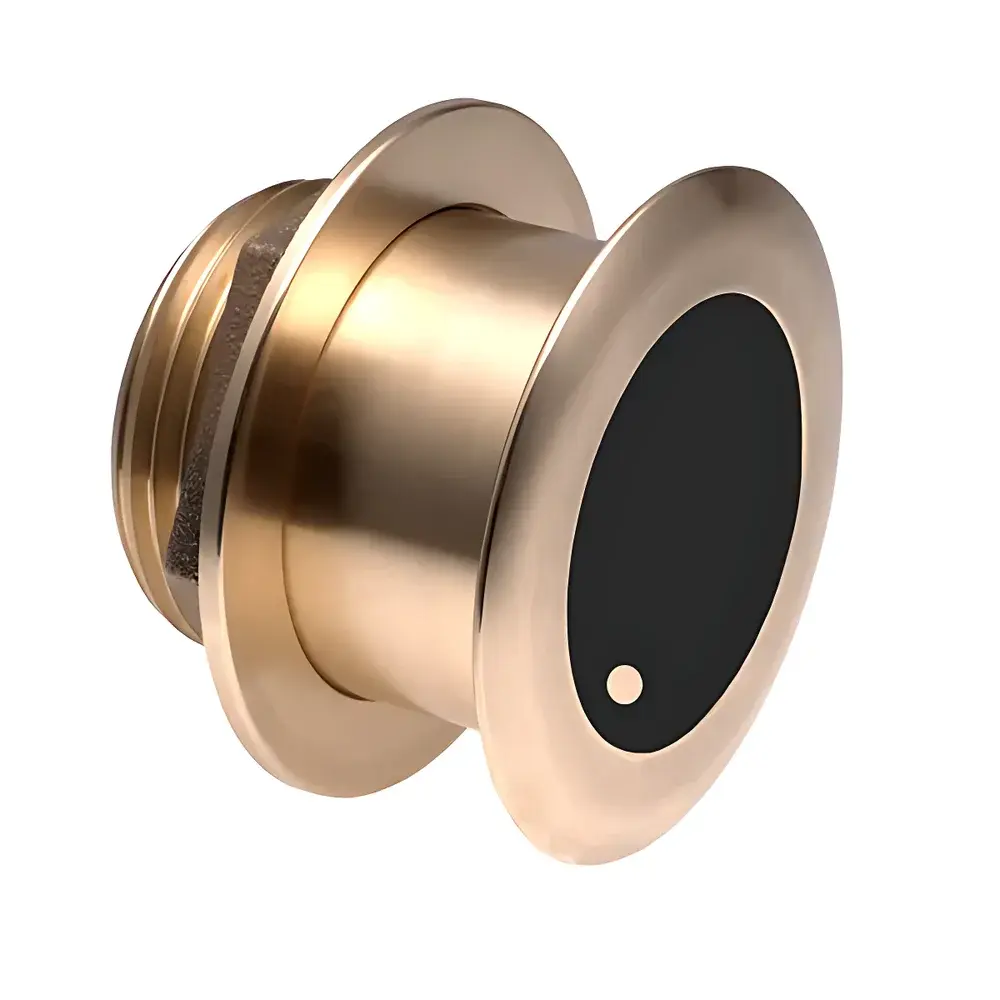
AirMar B175H Chirp Depth Sounder
| Brand | AirMar |
|---|---|
| Origin | USA |
| Model | B175H |
| Operating Frequency Range | 130–210 kHz |
| Output Power | 1000 W |
| Beam Width | 15°–9° (depending on tilt angle) |
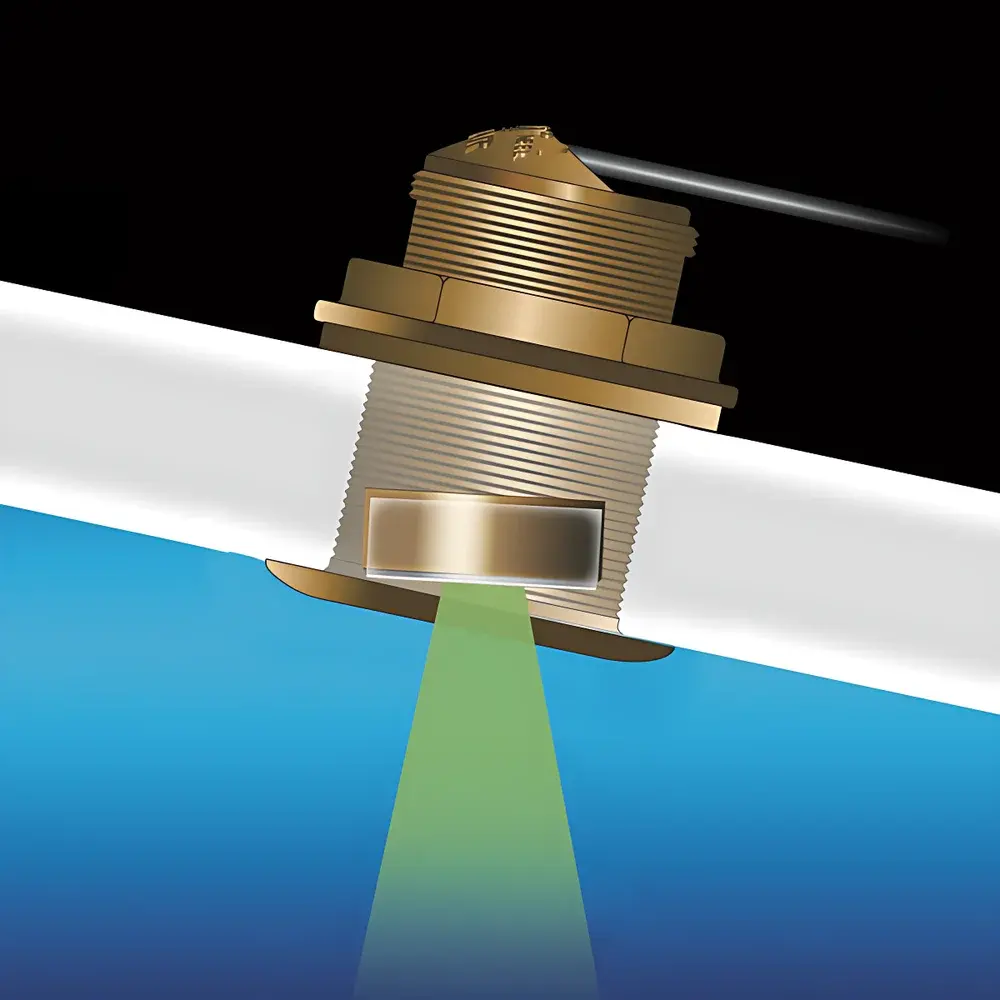
| Transducer Mounting | Low-profile through-hull |
| Housing Material | Bronze |
| Temperature Sensor | Integrated, fast-response |
| Maximum Depth Detection | 3000 m |
| Transducer Tilt Options | 0°, 12°, 20° |
| Hull Compatibility | Fiberglass or wood |
| Maximum Hull Deadrise | 28° |
| Acoustic Window Material | Polyurethane |
| Cutout Diameter | 98 mm |
| Stub Length | 118 mm |
| Cable Length | 10 m |
| Weight | 2.7 kg |
| Xducer ID® Technology | Yes |
Overview
The AirMar B175H is a high-frequency, single-beam CHIRP (Compressed High-Intensity Radar Pulse) depth sounder transducer engineered for precision hydrographic profiling and advanced fishery applications. Unlike conventional pulsed echo sounders, the B175H employs broadband frequency-modulated chirp technology—transmitting continuous swept-frequency signals across an 80 kHz bandwidth (130–210 kHz)—to achieve superior range resolution, signal-to-noise ratio, and target discrimination. This physics-based advantage enables consistent detection of seabed features at depths up to 3000 meters while resolving fine-scale acoustic returns from biological targets—including individual baitfish schools, pelagic game species, and submerged structural elements such as rock outcrops or wreck contours—with 5–10× greater detail than legacy 200 kHz narrowband transducers. Its low-profile through-hull installation architecture minimizes drag and maintains hull integrity, making it suitable for vessels up to 11 meters with fiberglass or wooden hulls and deadrise angles up to 28°.
Key Features
- High-frequency CHIRP operation (130–210 kHz) with 80 kHz instantaneous bandwidth for enhanced vertical and lateral resolution
- Integrated fast-response thermistor for simultaneous water temperature measurement—critical for sound velocity correction in depth calculation
- Three fixed-dead-rise tilt configurations (0°, 12°, 20°) to optimize beam alignment relative to hull geometry and minimize flow noise
- Patented Xducer ID® technology enabling automatic transducer identification and configuration recall within compatible marine network systems (e.g., NMEA 2000)
- Robust bronze housing with polyurethane acoustic window—chemically inert, cavitation-resistant, and acoustically transparent across the operational band
- Low-profile through-hull design requiring only a 98 mm cutout and 118 mm stub length—ideal for retrofitting without major structural modification
- 1000 W peak acoustic output power supporting long-range performance in turbid or deep-water environments
Sample Compatibility & Compliance
The B175H is designed for permanent installation on planing and semi-displacement hulls constructed from fiberglass or solid wood. It is not rated for metal-hulled vessels due to acoustic coupling constraints and potential interference from conductive materials. The transducer complies with IEC 62287-1 (Marine echosounders – Part 1: Performance requirements and methods of testing) for depth accuracy and repeatability under dynamic vessel motion. Its analog and NMEA 2000 digital outputs support integration into certified navigation and fisheries management systems compliant with IMO Resolution A.817(19) and EU Marine Strategy Framework Directive (MSFD) monitoring protocols. No hazardous substance declarations (RoHS/REACH) are required beyond standard bronze alloy composition documentation.
Software & Data Management
The B175H interfaces natively with chartplotters and multifunction displays (MFDs) supporting NMEA 2000 PGN 128259 (Depth, Temperature, and Water Speed) and PGN 128267 (Water Temperature). When paired with AirMar’s proprietary CHIRP processing firmware (v4.2+), raw IQ data streams can be logged via Ethernet or USB for post-processing using third-party hydroacoustic analysis tools such as Echoview or Sonar4. All temperature and depth measurements include embedded time stamps traceable to UTC via synchronized NMEA 0183 or NMEA 2000 time sources. Audit trails for calibration events and configuration changes are maintained in non-volatile memory per GLP-aligned logging practices.
Applications
- Commercial and recreational fisheries: Discrimination of layered fish aggregations, identification of spawning habitats, and real-time bathymetric mapping of fishing grounds
- Hydrographic survey support: Shallow-to-deep water profiling for chart update programs, dredging operations, and coastal zone management
- Scientific oceanography: Deployment on research vessels conducting benthic habitat classification, sediment layer analysis, and water column backscatter characterization
- Aquaculture site assessment: Monitoring bottom topography, current-induced scour patterns, and mooring anchor integrity
- Maritime safety: Integration into ECDIS and AIS-enabled bridge systems for collision avoidance in poorly charted waters
FAQ
What is the difference between the B175H and the B175L or B175M models?
The B175H operates in the high-frequency band (130–210 kHz), optimized for resolution and shallow-to-moderate depth applications; the B175L (low-band: 25–65 kHz) prioritizes penetration in turbid or deep water, while the B175M (mid-band: 50–120 kHz) balances both attributes.
Can the B175H be installed on aluminum or steel hulls?
No—it is specifically engineered for fiberglass and wood hulls. Installation on metal hulls requires alternative transducer designs with isolation mounts and impedance-matching layers.
Does the B175H require external power conditioning or a separate display unit?
It draws power directly from the host MFD or sounder processor via NMEA 2000 bus or dedicated 12 V DC input; no external amplifier or signal conditioner is needed.
Is the temperature sensor calibrated to NIST-traceable standards?
Yes—the integrated thermistor is factory-calibrated against NIST-traceable reference standards with documented uncertainty ≤ ±0.2°C over 0–35°C.
How does Xducer ID® improve system setup?
Xducer ID® stores model-specific parameters—including beam pattern, frequency response, and tilt offset—in onboard EEPROM, eliminating manual configuration during replacement or system reinitialization.