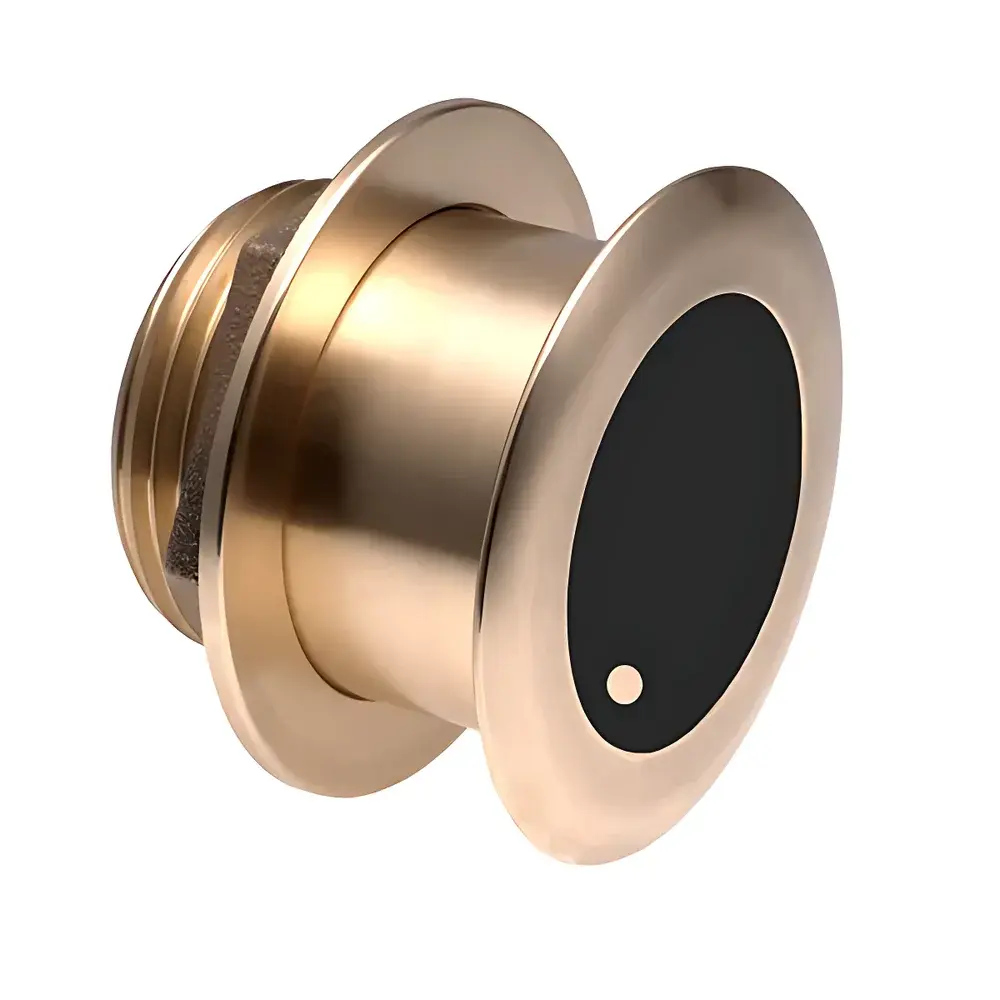
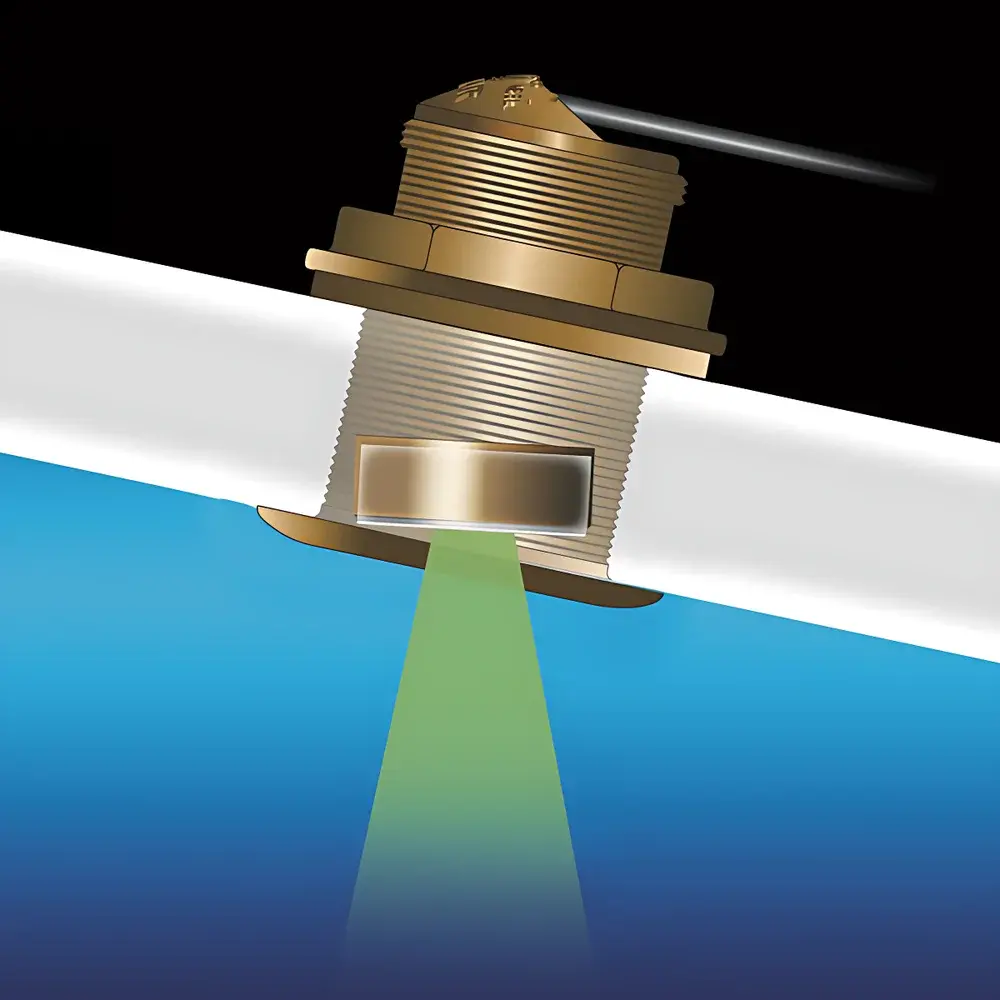
AirMar B175HW Wide-Beam High-Frequency Chirp Depth Sounder
| Brand | AirMar |
|---|---|
| Origin | USA |
| Model | B175HW |
| Operating Frequency Range | 150–250 kHz |
| Beam Width | Fixed 25° |
| Transmit Power | 1000 W |
| Housing Material | Bronze |
| Mounting Type | Low-Profile Through-Hull |
| Transducer Window Material | Polyurethane |
| Hole Diameter | 98 mm |
| Stub Length | 118 mm |
| Cable Length | 10 m |
| Integrated Temperature Sensor | Yes |
| Maximum Hull Deadrise Angle | 28° |
| Compatible Hull Materials | Fiberglass, Wood |
| Weight | 2.7 kg |
| Total Bandwidth | 100 kHz |
Overview
The AirMar B175HW is a through-hull mounted wide-beam chirp depth sounder engineered for precision hydrographic profiling and real-time bathymetric monitoring on small to mid-sized vessels. Utilizing broadband chirp sonar technology, it transmits frequency-modulated pulses across a continuous 100 kHz bandwidth (150–250 kHz), enabling superior target resolution, improved signal-to-noise ratio, and enhanced bottom discrimination compared to conventional pulsed echo sounders. Its fixed 25° beam width delivers consistent spatial coverage regardless of depth, effectively doubling the seabed swath width beneath the vessel relative to narrow-beam alternatives—making it particularly suitable for shallow-water mapping, navigational safety, and fisheries support applications where lateral coverage and rapid depth acquisition are critical. The transducer integrates a calibrated thermistor-based water temperature sensor, providing concurrent thermal data synchronized with depth returns.
Key Features
- Wide-beam chirp architecture with fixed 25° vertical beam angle for uniform swath geometry and extended lateral coverage
- High-power 1000 W output optimized for reliable performance in turbid, sediment-laden, or acoustically challenging environments
- Low-profile through-hull mounting design minimizes drag and maintains hull integrity; compatible with fiberglass and wood hulls up to 8 meters LOA
- Patented Xducer ID® technology enables automatic recognition and configuration by compatible chartplotters and multifunction displays (MFDs), reducing setup time and eliminating manual parameter entry errors
- Durable bronze housing with polyurethane acoustic window ensures long-term corrosion resistance and optimal acoustic coupling in saltwater and brackish conditions
- Integrated NMEA 2000-compatible temperature sensor with ±0.5°C accuracy over 0–30°C range, supporting environmental correlation studies and density compensation
- Optimized for operation at 200 kHz—the industry-standard fish-finding frequency—while maintaining full chirp advantages including pulse compression and Doppler tolerance
Sample Compatibility & Compliance
The B175HW is designed for installation on planing and displacement hulls with deadrise angles up to 28°, accommodating typical recreational and light commercial craft constructed from fiberglass or solid wood. It does not require fairing blocks or wedge kits for standard installations, simplifying retrofitting. The transducer complies with IEC 62239 (marine electronic equipment environmental testing) and meets EMC requirements per EN 55022 Class B. While not certified for Class A survey-grade hydrography per IHO S-44, its performance aligns with IHO Special Order tolerances in depths ≤50 m under favorable acoustic conditions. No proprietary calibration certificates are supplied; users must perform routine verification using known-depth reference sites or traceable acoustic test tanks per ISO 17025–accredited procedures if used in regulated QA/QC workflows.
Software & Data Management
The B175HW outputs raw depth and temperature data via NMEA 2000 (PGNs 128259, 130311) and analog voltage (0–5 V) interfaces, enabling integration with third-party logging systems, GIS platforms, and vessel management software. When paired with AirMar’s compatible MFDs (e.g., Raymarine Axiom, Garmin GPSMAP series), it supports real-time depth contouring, bottom hardness estimation, and split-screen overlay with AIS or radar. All firmware updates are delivered via microSD card or USB-to-NMEA gateway; no cloud dependency or subscription services are required. Audit trails for configuration changes are maintained locally on the host display unit, satisfying basic GLP documentation needs for non-GMP marine operations.
Applications
- Shallow-water bathymetric surveys for coastal zone management and habitat mapping
- Navigational safety augmentation on pilot boats, research tenders, and inland waterway patrol craft
- Hydroacoustic validation of LiDAR-derived DEMs in estuarine and lacustrine environments
- Real-time water column profiling during aquaculture site selection and monitoring
- Support instrumentation for university marine science field courses requiring portable, low-maintenance depth sensing
- Integration into autonomous surface vehicle (ASV) platforms for uncrewed hydrographic missions
FAQ
Can the B175HW be installed on aluminum or steel hulls?
No—its through-hull design and bronze housing are specifically validated for fiberglass and wood. Aluminum or steel hulls require alternative mounting solutions (e.g., transom or trolling motor brackets) and are not supported under warranty.
Is the temperature sensor factory-calibrated and traceable to NIST standards?
The sensor is factory-calibrated against reference thermistors; however, formal NIST-traceable calibration documentation is not included. Users requiring metrological traceability must arrange third-party calibration per ISO/IEC 17025.
Does the B175HW support CHIRP data export in vendor-neutral formats such as .csv or .nmea?
Yes—depth and temperature values are accessible as ASCII NMEA 0183 sentences or binary NMEA 2000 PGNs, both of which are widely supported by open-source parsing libraries and GIS data ingestion tools.
What is the minimum operating depth for reliable bottom detection?
Under typical freshwater conditions with moderate turbidity, the minimum reliable detection depth is approximately 0.3 m; in seawater with high conductivity, it may extend to 0.5 m due to increased acoustic absorption.
Can multiple B175HW units operate simultaneously on one vessel without interference?
Yes—chirp waveforms are inherently orthogonal; simultaneous operation of two or more units is feasible provided their center frequencies are separated by ≥20 kHz and physical spacing exceeds three wavelengths at the lowest operating frequency.