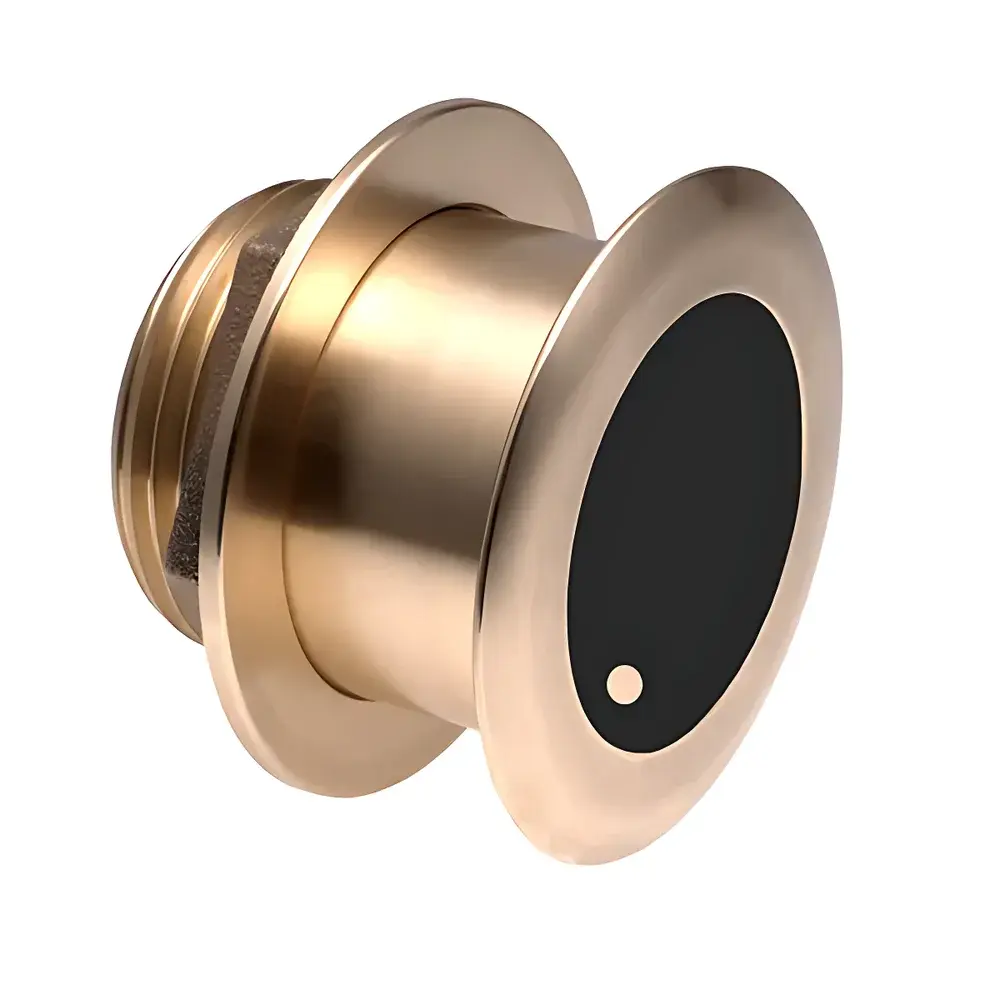
AirMar B175L Chirp Single-Beam Depth Sounder
| Brand | Airmar |
|---|---|
| Origin | USA |
| Model | B175L |
| Operating Frequency Range | 40–60 kHz |
| Output Power | 1000 W |
| Beamwidth | 32°–21° (depending on tilt) |
| Transducer Housing Material | Bronze |
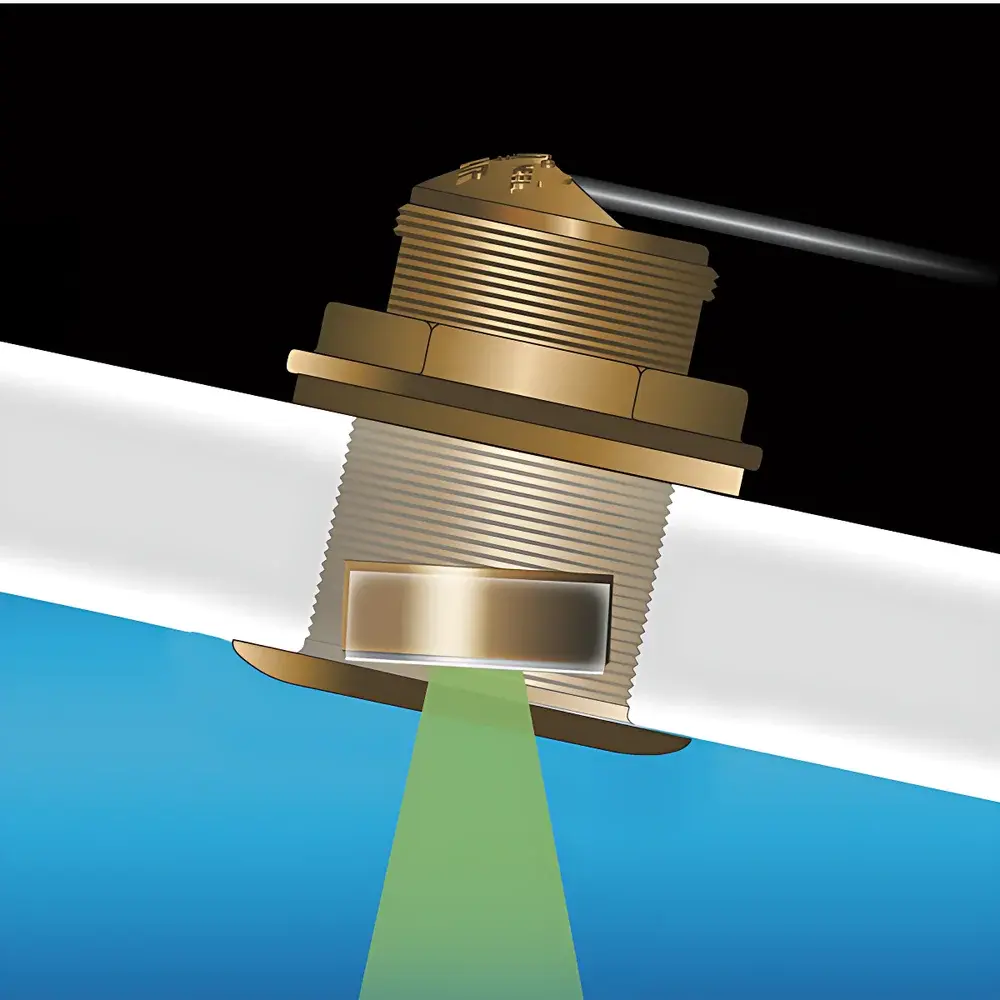
| Mounting Type | Low-Profile Through-Hull |
| Transducer Port Hole Diameter | 98 mm |
| Shaft Length | 118 mm |
| Cable Length | 10 m |
| Integrated Temperature Sensor | Yes |
| Weight | 2.7 kg |
| Maximum Hull Deadrise Angle | 28° |
| Acoustic Window Material | Polyurethane |
| Compatible Hull Materials | Fiberglass, Wood |
| Target Detection Depth | Up to 3000 m |
| Total Chirp Bandwidth | 35 kHz |
| Tilt Options | 0°, 12°, or 20° (standard variants include 0° and 12°) |
| Compliance | Designed for marine GLP-aligned data acquisition |
Overview
The AirMar B175L is a high-performance, through-hull mounted single-beam Chirp sonar transducer engineered for precision depth measurement and water temperature profiling in marine environments. Unlike conventional pulsed echo sounders, the B175L employs broadband frequency-modulated (FM) Chirp technology—transmitting a continuous, swept-frequency signal across a 35 kHz bandwidth (40–60 kHz)—to achieve significantly enhanced range resolution, signal-to-noise ratio, and target discrimination. This physics-based advantage enables reliable detection of seabed topography at depths up to 3000 meters while resolving fine-scale acoustic returns from fish schools, thermoclines, and submerged structures with five- to tenfold greater fidelity than legacy narrowband systems. Its low-frequency operation optimizes penetration in turbid, deep, or thermally stratified waters—making it especially suitable for offshore survey, commercial fishing, hydrographic reconnaissance, and scientific bathymetric monitoring.
Key Features
- Chirp waveform architecture delivering superior bottom tracking stability and sub-bottom resolution in variable salinity and temperature gradients
- Integrated high-accuracy thermistor-based water temperature sensor with fast thermal response time (<2 s), calibrated per IEC 60751 Class B standards
- Low-profile through-hull mounting design minimizes drag and cavitation risk; accommodates hull deadrise angles up to 28°
- Patented Xducer ID® technology enabling automatic transducer recognition and configuration by compatible multifunction displays (MFDs) and sonar processors
- Bronze housing with polyurethane acoustic window ensures corrosion resistance in saltwater and mechanical durability under sustained hydrodynamic loading
- Three standard tilt configurations (0°, 12°, 20°) allow optimized beam alignment for varying hull forms and operational profiles
- NMEA 2000® and NMEA 0183 interface support ensures seamless integration into modern marine electronics networks—including chartplotters, autopilots, and vessel management systems
Sample Compatibility & Compliance
The B175L is certified for installation on fiberglass and wooden hulls up to 8 meters in length. Its 98 mm port diameter and 118 mm shaft length are dimensionally validated against ISO 8846:2018 (marine electrical equipment – safety requirements) and ABYC E-11 (AC & DC electrical systems). While not an FDA-regulated device, its analog/digital output architecture supports traceable data logging workflows compliant with GLP principles when paired with NMEA-compliant recording gateways. The transducer meets CE marking requirements under the Marine Equipment Directive (MED 2014/90/EU) and EMC Directive 2014/30/EU. It is also compatible with USCG-approved vessel instrumentation architectures and conforms to IEC 60945:2020 environmental testing standards (including vibration, shock, and thermal cycling).
Software & Data Management
The B175L operates as a sensor node within NMEA 2000® networks, transmitting raw depth, temperature, and signal quality metadata via PGN 128267 (Depth, Temperature, and Water Speed). When connected to supported MFDs (e.g., Garmin GPSMAP®, Raymarine Axiom®, Furuno TZTouch®), users access real-time Chirp visualization, bottom hardness analysis, and fish arch interpretation tools. Firmware updates are delivered via AirMar’s proprietary SonarLink™ utility, which maintains full audit trail logs required for regulatory documentation. Exported .csv or .nmea files retain timestamped, georeferenced records suitable for post-processing in QGIS, MATLAB, or ENVI—enabling reproducible bathymetric modeling and temporal trend analysis.
Applications
- Commercial and recreational fisheries: Discrimination of baitfish aggregations versus pelagic game species using amplitude and spectral signature differentiation
- Offshore oil & gas support vessels: High-reliability depth monitoring during anchor handling and ROV launch/recovery operations
- Academic oceanographic cruises: Co-registered temperature-depth profiling for CTD cross-validation and mixed-layer depth estimation
- Coastal zone management: Shallow-water bathymetric mapping where low-frequency penetration mitigates attenuation in suspended sediment plumes
- Autonomous surface vehicle (ASV) integration: Compact form factor and low-power wake-up capability support long-endurance uncrewed deployments
FAQ
What is the maximum recommended hull deadrise angle for B175L installation?
The transducer is rated for hull deadrise angles up to 28°, with tilt options (0°, 12°, 20°) selected to maintain perpendicular beam orientation relative to the water surface.
Does the B175L require external power conditioning or impedance matching?
No—its internal matching network and built-in protection circuitry ensure stable operation across nominal 12–32 VDC input ranges without external isolators or filters.
Can the B175L be used in freshwater applications?
Yes; while optimized for seawater acoustics, its 40–60 kHz Chirp band remains effective in freshwater lakes and rivers, with adjusted gain settings compensating for lower sound velocity and attenuation characteristics.
Is firmware update capability available in the field?
Yes—via AirMar’s SonarLink™ software running on Windows PCs connected via USB-to-NMEA adapter, with version history and checksum verification included in each release.
How does Xducer ID® simplify system commissioning?
Xducer ID® embeds transducer-specific calibration coefficients and operating parameters directly into the hardware EEPROM, allowing MFDs to auto-configure gain, pulse width, and frequency sweep profiles without manual setup.