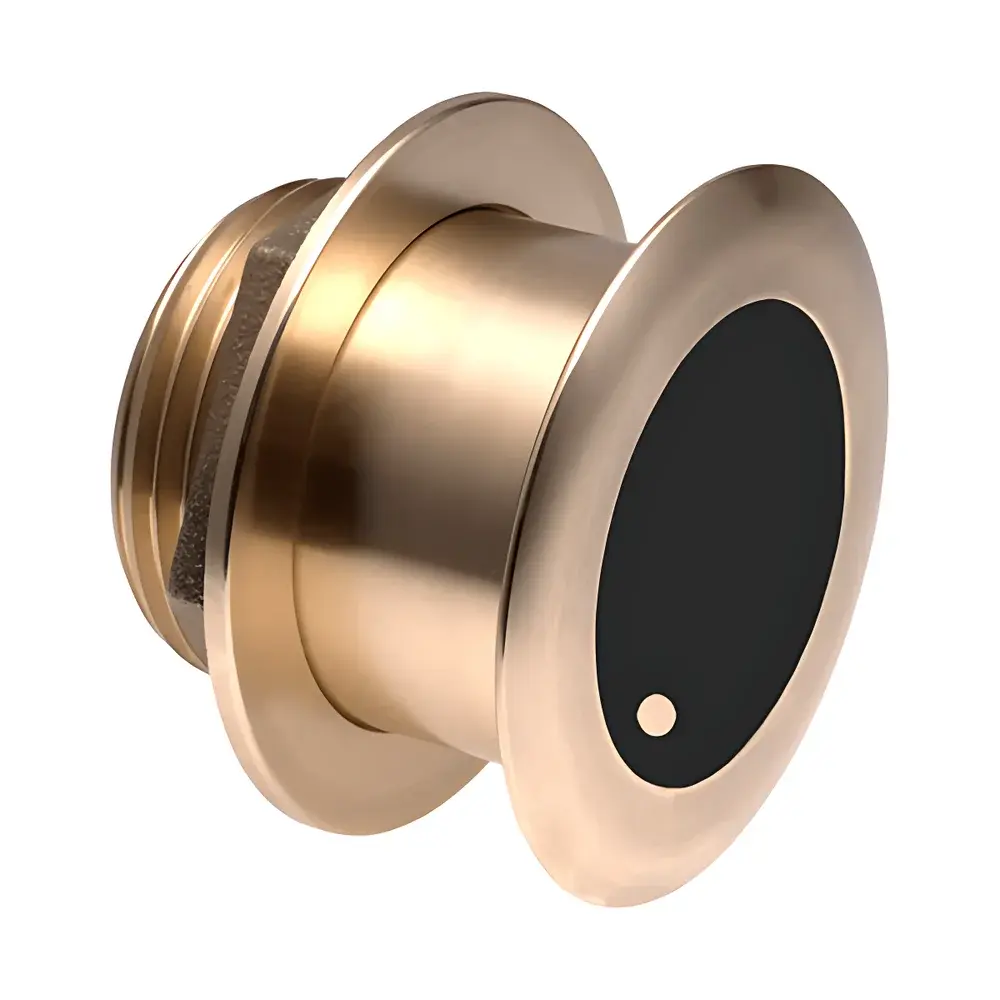
AIRMAR B175MW Chirp-Ready Mid-Frequency Wide-Beam Through-Hull Transducer
| Brand | AIRMAR |
|---|---|
| Origin | USA |
| Model | B175MW |
| Power Output | 1 kW |
| Operating Frequency Range | 60–100 kHz |
| Beam Width | 57°–73° (Port/Starboard), Avg. 16° (Forward/Aft) |
| Maximum Depth Rating | 400 m |
| Housing Material | Bronze |
| Mounting Type | Through-Hull with Tilted Element™ |
| Tilt Options | 0°, 12°, or 20° fixed |
| Transducer Window Material | Polyurethane |
| Hull Compatibility | Fiberglass or Wood, Max. Hull Thickness: Not Specified, Max. Vessel Length: 11 m |
| Cable Length | 9 m |
| Weight | 2.7 kg |
Overview
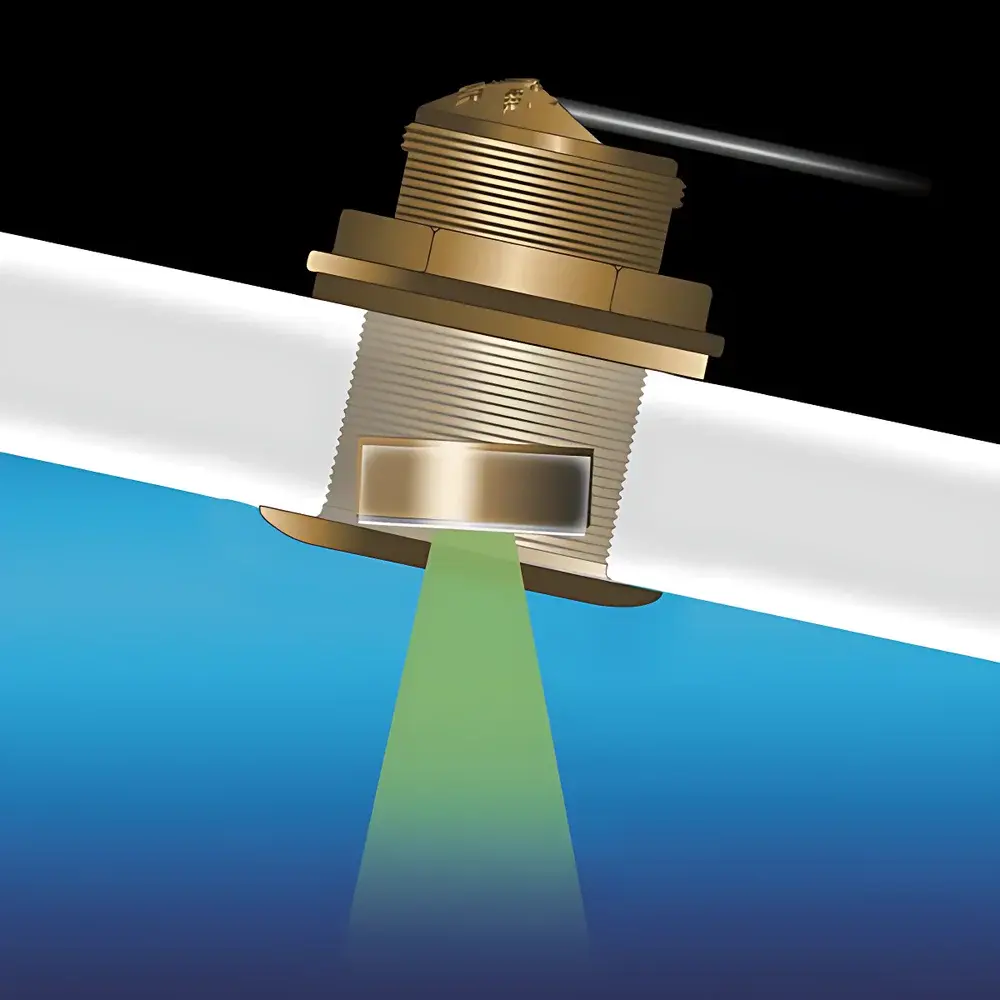
The AIRMAR B175MW is a high-performance, chirp-ready mid-frequency wide-beam through-hull transducer engineered for marine echo sounders operating in the 60–100 kHz band. Unlike conventional single-frequency transducers, the B175MW leverages a broad instantaneous bandwidth of 40 kHz—enabling compatibility with modern CHIRP (Compressed High-Intensity Radar Pulse) sonar systems that transmit frequency-swept pulses rather than narrowband bursts. This architecture delivers significantly improved target resolution, enhanced signal-to-noise ratio, and superior discrimination of closely spaced fish targets in the water column—particularly critical for pelagic and mid-water species identification. Its tilted-element design compensates for hull deadrise angles up to 24°, ensuring acoustic energy is transmitted and received along a true vertical axis relative to the water surface—maximizing echo return integrity and minimizing beam distortion. The transducer is optimized for vessels up to 11 meters in length with fiberglass or wood hulls, and its low-profile through-hull installation minimizes hydrodynamic drag while maintaining mechanical robustness in demanding offshore environments.
Key Features
- Tilted Element™ technology with three fixed-angle options (0°, 12°, or 20°) to match vessel hull deadrise and maintain vertical beam alignment
- Bronze housing rated for long-term corrosion resistance in saltwater and brackish environments
- Integrated high-accuracy temperature sensor for real-time water column correction and density compensation
- 1 kW peak power output supporting reliable detection at depths up to 400 m (1,300 ft) under typical oceanic conditions
- Polyurethane acoustic window providing broadband transmission efficiency and mechanical protection against impact and abrasion
- Xducer ID® digital identification protocol enabling automatic transducer recognition and configuration by compatible CHIRP sounders (e.g., Raymarine Axiom+, Garmin GPSMAP, Simrad NSS)
- Wide angular coverage: 57°–73° port/starboard beam width and ~16° forward/aft beam width—ideal for broad-area scanning and lateral fish school mapping
Sample Compatibility & Compliance
The B175MW is designed for integration into commercial and recreational marine navigation and fisheries monitoring systems compliant with IEC 62288 (Maritime navigation and radiocommunication equipment and systems – General requirements) and ISO 8727 (Ships and marine technology – Echo sounding equipment). Its mechanical interface conforms to standard through-hull mounting practices for fiberglass and wooden hulls, with a 95 mm cutout diameter and recommended minimum hull thickness per AIRMAR installation guidelines. While not certified for Class-approved vessel applications (e.g., SOLAS), it meets functional performance expectations for non-safety-critical depth and biomass assessment use cases. The transducer operates within FCC Part 15 and CE RED Directive emission limits for marine RF devices. No regulatory certification for underwater noise emissions (e.g., ICES-2019-017) is claimed, though its mid-frequency operation inherently avoids sensitive low-frequency marine mammal communication bands.
Software & Data Management
The B175MW does not include embedded firmware or onboard data storage; instead, it functions as an analog/digital hybrid transducer that interfaces directly with host echosounder units supporting CHIRP processing. When paired with compatible chartplotters or PC-based hydrographic software (e.g., SonarTRX, QPS Qimera), raw IQ data streams can be captured, time-stamped, and georeferenced using NMEA 2000 or Ethernet protocols. Xducer ID® enables automatic loading of calibrated beam pattern profiles and frequency response curves into the host system—reducing manual setup errors and improving repeatability across multi-transducer deployments. All operational parameters—including tilt angle, center frequency, and pulse duration—are configured externally via the host device’s UI. Audit trails for transducer configuration changes are maintained only if the host system supports GLP-compliant logging (e.g., FDA 21 CFR Part 11–enabled platforms used in research vessel operations).
Applications
- Commercial and sport fishing operations targeting pelagic and mesopelagic species (e.g., tuna, mackerel, herring) in depths from 10 m to 400 m
- Hydrographic survey support for shallow-to-medium depth bathymetric mapping where wide-swath coverage improves survey line efficiency
- Scientific fisheries acoustics studies requiring high-resolution target strength quantification and school morphology analysis
- Marine habitat assessment, including seafloor classification and macrofauna distribution mapping using dual-frequency or split-beam correlation techniques
- Vessel-based environmental monitoring programs integrating depth, temperature, and echo intensity for water column stratification modeling
FAQ
Is the B175MW compatible with all CHIRP-capable sounders?
Yes—provided the host unit supports mid-frequency (60–100 kHz) CHIRP operation and recognizes AIRMAR’s Xducer ID® protocol. Verified compatibility includes Raymarine Axiom Pro/Series, Garmin GPSMAP 8000/10000 Series, and Simrad NSS evo3 with appropriate firmware updates.
Can the B175MW be installed on aluminum or steel hulls?
No—AIRMAR specifies fiberglass or wood hulls only. Aluminum and steel hulls require specialized fairing blocks or external mounting solutions not supported by the B175MW’s through-hull mechanical design.
What is the significance of the 40 kHz total bandwidth?
This bandwidth enables fine range resolution (~0.37 m theoretical at 80 kHz center frequency) and improved Doppler sensitivity for moving target analysis—key advantages over legacy 10–20 kHz bandwidth transducers.
Does the integrated temperature sensor meet ASTM D1125 standards for water temperature measurement?
The sensor provides functional accuracy suitable for echo correction but is not calibrated or certified to ASTM D1125 or ISO 7888; users requiring traceable metrology should deploy a secondary NIST-traceable probe.
How does tilt angle selection affect beam geometry?
The fixed tilt compensates for hull deadrise so the ceramic element remains vertically oriented in water; incorrect tilt selection results in beam skew, reduced bottom return, and asymmetric left/right detection ranges.