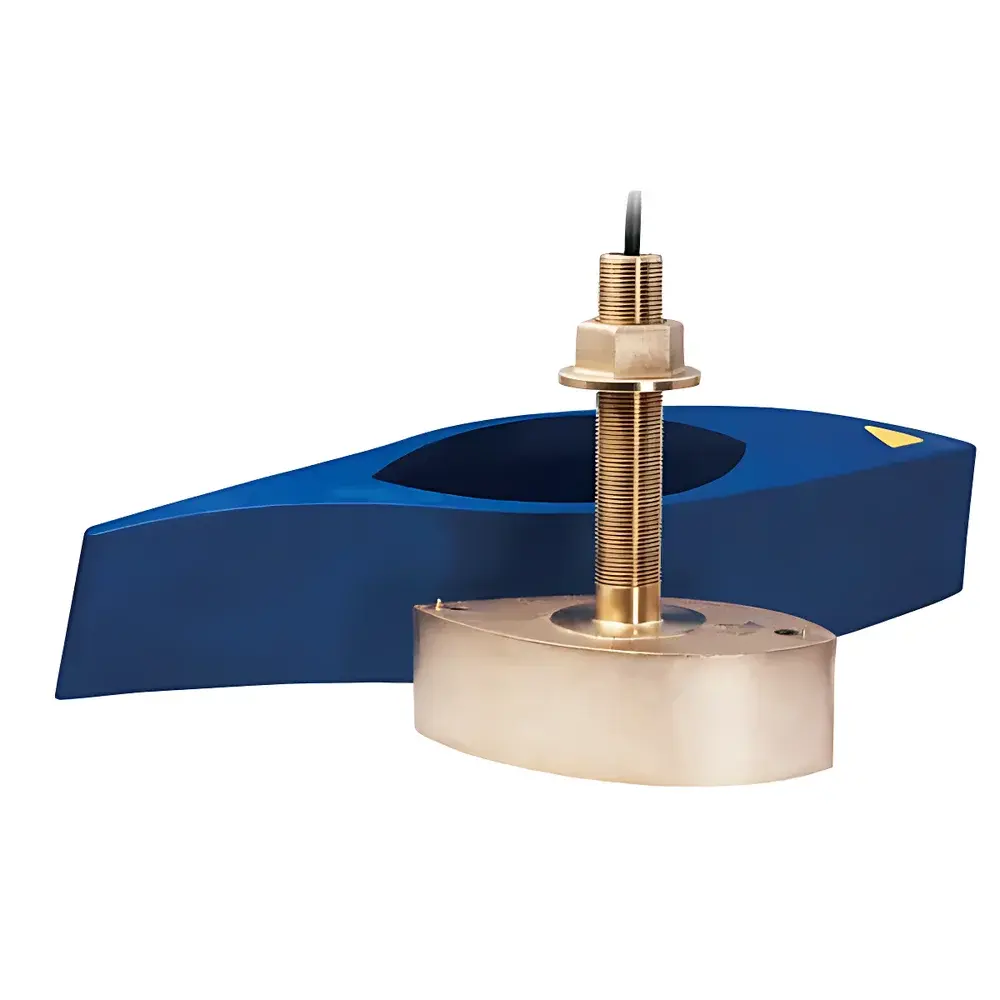
AirMar B260 Through-Hull Depth Sounder Transducer
| Brand | Airmar |
|---|---|
| Origin | USA |
| Model | B260 |
| Power Output | 1000 W |
| Operating Frequencies | 50 kHz / 200 kHz |
| Beamwidth | 14° × 23° @ 50 kHz / 3° × 5° @ 200 kHz |
| Housing Material | Bronze (optional stainless steel SS260) |
| Mounting Type | Through-hull |
| Port Diameter | 30 mm |
| Shaft Length | 121 mm |
| Cable Length | 10 m |
| Integrated Temperature Sensor | ±0.2°C accuracy |
| Maximum Hull Tilt Tolerance | 20° |
| Lens Material | Polyurethane |
| Weight | 7.3 kg |
Overview
The AirMar B260 is a high-performance, through-hull mounted depth sounder transducer engineered for reliable hydroacoustic depth measurement and bottom profiling in marine environments. Based on piezoelectric transduction principles, the B260 emits and receives acoustic pulses in dual-frequency bands—50 kHz for deep-water penetration and broad-area seabed mapping, and 200 kHz for high-resolution shallow-water imaging and target discrimination. Its robust bronze housing provides corrosion resistance in saltwater and freshwater applications, while its streamlined hydrodynamic profile minimizes flow-induced noise and cavitation during vessel operation. Designed specifically for vessels up to 9 meters (30 feet), the B260 delivers consistent echo return integrity across varying hull geometries and speeds, making it suitable for both recreational sportfishing platforms and light commercial workboats operating under GLP-aligned operational protocols.
Key Features
- 1000 W peak acoustic output power ensures strong signal-to-noise ratio even in turbid or thermally stratified water columns
- Dual-frequency operation (50/200 kHz) enables adaptive sonar mode selection based on depth range, resolution requirements, and environmental conditions
- Ergonomic elliptical face geometry increases effective radiating surface area—enhancing sensitivity and reducing beam distortion at oblique incidence angles
- Integrated fast-response temperature sensor (±0.2°C accuracy) supports real-time sound velocity correction in echo sounder firmware, improving depth calculation fidelity
- XducerID® technology enables automatic transducer identification and configuration recall within compatible chartplotters and multifunction displays—reducing setup time and minimizing user error
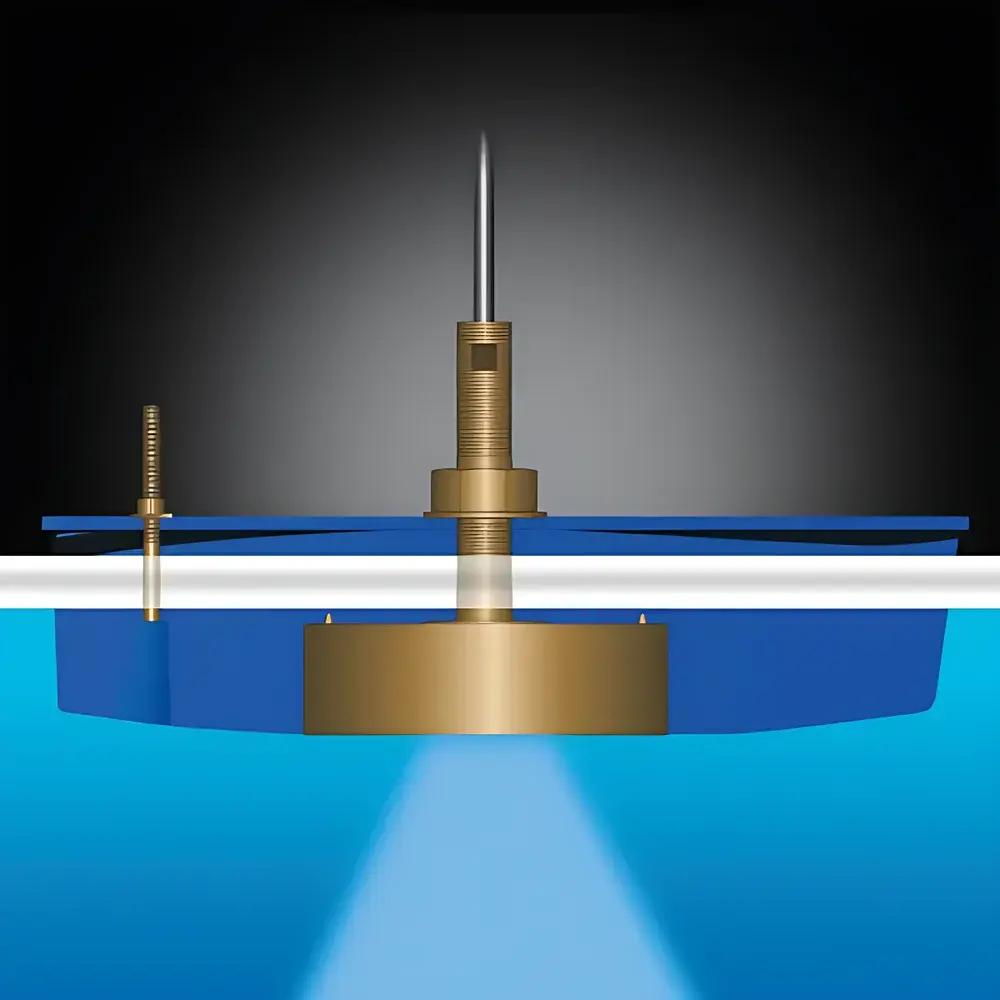
- Through-hull mounting architecture eliminates external drag and maintains hull integrity; accommodates hull tilt up to 20° with optional custom-cut polyurethane fairing
- Patented polyurethane lens material provides broadband acoustic coupling while resisting abrasion, biofouling adhesion, and UV degradation
Sample Compatibility & Compliance
The B260 is validated for use with NMEA 2000–compliant echo sounders, including but not limited to Raymarine Axiom, Garmin GPSMAP, Lowrance HDS Live, and Simrad NSS evo3 systems. Its mechanical design conforms to ISO 8846 (Marine equipment – Electrical devices – Safety requirements) and ABYC E-11 (Marine Electrical Systems). The bronze housing meets ASTM B150/B150M standards for naval brass alloys, ensuring long-term structural stability in seawater immersion. While the transducer itself does not carry CE or FCC certification as a standalone component, it operates within emission limits defined by ITU-R SM.326 when integrated into certified marine electronics systems. No hazardous substance declarations (RoHS, REACH) are required due to absence of restricted materials in active transduction elements.
Software & Data Management
When paired with compatible MFDs, the B260 supports full digital data exchange via NMEA 2000 PGNs 128259 (Depth Below Transducer), 128267 (Water Temperature), and 127250 (Transducer Configuration). Firmware updates—where applicable—are delivered through host display units using standardized NMEA OneNet protocols. All raw echo log data remains accessible for post-processing in third-party hydrographic analysis tools such as QPS Qimera or SonarWiz, provided the host system exports binary or CSV-formatted logs. Audit-trail functionality is maintained at the display level per IEC 62304 Class B software lifecycle requirements, though the transducer contributes no embedded logic or storage.
Applications
- Recreational navigation and bathymetric charting on center-console, walkaround, and cuddy cabin vessels
- Commercial fisheries support—bottom contour mapping, fish school localization, and gear placement verification
- Shallow-draft survey operations requiring high angular coverage without external pod protrusion
- Coastal research deployments where thermal profiling integration improves depth calibration accuracy
- Marina infrastructure monitoring—including dock clearance verification and sediment accumulation tracking
FAQ
Is the B260 compatible with CHIRP-enabled sounders?
No—the B260 is a fixed-frequency transducer and does not support swept-frequency (CHIRP) excitation protocols.
Does the B260 require a separate duplexer when used with a single-channel echo sounder?
Yes—a duplexer is mandatory for single-channel systems to isolate transmit and receive paths; dual-channel systems handle this internally.
Can the B260 be installed on aluminum or cored fiberglass hulls?
Yes, provided proper bedding compound and mechanical isolation are applied per ABYC E-11 guidelines to prevent galvanic corrosion or core saturation.
What is the maximum recommended operating speed for optimal echo return?
Up to 35 knots under calm sea state conditions; performance degrades above this threshold due to boundary layer turbulence and air entrainment.
Is XducerID® functionality dependent on specific MFD firmware versions?
Yes—XducerID® requires MFD firmware v5.2 or later from supported manufacturers; consult device-specific compatibility matrices prior to installation.