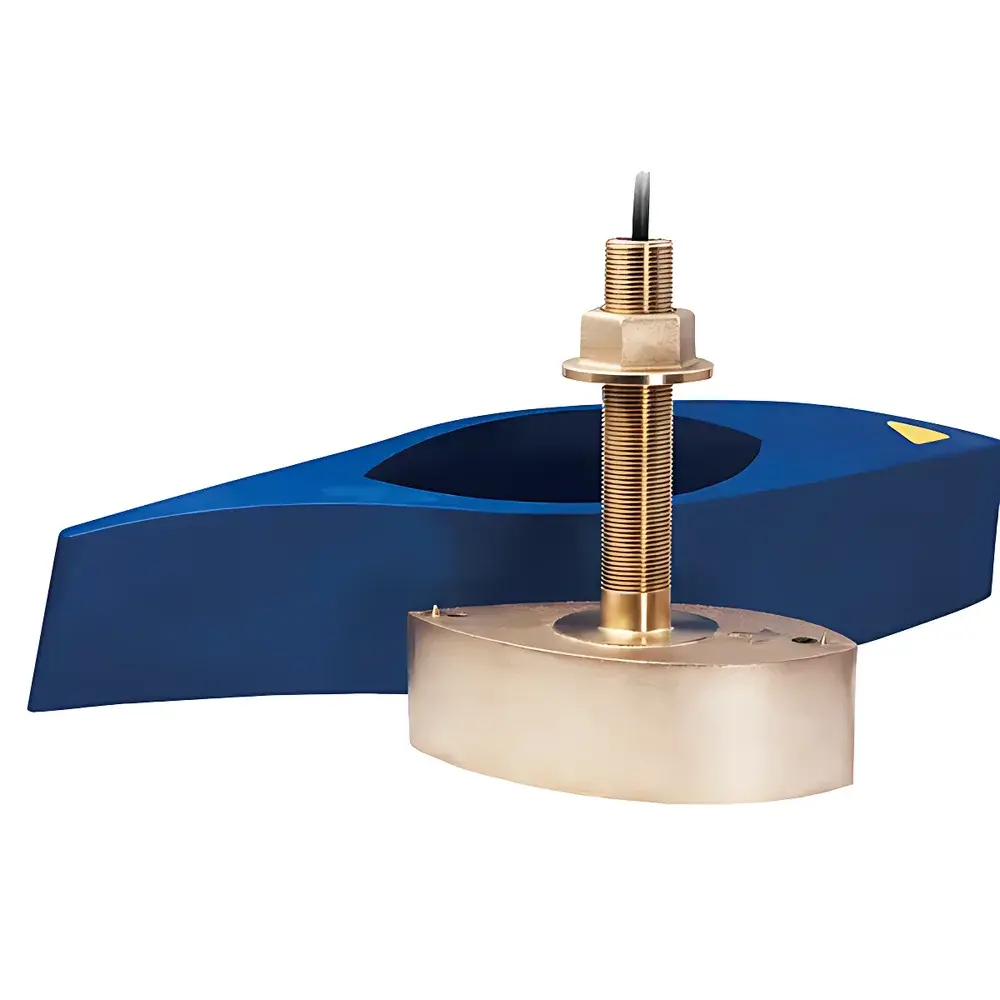
AirMar B265LH Dual-Frequency Chirp Depth Sounder
| Brand | AIRMAR |
|---|---|
| Origin | USA |
| Model | B265LH |
| Frequency Range (Low) | 42–65 kHz, Beamwidth: 25°–16° |
| Frequency Range (High) | 130–210 kHz, Beamwidth: 10°–6° |
| Output Power | 1000 W |
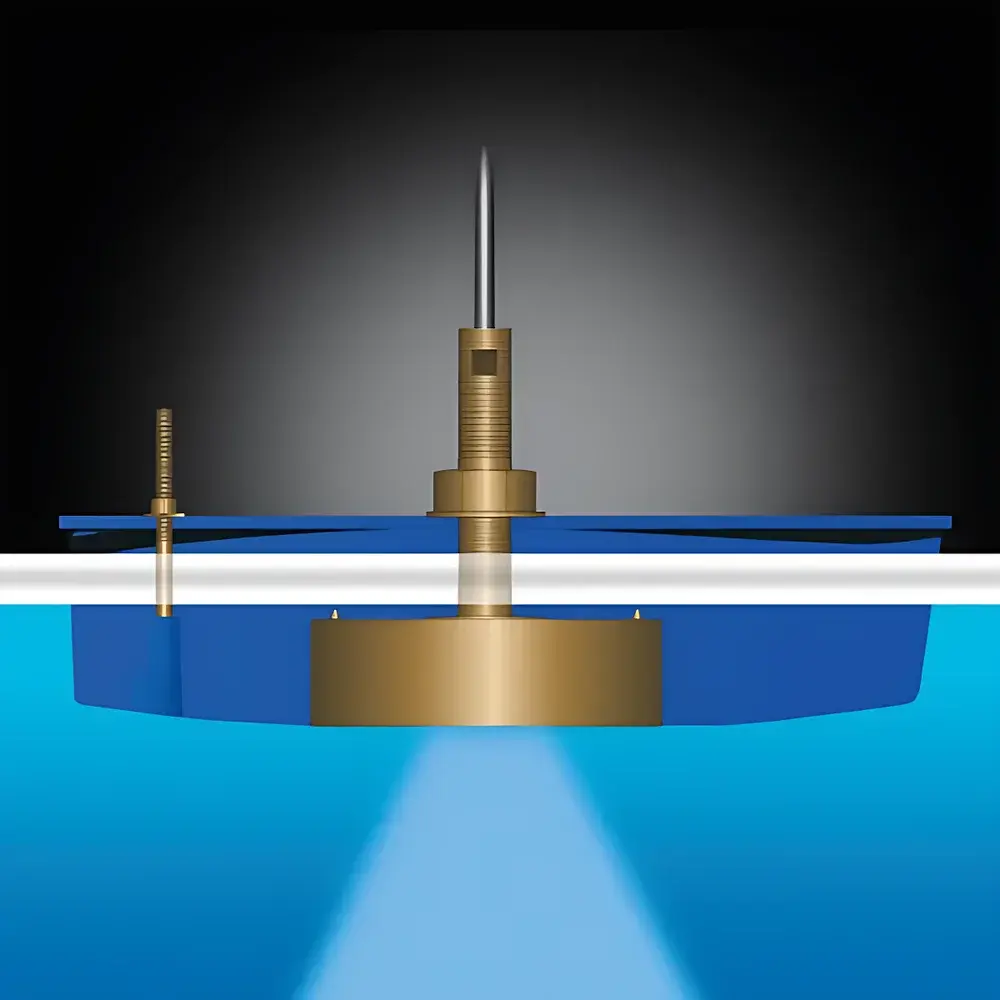
| Installation Type | Through-Hull with Hydrodynamic Fairing |
| Housing Material | Bronze (transducer body), Polyurethane (fairing) |
| Mounting Hole Diameter | 33 mm |
| Shaft Length | 178 mm |
| Cable Length | 10 m |
| Integrated Temperature Sensor | Yes |
| Maximum Hull Deadrise Angle | 20° |
| Compatible Hull Materials | Fiberglass, Wood |
| Weight | 7.3 kg |
| Total Bandwidth | 103 kHz |
| Dual-Beam Chirp Architecture | Yes |
Overview
The AirMar B265LH is a dual-frequency, through-hull mounted Chirp depth sounder engineered for high-fidelity hydrographic profiling and fisheries-oriented echosounding. Unlike conventional fixed-frequency echo sounders, the B265LH employs broadband frequency-modulated (FM) chirp technology—transmitting continuous swept signals across two distinct, non-overlapping bands: a low-frequency band (42–65 kHz) optimized for deep-water penetration and bottom detection to 3,000 meters (10,000 ft), and a high-frequency band (130–210 kHz) delivering superior lateral and vertical resolution for target discrimination in mid-water columns. This dual-band architecture enables simultaneous acquisition of complementary acoustic data streams, significantly enhancing signal-to-noise ratio (SNR), target separation capability, and classification confidence—particularly critical for distinguishing baitfish schools, game fish aggregations, and complex benthic structures such as rock piles, wrecks, or submerged vegetation.
Key Features
- Dual-band Chirp transduction: Independent low- and high-frequency transducers housed in a single bronze alloy body, each with dynamically variable beamwidth (25°–16° at low band; 10°–6° at high band) to balance coverage and resolution.
- 1000 W peak acoustic output power ensures robust signal propagation in turbid, saline, or thermally stratified water columns.
- Integrated fast-response thermistor located within the transducer housing provides real-time water temperature measurements synchronized with depth returns—essential for sound velocity correction and accurate depth calibration per ISO 17025 traceable workflows.
- Patented Xducer ID® technology enables automatic transducer identification and configuration recall when connected to compatible multifunction displays (MFDs) or NMEA 2000 networks—reducing setup time and minimizing configuration errors in multi-transducer installations.
- Hydrodynamically optimized polyurethane fairing minimizes flow-induced noise and cavitation across vessel speeds up to 35 knots, maintaining acoustic integrity without requiring hull modification beyond a standard 33 mm through-hull opening.
- Designed for fiberglass and wood hulls with deadrise angles up to 20°, the B265LH eliminates the need for tilt kits or custom mounting brackets in most small commercial and research vessels (≥8 m LOA).
Sample Compatibility & Compliance
The B265LH is intended for use in marine and freshwater environments where precise bathymetric mapping, stock assessment surveys, and habitat characterization are required. Its dual-band response supports compliance with data quality requirements outlined in ICES Cooperative Research Reports (CRRs) for acoustic fisheries surveys and aligns with best practices referenced in NOAA Technical Memorandum NMFS-F/SPO-132. The transducer’s bronze housing meets ASTM B150/B150M specifications for naval brass alloys, while its polyurethane fairing conforms to MIL-STD-810G for environmental durability. All electrical interfaces comply with IEC 61162-1 (NMEA 0183) and IEC 61162-450 (NMEA 2000) standards. No hazardous substances are used in construction per RoHS Directive 2011/65/EU.
Software & Data Management
Raw and processed echo data from the B265LH are accessible via industry-standard NMEA 2000 PGNs (e.g., PGN 128267 for depth, PGN 130311 for water temperature, PGN 128275 for transducer status). When interfaced with Echoview, Sonar4, or QPS Qimera software platforms, users can perform post-processed target strength analysis, volume backscattering coefficient (Sv) derivation, and GIS-integrated habitat layering. Firmware updates and diagnostic logging are supported through AirMar’s proprietary Transducer Configuration Utility (TCU), which maintains full audit trails—including timestamped parameter changes—required for GLP-compliant field data collection protocols.
Applications
- Commercial fisheries: Real-time identification and quantification of pelagic species layers using differential frequency response signatures.
- Hydrographic surveying: High-resolution bathymetry generation in coastal zones and fjords where multipath interference limits conventional sonar performance.
- Aquaculture site assessment: Detection of sediment accumulation, oxygen depletion zones, and structural integrity of net pens via thermal-acoustic correlation.
- Environmental monitoring: Long-term tracking of benthic change, invasive species dispersion, and cold-water coral reef morphology.
- Academic oceanography: Calibration reference for multibeam systems and validation of acoustic scattering models (e.g., Kirchhoff Approximation, Distorted Wave Born Approximation).
FAQ
Does the B265LH support integration with existing NMEA 2000 networks?
Yes—the transducer outputs standardized PGNs compatible with all NMEA 2000-certified MFDs, autopilots, and data loggers.
Is firmware update capability available without proprietary hardware?
Firmware updates require AirMar’s TCU software and a USB-to-NMEA 2000 gateway; no additional dongles or subscription services are needed.
Can the B265LH be installed on aluminum hulls?
No—bronze-on-aluminum galvanic coupling presents unacceptable corrosion risk; installation is restricted to fiberglass, wood, or composite hulls per manufacturer specification.
What is the maximum recommended vessel speed for optimal Chirp performance?
For consistent signal coherence and minimal flow noise, sustained operation above 35 knots is not advised; empirical testing shows optimal SNR below 28 knots in open-water conditions.
How does the integrated temperature sensor contribute to measurement accuracy?
It provides real-time in-situ sound velocity input for dynamic depth correction algorithms, reducing depth error by up to 0.8% in thermocline-affected waters compared to fixed-velocity assumptions.