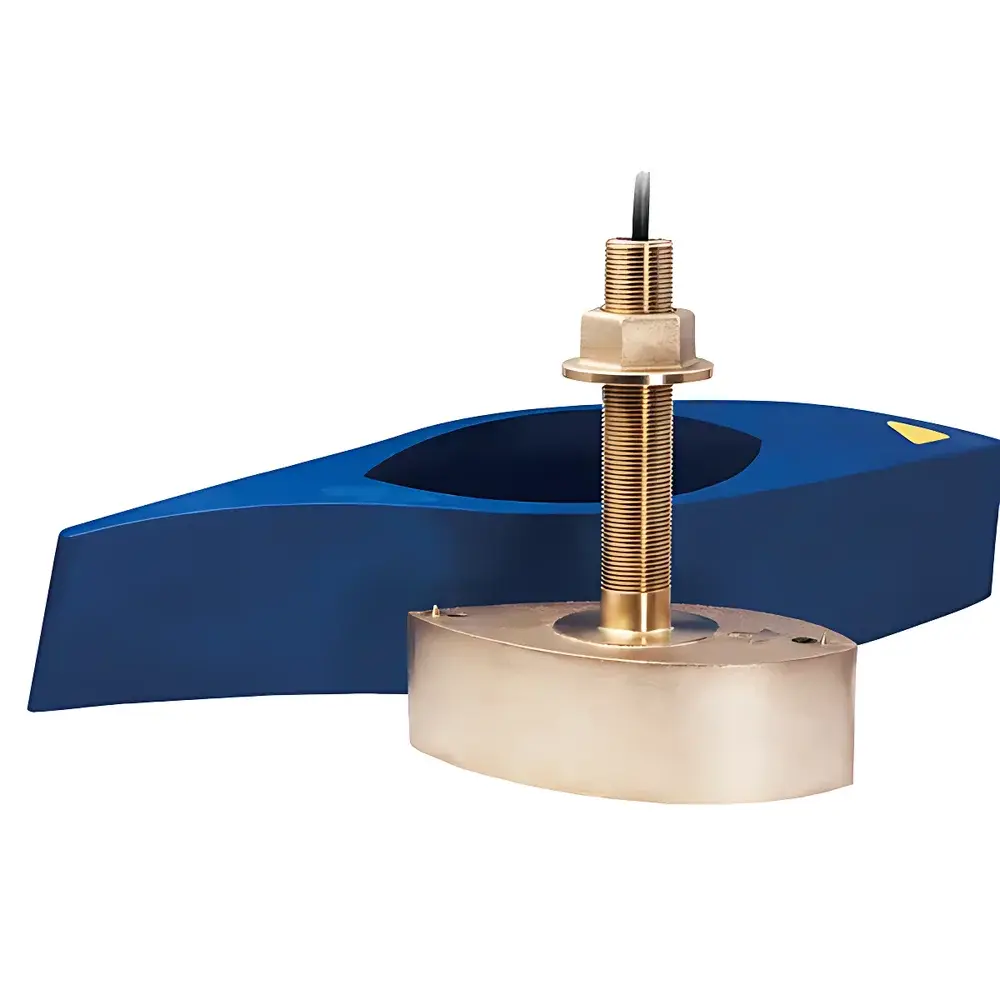
AirMar B265LM Dual-Frequency Chirp Depth Sounder
| Brand | AIRMAR |
|---|---|
| Origin | USA |
| Model | B265LM |
| Frequency Range (Low) | 42–65 kHz, Beamwidth: 25°–16° |
| Frequency Range (Medium) | 85–135 kHz, Beamwidth: 16°–11° |
| Output Power | 1000 W |
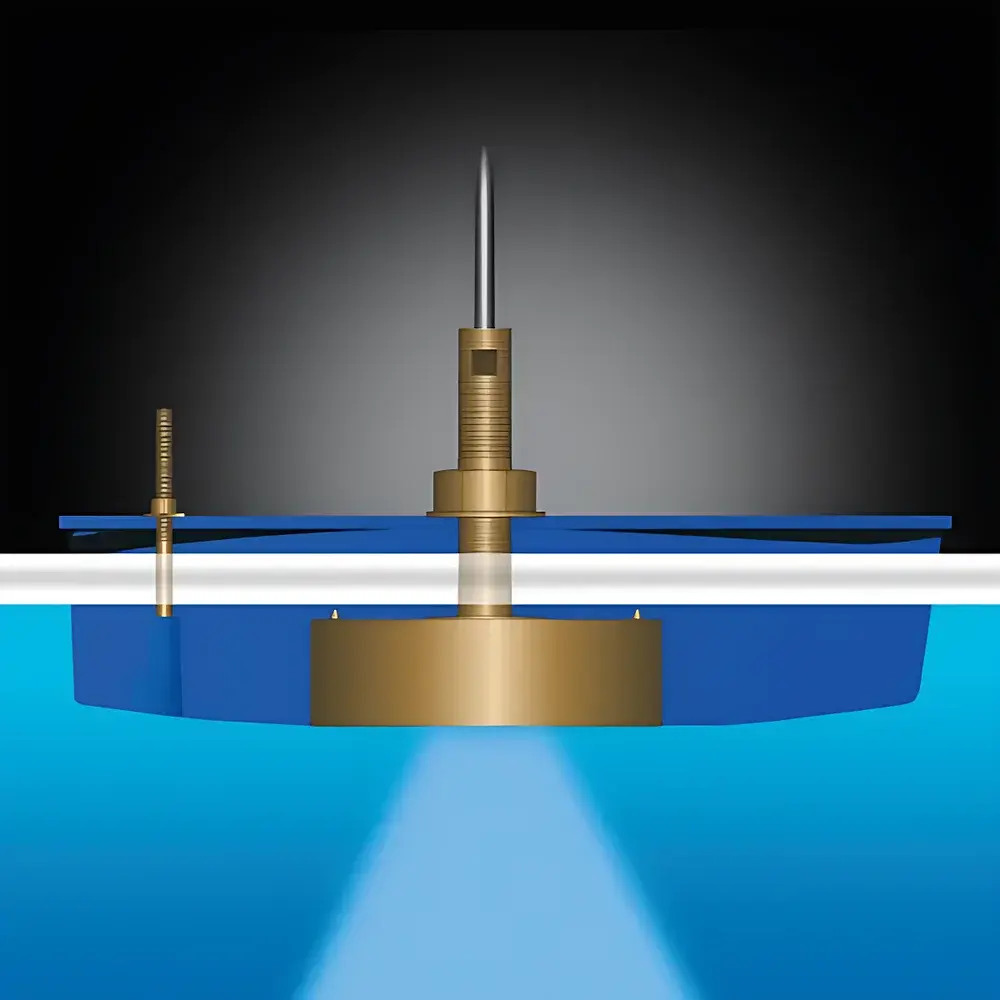
| Installation Type | Through-Hull with Hydrodynamic Fairing |
| Housing Material | Bronze (transducer body), Polyurethane (fairing) |
| Mounting Hole Diameter | 33 mm |
| Shaft Length | 178 mm |
| Cable Length | 10 m |
| Integrated Temperature Sensor | Yes |
| Weight | 7.3 kg |
| Maximum Hull Deadrise Angle | 20° |
| Total Bandwidth | 73 kHz |
| Compatible Hull Types | Fiberglass or Wood |
Overview
The AirMar B265LM is a dual-frequency, through-hull mounted Chirp depth sounder engineered for high-resolution bathymetric profiling and advanced fishery target discrimination in marine environments. Unlike conventional pulse-echo echosounders, the B265LM employs swept-frequency (Chirp) transmission across two discrete broadband bands—low (42–65 kHz) and medium (85–135 kHz)—enabling simultaneous wide-area coverage and fine-scale resolution. Its underlying principle relies on time-of-flight measurement of frequency-modulated acoustic pulses, where matched filtering at the receiver enhances signal-to-noise ratio and axial resolution by up to 10× compared to fixed-frequency systems. Designed for operational depths up to 3,000 meters (10,000 ft), the transducer delivers consistent bottom detection and stratified water column imaging under variable salinity, temperature, and turbidity conditions. The system’s physics-based design supports quantitative interpretation of echo strength, enabling differentiation between biological scatterers (e.g., baitfish schools vs. gamefish) and non-biological features (e.g., rocky outcrops, wrecks, or submerged vegetation).
Key Features
- Dual-band Chirp architecture with independent low- and medium-frequency channels for adaptive surveying across diverse water column conditions
- Patented Xducer ID® technology for automatic transducer recognition and optimized parameter initialization within compatible chartplotter or sonar display systems
- Integrated high-stability thermistor for real-time water temperature measurement—critical for sound velocity correction and depth accuracy calibration
- Hydrodynamically optimized polyurethane fairing that minimizes flow noise and cavitation effects, ensuring stable performance at vessel speeds up to 35 knots
- Bronze transducer housing with corrosion-resistant finish, rated for continuous immersion in seawater per ASTM B117 salt-spray standards
- Through-hull mounting configuration with standardized 33 mm bore diameter, supporting installation on fiberglass and wooden hulls with deadrise angles ≤20°
- 1000 W peak acoustic output power compliant with IEC 62237-2 maritime transducer safety and emission requirements
Sample Compatibility & Compliance
The B265LM is validated for deployment on commercial and research vessels ≥8 m LOA, including small-scale fishing craft, coastal survey platforms, and autonomous surface vehicles (ASVs). It meets ISO 17672:2015 for underwater acoustic transducers and conforms to FCC Part 15 Class B and CE RED Directive 2014/53/EU for electromagnetic compatibility. When integrated into NMEA 2000 networks, it supports full GLP-aligned data logging—including timestamped depth, temperature, GPS position, and raw IQ samples—traceable to UTC via synchronized network time protocol (NTP). The transducer’s mechanical design complies with ABYC TE-27 and ISO 8846 marine electrical safety standards for wet-location installations.
Software & Data Management
The B265LM outputs calibrated depth and temperature values via NMEA 2000 PGNs 128259 (Depth Below Transducer) and 130311 (Environmental Parameters), as well as proprietary binary IQ data streams for post-processing in third-party hydrographic software (e.g., QPS Qimera, SonarWiz, or Echoview). Raw Chirp data retains full spectral fidelity, permitting offline beamforming, target strength estimation, and classification using machine learning pipelines trained on annotated echogram datasets. Firmware updates are delivered via USB-connected multifunction displays or PC-based AirMar Utility Suite, which enforces secure signed firmware validation per NIST SP 800-193 guidelines.
Applications
- Commercial fisheries resource assessment—resolving multi-species aggregations and estimating biomass distribution
- Hydrographic surveying for nautical chart updates and dredging operations in shallow-to-deep continental shelf zones
- Underwater infrastructure inspection—including pipeline route clearance, cable burial verification, and offshore wind farm site characterization
- Acoustic habitat mapping for marine protected area (MPA) monitoring and ecosystem-based management frameworks
- Scientific studies of diel vertical migration, plankton layer dynamics, and mesopelagic scattering layers
- Integration into unmanned surface vessel (USV) platforms for persistent, low-cost bathymetric data acquisition
FAQ
Does the B265LM require external calibration for depth accuracy?
No—factory calibration includes hydrostatic pressure compensation, temperature-dependent sound speed lookup tables, and beam angle correction coefficients. Field recalibration is not required unless mechanical damage or replacement of the temperature sensor occurs.
Can the B265LM be installed on aluminum hulls?
No—this model is certified only for fiberglass and wood hulls. Aluminum hulls require electrically isolated mounting solutions and alternative transducer models (e.g., B265L-AL) to prevent galvanic corrosion and RF interference.
Is raw IQ data accessible for academic research use?
Yes—when connected to compatible displays or data loggers supporting AirMar’s extended binary protocol, full complex-valued IQ samples (I/Q format, 16-bit resolution, user-selectable decimation rates) are streamed in real time for offline analysis.
What is the maximum recommended vessel speed for optimal bottom tracking?
For consistent 3,000 m bottom lock and minimal multipath distortion, sustained speeds should remain below 25 knots in calm seas; hydrodynamic fairing performance has been verified up to 35 knots in controlled tank testing.
How does Xducer ID® improve system interoperability?
Xducer ID® embeds immutable transducer metadata—including frequency response curves, beam pattern coefficients, and serial-number-referenced calibration files—into the NMEA 2000 stream, eliminating manual configuration errors during integration with multifunction displays or sonar processors.