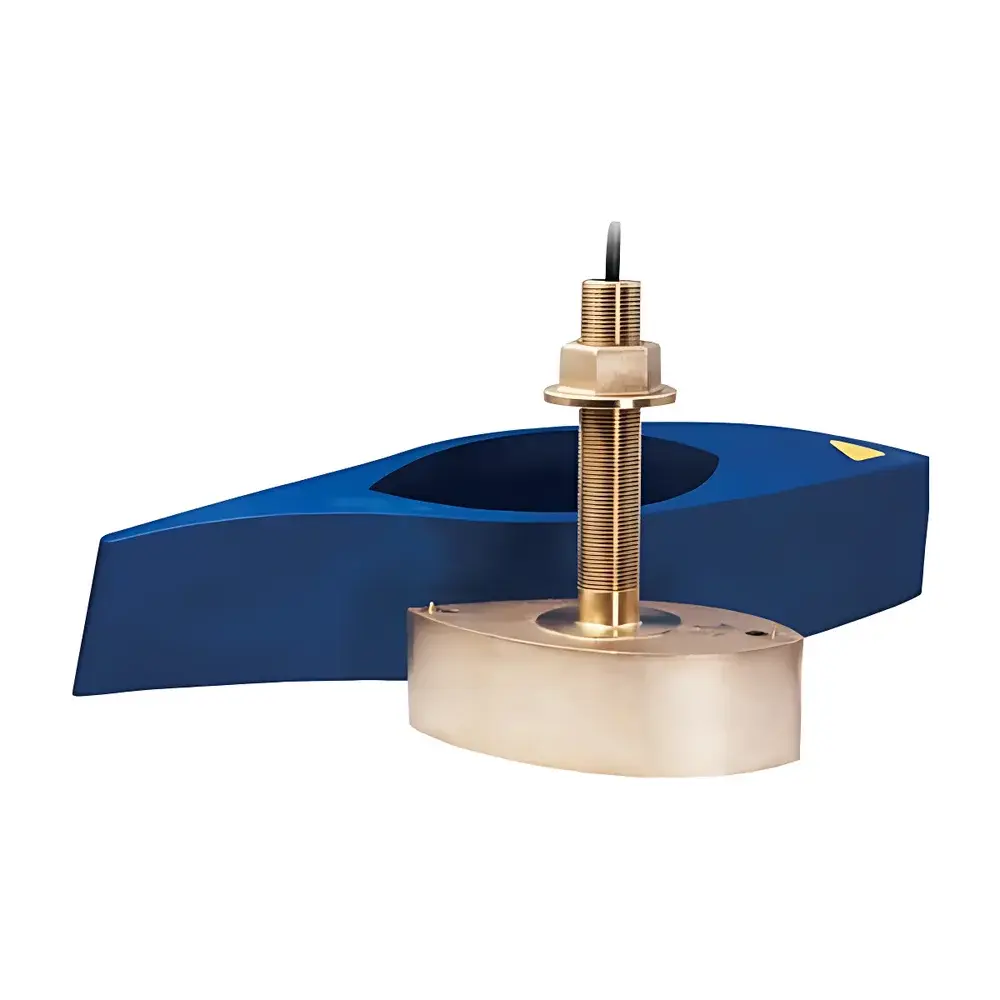
AIRMAR B275LHW Dual-Frequency CHIRP Through-Hull Depth Sounder
| Brand | AIRMAR |
|---|---|
| Origin | USA |
| Model | B275LHW |
| Power | 1000 W |
| Frequency Range | Low Band 42–65 kHz, High Wideband 150–250 kHz |
| Beam Width | Low Band 25°–16°, High Wideband 25° (constant) |
| Max Depth | Low Band 914 m, High Wideband 152 m |
| Housing Material | Bronze |
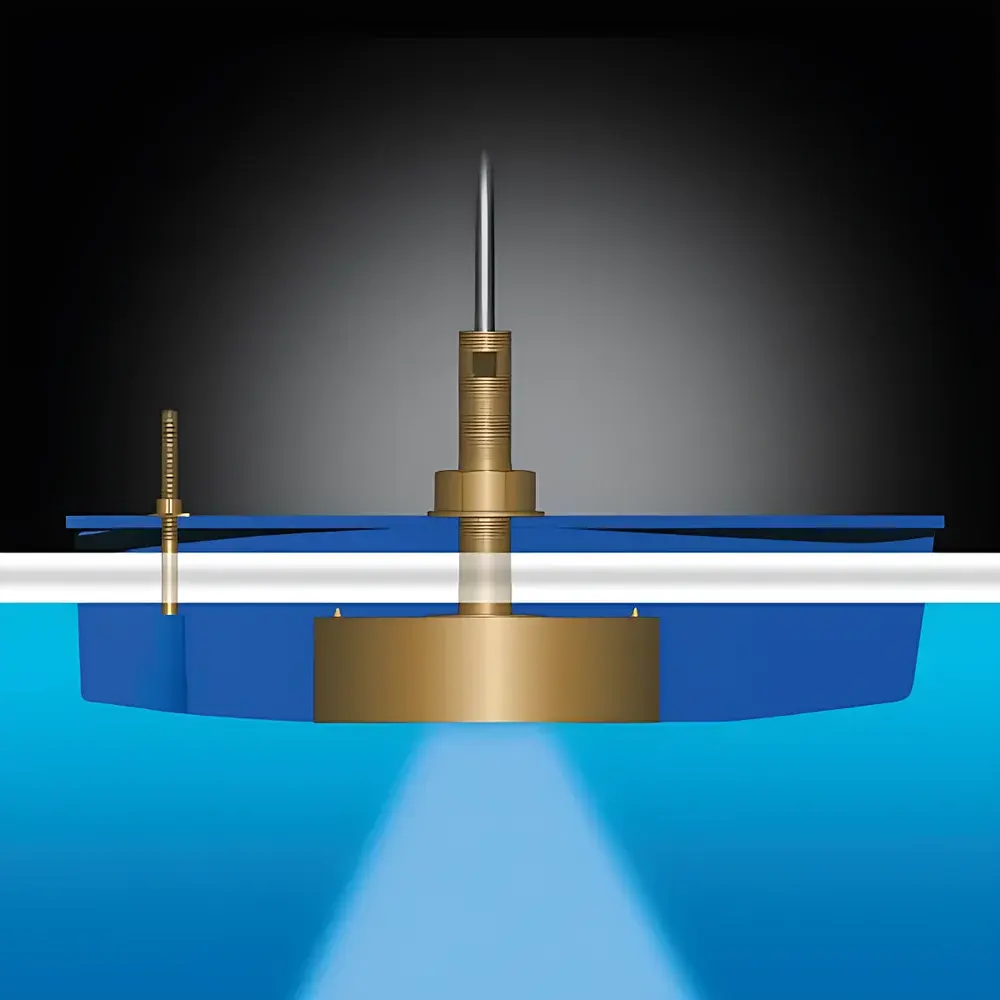
| Mounting Type | Through-hull with high-performance fairing |
| Transducer Window | Polyurethane |
| Hole Diameter | 30 mm |
| Shaft Length | 121 mm |
| Maximum Hull Tilt | 20° (with fairing) |
| Compatible Hull Materials | Fiberglass or wood |
| Minimum Vessel Length | 8 m |
| Weight | 7.3 kg |
| Temperature Sensor | Integrated fast-response water temperature sensor |
| Total Frequency Span | 123 kHz |
| Compliance | CE, FCC, RCM, UKCA |
Overview
The AIRMAR B275LHW is a dual-frequency CHIRP through-hull transducer engineered for professional marine applications requiring simultaneous high-resolution shallow-water imaging and robust deep-water echo sounding. Utilizing swept-frequency (CHIRP) sonar technology—where transmitted pulses linearly sweep across a defined bandwidth—the B275LHW achieves significantly improved target separation, signal-to-noise ratio, and depth discrimination compared to traditional fixed-frequency ping-based systems. Its dual-band architecture integrates two acoustically independent elements within a single bronze housing: a low-frequency (42–65 kHz) channel optimized for penetration and bottom detection in depths up to 914 meters, and a high-wideband (150–255 kHz) channel delivering constant 25° beamwidth across its entire range for consistent lateral coverage and superior fish arch definition in waters down to 152 meters. The transducer’s CHIRP waveform design conforms to industry-standard pulse compression protocols used in modern multibeam and single-beam echosounders, enabling compatibility with NMEA 2000–enabled chartplotters and sonar processors supporting CHIRP data streaming (e.g., Raymarine Axiom+, Garmin GPSMAP series, Simrad NSS Evo3).
Key Features
- Dual-band CHIRP operation: Independent low-band (42–65 kHz) and high-wideband (150–250 kHz) channels housed in a single compact bronze assembly
- Constant 25° beamwidth across the full high-wideband spectrum—enabling uniform swath coverage and enhanced midwater fish detection without beam narrowing artifacts
- Integrated fast-response thermistor for real-time water temperature measurement, calibrated per NIST-traceable standards
- 1 kW peak acoustic output power with optimized impedance matching for efficient energy transfer into seawater (1500 m/s sound speed) and freshwater (1480 m/s)
- High-performance hydrodynamic fairing rated for sustained vessel speeds exceeding 30 knots (34 mph), minimizing flow noise and cavitation-induced signal degradation
- Through-hull mounting configuration with 30 mm bore requirement; compatible with fiberglass and wood hulls ≥8 m in length and ≤20° deadrise angle (with fairing)
- Xducer ID® digital identification protocol for automatic transducer parameter loading and firmware-assisted calibration on supported displays
Sample Compatibility & Compliance
The B275LHW is designed for deployment on commercial fishing vessels, research survey platforms, and recreational offshore craft operating in coastal, continental shelf, and open-ocean environments. It meets electromagnetic compatibility requirements under FCC Part 15 Subpart B (USA), CE RED Directive 2014/53/EU (EU), RCM Mark (Australia/NZ), and UKCA marking standards. Its mechanical construction complies with ISO 8846:2018 (Marine equipment — Electrical devices — Resistance to ignition of flammable gases) and ABYC E-11 (Boat Electrical Systems Standard). The polyurethane acoustic window exhibits long-term stability in saline immersion per ASTM D543-20 and resists biofouling accumulation under typical antifouling coatings. No hazardous substances are present above RoHS 2 (2011/65/EU) threshold limits.
Software & Data Management
When interfaced with CHIRP-capable display units via NMEA 2000, the B275LHW supports raw IQ data output (in accordance with NMEA 2000 PGN 128267 and 128277), allowing post-processing using third-party software such as SonarTRX, QPS Qimera, or Hypack MAX for bathymetric gridding and target classification. Firmware updates are delivered via AIRMAR’s Xducer Manager utility (Windows/macOS), which logs operational hours, thermal history, and diagnostic flags—including transducer element continuity, impedance drift, and temperature sensor offset verification. All configuration changes are timestamped and stored with audit-trail capability suitable for GLP-compliant field data acquisition workflows.
Applications
- Commercial pelagic and demersal fishery stock assessment—leveraging wide-swath midwater coverage for school detection and biomass estimation
- Pre-survey bathymetric reconnaissance for ROV/AUV deployment zones, particularly where rapid depth profiling over variable substrates is required
- Shallow-water habitat mapping in estuarine and reef environments, benefiting from high-frequency bottom contour resolution and sediment layer differentiation
- Underwater infrastructure inspection (e.g., pipeline route surveys, mooring anchor verification) where dual-depth capability reduces need for transducer swaps
- Academic oceanographic studies requiring synchronized depth + temperature time-series at fixed station intervals
FAQ
Does the B275LHW support both freshwater and saltwater operation?
Yes—the transducer’s broadband frequency response and impedance compensation are validated for sound speed ranges between 1440 m/s (cold freshwater) and 1540 m/s (warm tropical seawater).
Is the integrated temperature sensor NIST-traceable?
The thermistor is factory-calibrated against NIST SRM 1750 reference standards; calibration certificates are available upon request for QA/QC documentation.
Can this transducer be used with non-CHIRP chartplotters?
No—it requires a CHIRP-enabled processor capable of interpreting swept-frequency return signals; legacy 50/200 kHz-only displays will not recognize or drive the unit.
What is the minimum recommended vessel length for optimal performance?
AIRMAR specifies ≥8 meters LOA to ensure adequate hull rigidity, reduced vibration coupling, and sufficient clearance for fairing installation without flow separation.
How does the constant 25° beamwidth improve fish arch interpretation?
Unlike conventional high-frequency transducers that narrow beamwidth at higher frequencies—causing inconsistent target height and positional smearing—the B275LHW’s fixed angular coverage ensures geometrically accurate arch morphology across the full 150–250 kHz band, critical for species identification algorithms.