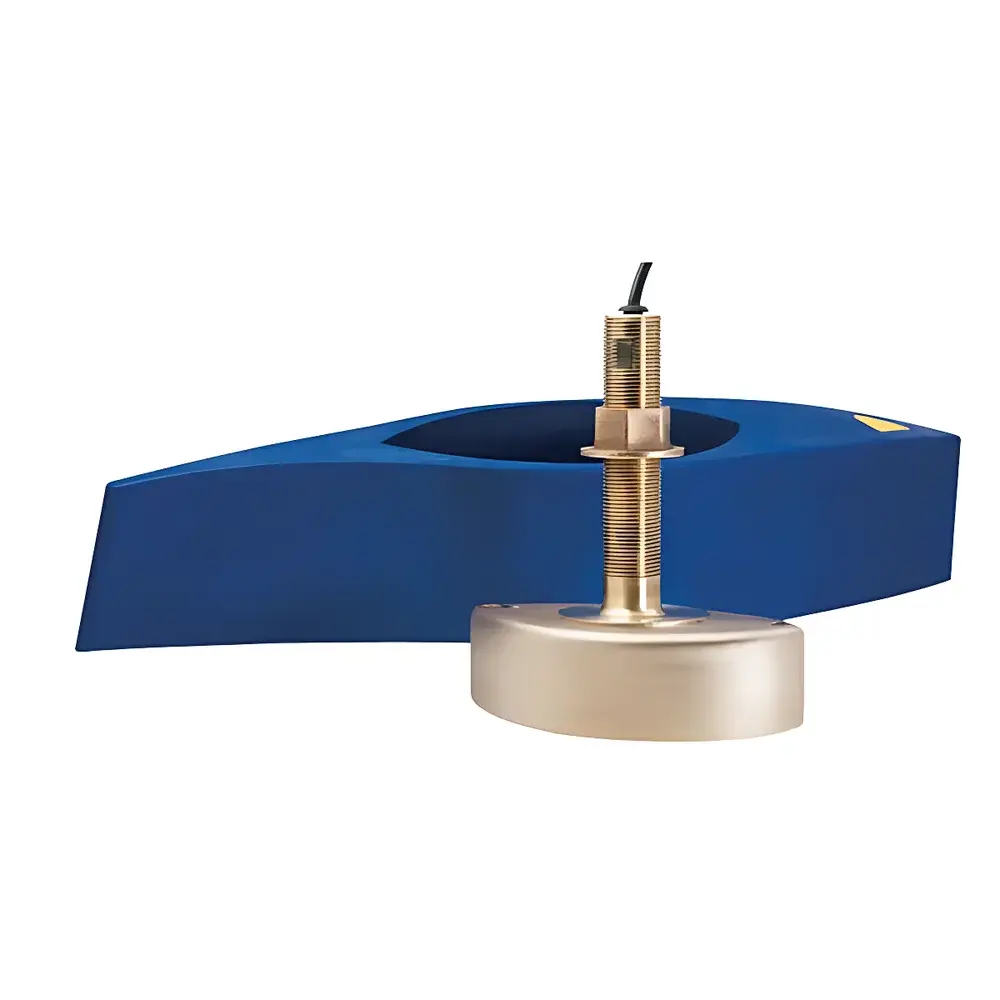
AirMar B285HW Wide-Beam Chirp Depth Sounder
| Brand | Airmar |
|---|---|
| Origin | USA |
| Model | B285HW |
| Operating Frequency Range | 150–250 kHz |
| Beam Width | 25° (fixed) |
| Transmit Power | 1000 W |
| Maximum Depth Rating | 240 m |
| Transducer Housing Material | Bronze |
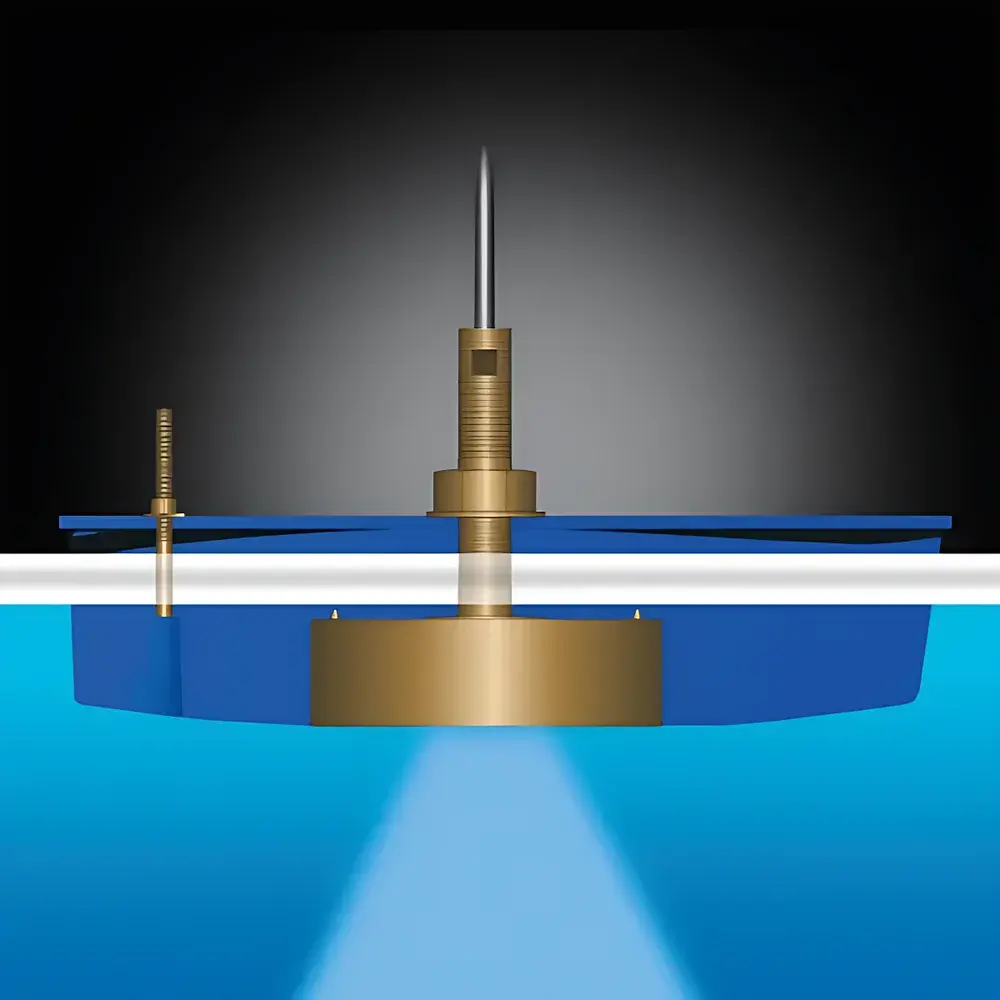
| Mounting Type | Through-hull with fairing |
| Hull Cutout Diameter | 51 mm |
| Stub Length | 97 mm |
| Cable Length | 10 m |
| Integrated Temperature Sensor | Yes |
| Transducer Weight | 2.5 kg |
| Maximum Hull Deadrise Angle | 24° |
| Acoustic Window Material | Polyurethane |
| Xducer ID® Technology | Yes |
| Compatible Vessel Length | Up to 9 m |
Overview
The AirMar B285HW is a through-hull mounted, wide-beam CHIRP (Compressed High-Intensity Radar Pulse) depth sounder engineered for high-fidelity bathymetric profiling and real-time target discrimination in marine environments. Unlike conventional single-frequency echosounders, the B285HW employs swept-frequency CHIRP technology across a calibrated 150–250 kHz bandwidth, enabling simultaneous transmission of long-duration, low-power pulses with linear frequency modulation. This architecture significantly improves signal-to-noise ratio (SNR), range resolution, and target separation capability—particularly critical when distinguishing closely spaced biological targets (e.g., baitfish schools vs. gamefish) or resolving subtle bathymetric features such as drop-offs, wrecks, or submerged vegetation. The transducer’s fixed 25° conical beam provides consistent spatial coverage independent of depth, delivering up to twice the seabed swath width compared to narrow-beam alternatives at equivalent installation depths. Designed for vessels up to 9 meters in length, the B285HW integrates a factory-calibrated, fast-response thermistor for concurrent water temperature measurement—supporting density correction in depth calculations and environmental monitoring workflows.
Key Features
- CHIRP broadband operation (150–250 kHz) with optimized pulse compression for enhanced vertical and horizontal resolution
- Fixed 25° beam angle ensures uniform coverage geometry and eliminates beam-angle variability errors common in variable-beam systems
- 1000 W peak transmit power enables reliable bottom detection to 240 m in standard seawater conditions (1540 m/s sound speed)
- Through-hull mounting configuration with integrated hydrodynamic fairing minimizes flow noise and cavitation artifacts
- Bronze housing with polyurethane acoustic window offers corrosion resistance, mechanical durability, and optimal acoustic impedance matching
- Xducer ID® technology enables automatic transducer identification and parameter loading in compatible multifunction displays (MFDs), reducing setup time and configuration errors
- Integrated NTC thermistor (±0.5°C accuracy, 1-second response time) co-located with the acoustic element for precise in-situ temperature measurement
- Optimized for deadrise angles up to 24°, supporting installation on planing hulls and semi-displacement vessels without performance degradation
Sample Compatibility & Compliance
The B285HW is designed for use in freshwater, brackish, and saltwater environments with sound speed ranges from 1450 to 1550 m/s. Its bronze housing meets ASTM B150/B150M specifications for naval brass alloys, ensuring long-term immersion integrity. The polyurethane acoustic window complies with ISO 18434-1 for ultrasonic transducer materials, exhibiting low attenuation (<0.5 dB/mm at 200 kHz) and stable acoustic velocity (2300 ± 30 m/s). The transducer conforms to IEC 62287-1 for echo sounder safety and EMC requirements, and supports NMEA 2000 (IEC 61162-3) digital interface protocols for seamless integration into marine electronics networks. While not certified for Class I Div 1 hazardous locations, it complies with UL 1101 marine electrical standards and is suitable for GLP-aligned hydrographic survey applications where traceable calibration and repeatable installation are required.
Software & Data Management
The B285HW outputs raw echo data and processed depth/temperature values via NMEA 2000 PGNs 128259 (Depth Below Transducer), 128267 (Water Temperature), and 127250 (Transducer Identification). When paired with supported MFDs (e.g., Garmin GPSMAP, Raymarine Axiom, Furuno TZtouch), users access real-time CHIRP sonar imaging, bottom hardness estimation, and fish arch interpretation algorithms. All sensor metadata—including frequency sweep parameters, beam geometry, and Xducer ID® registration—are stored in non-volatile memory and retrievable via diagnostic queries. Firmware updates are delivered through standard NMEA 2000 firmware update PGNs (126208), ensuring field-upgradability without hardware modification. Audit trails for configuration changes are maintained per device log—not externally synchronized—making the unit compatible with basic GLP documentation practices where timestamped setup records are retained manually.
Applications
- Commercial and recreational fisheries: Discrimination of pelagic biomass layers, identification of thermocline boundaries, and mapping of benthic habitat complexity
- Hydrographic survey support: Shallow-water bathymetry (≤240 m) for charting, dredging planning, and coastal zone management
- Scientific limnology: Long-term water column profiling in lakes and reservoirs, including seasonal temperature stratification studies
- Vessel performance optimization: Real-time depth and temperature feedback for trim and draft adjustment in dynamic loading scenarios
- Underwater infrastructure inspection: Detection and characterization of submerged pilings, pipelines, and debris fields in port and marina environments
FAQ
What is the maximum operational depth for the B285HW?
The B285HW is rated for continuous operation to 240 meters in seawater under nominal sound speed conditions (1540 m/s); bottom detection beyond this depth may occur under favorable propagation conditions but is not guaranteed.
Does the B285HW require external cooling or water flow?
No—the transducer is passively cooled via thermal conduction through the bronze housing and hull interface; no dedicated water flush or forced-air system is required.
Can the B285HW be installed on fiberglass or aluminum hulls?
Yes, provided the hull deadrise does not exceed 24° and the through-hull opening (51 mm diameter) is precisely drilled with proper backing plates and sealant application per Airmar installation guidelines.
Is the temperature sensor independently calibrated?
Yes—the NTC thermistor is factory-calibrated against NIST-traceable reference standards and maintains stability within ±0.5°C over its operational range (−5 to +40°C).
How does CHIRP improve resolution compared to traditional 200 kHz sonar?
By transmitting longer, frequency-modulated pulses and applying matched filtering during reception, CHIRP achieves effective pulse compression—yielding up to 10× better range resolution than equivalent-power FM-CW or pulsed systems operating at fixed frequencies.