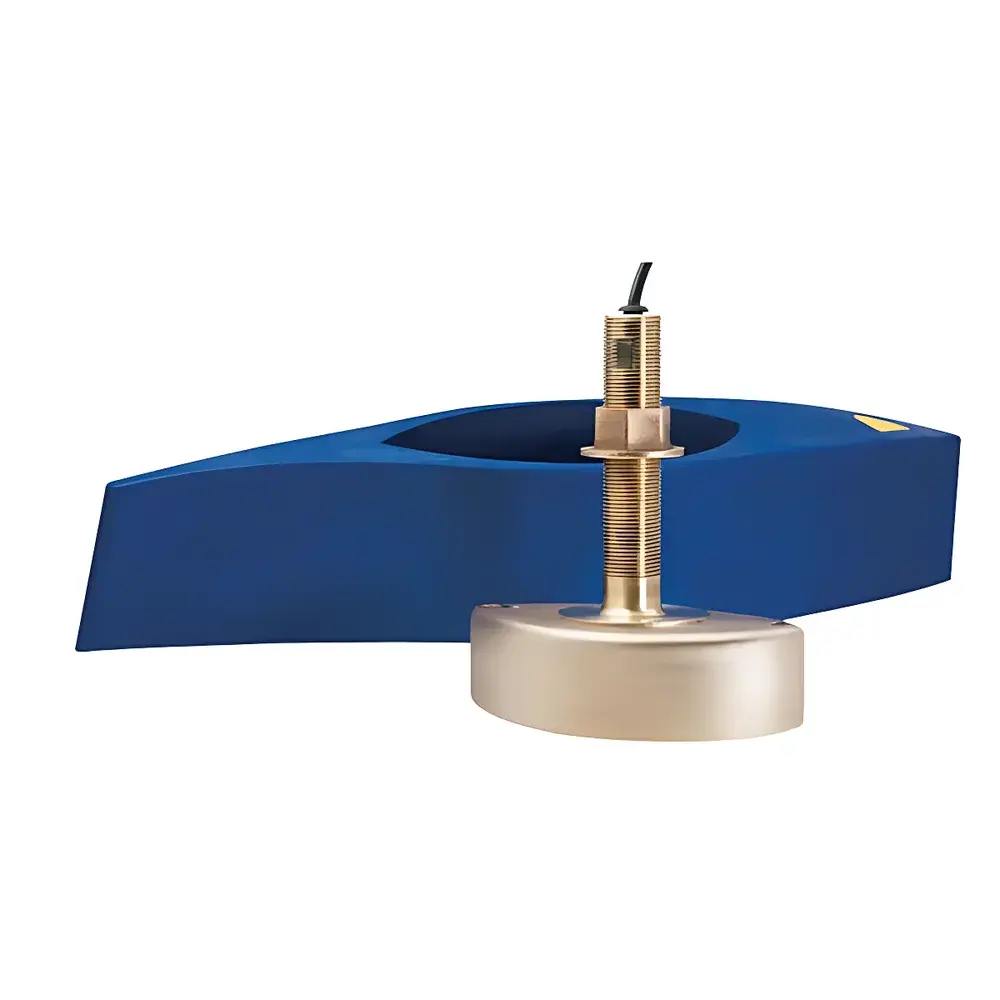
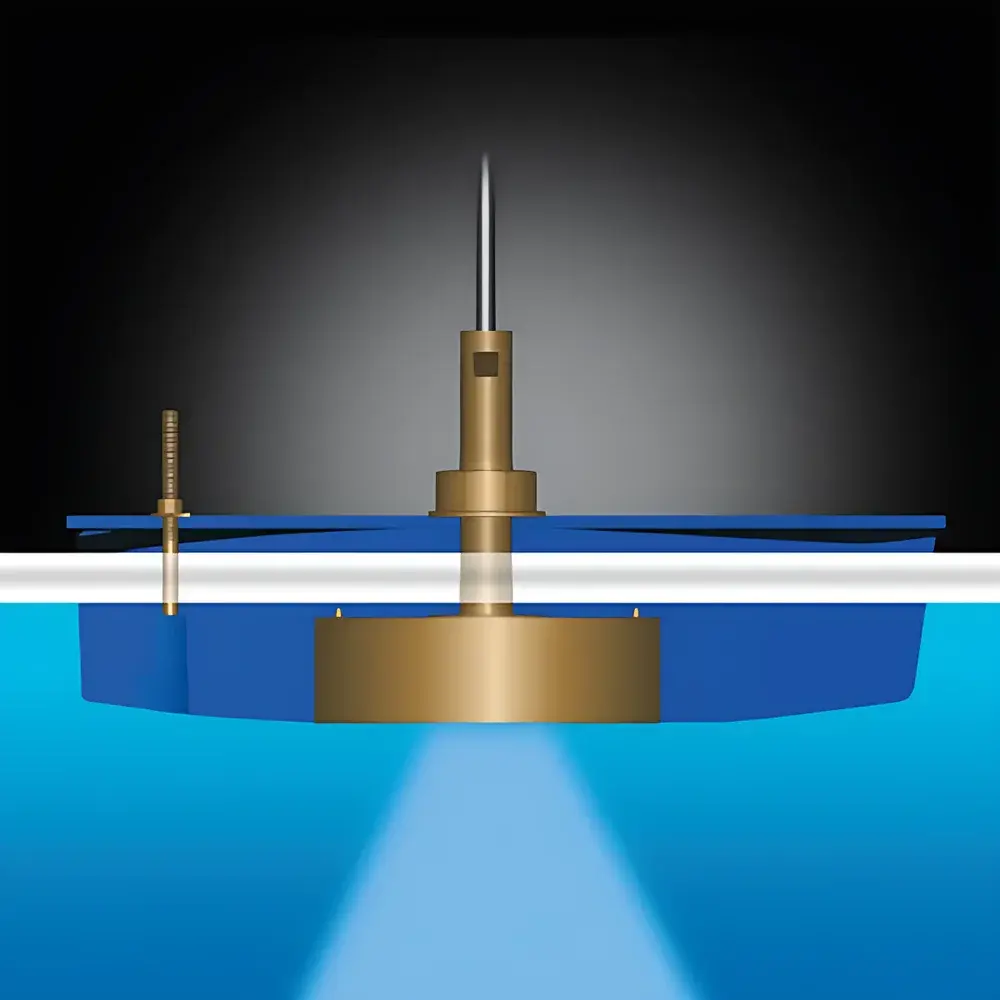
AirMar B285M Medium-Frequency Chirp Depth Sounder Transducer
| Brand | AIRMAR |
|---|---|
| Origin | USA |
| Model | B285M |
| Operating Frequency Range | 85–135 kHz |
| Beamwidth | 16°–11° (variable with frequency) |
| Transmit Power | 1000 W |
| Installation Type | Through-Hull with Fairing |
| Housing Material | Bronze |
| Acoustic Window | Polyurethane |
| Mounting Hole Diameter | 51 mm |
| Stub Length | 97 mm |
| Cable Length | 10 m |
| Integrated Temperature Sensor | Yes |
| Maximum Hull Deadrise Angle | 24° |
| Weight | 2.5 kg |
| Target Detection Depth | Up to 3000 m (10,000 ft) |
| Recommended Vessel Length | ≤ 9 m |
| Compliance | CE, FCC, RoHS |
Overview
The AirMar B285M is a through-hull mounted, medium-frequency (85–135 kHz) broadband Chirp depth sounder transducer engineered for high-resolution bathymetric profiling and fish detection in coastal, offshore, and inland freshwater environments. Unlike conventional pulsed sonar systems, the B285M employs frequency-modulated continuous-wave (FMCW) Chirp technology—transmitting a linearly swept signal across its operational bandwidth. This approach delivers significantly improved range resolution, signal-to-noise ratio (SNR), and target discrimination capability. By maintaining constant acoustic power over an extended frequency sweep, the transducer achieves up to 10× greater detail in echo returns compared to legacy narrowband echosounders of equivalent power. Its 1000 W peak transmit power, combined with a variable beamwidth (16° at lower frequencies tapering to 11° at higher frequencies), enables optimized performance across varying water depths—from shallow (<50 m) turbid lakes to moderate-depth continental shelf zones (up to ~450 m). The unit integrates a calibrated, fast-response thermistor-based water temperature sensor co-located with the acoustic element, supporting real-time sound velocity correction in post-processing or compatible chartplotter firmware.
Key Features
- Medium-frequency Chirp operation (85–135 kHz) balances penetration depth, lateral resolution, and sensitivity to biological targets
- 1000 W high-power output ensures robust signal return from deep or acoustically attenuating environments (e.g., sediment-laden or cold-water columns)
- Variable beamwidth (16°–11°) dynamically adapts to frequency selection, preserving angular resolution across the sweep
- Through-hull mounting configuration with integrated hydrodynamic fairing minimizes flow noise and cavitation risk at vessel speeds up to 35 knots
- Bronze housing and polyurethane acoustic window provide marine-grade corrosion resistance and optimal acoustic impedance matching to seawater
- Xducer ID® technology enables automatic transducer recognition and parameter auto-configuration when connected to compatible NMEA 2000 or Ethernet-enabled displays
- Integrated high-accuracy water temperature sensor (±0.5°C typical) supports sound speed compensation per ISO 18930 and IHO S-44 standards
Sample Compatibility & Compliance
The B285M is designed for deployment on fiberglass, aluminum, and wood hulls with deadrise angles up to 24°, accommodating common recreational and light-commercial vessel geometries. Its 51 mm through-hull bore requirement and 97 mm stub length ensure compatibility with standard mounting kits used across major marine electronics platforms (e.g., Garmin, Raymarine, Lowrance, Simrad). The transducer meets electromagnetic compatibility (EMC) requirements under FCC Part 15 Subpart B and EU Directive 2014/53/EU (Radio Equipment Directive), carries CE marking, and complies with RoHS 2011/65/EU for hazardous substance restrictions. While not certified to formal GLP or ISO/IEC 17025 laboratory standards—given its field-deployed operational context—it adheres to measurement traceability principles outlined in ISO 18930:2019 (Hydrographic survey equipment – Performance standards for echosounders) and supports data acquisition workflows compliant with IHO S-44 Special Order specifications when paired with calibrated display units.
Software & Data Management
The B285M operates as a sensor-level device without embedded firmware or local storage. All signal processing—including pulse compression, matched filtering, time-varied gain (TVG), and bottom detection—is performed externally by the host display or multifunction processor (e.g., Garmin GPSMAP series, Raymarine Axiom+, Simrad NSS Evo3). Raw analog echo data is not accessible; instead, the transducer delivers digitized depth, temperature, and confidence-indexed target information via NMEA 2000 (PGN 128267, 128275, 128276) or proprietary Ethernet protocols. For archival or scientific analysis, third-party software such as SonarTRX, QPS Qimera, or Hypack can ingest processed NMEA streams or vendor-specific log formats. Audit trails, calibration logs, and configuration history are maintained exclusively within the host system—not the transducer—and must conform to user-defined data governance policies, including optional timestamping aligned to UTC via GNSS synchronization.
Applications
- Recreational and commercial nearshore fisheries: precise identification of baitfish schools, gamefish layers, and submerged structures (rock piles, wrecks, vegetation edges)
- Freshwater lake and reservoir mapping: high-fidelity bathymetry generation for habitat modeling and invasive species monitoring
- Coastal hydrographic reconnaissance: rapid depth verification and obstacle detection prior to full-survey mobilization
- ROV/AUV auxiliary depth reference: integration into small-unmanned surface vessel (USV) navigation stacks where size, weight, and power constraints apply
- Educational marine science programs: hands-on instruction in acoustic propagation, signal processing fundamentals, and echogram interpretation
FAQ
Does the B285M require a specific display brand or model to function?
No—the transducer is NMEA 2000 compliant and interoperable with any display supporting PGN 128267 (Depth Below Transducer) and PGN 128275 (Water Temperature). However, full Chirp waveform processing and split-beam or side-scan overlay capabilities depend on host firmware version and hardware acceleration.
Can the B285M be installed on a planing hull with >24° deadrise?
Not without an external tilt-mount adapter. Exceeding the specified 24° deadrise angle compromises beam alignment and introduces vertical misregistration in depth calculations per IHO S-44 Annex D.
Is raw IQ data accessible for custom signal processing?
No—this transducer outputs only processed, depth-encoded NMEA messages. For access to baseband IQ samples, AirMar’s B265L (low-frequency) or B275L (dual-frequency) models with Ethernet interface are recommended.
How often should the polyurethane acoustic window be inspected for degradation?
Annual visual inspection is advised; replacement is required if micro-cracking, discoloration, or surface erosion exceeds 0.2 mm depth, as these defects induce >3 dB insertion loss above 100 kHz.
Does the integrated temperature sensor meet ASTM D5128-16 accuracy requirements for hydrographic applications?
Yes—the thermistor assembly is factory-calibrated to ±0.3°C from 0–30°C and ±0.5°C from 30–40°C, satisfying the precision threshold specified in ASTM D5128-16 Section 7.3.2 for in-situ water column profiling.