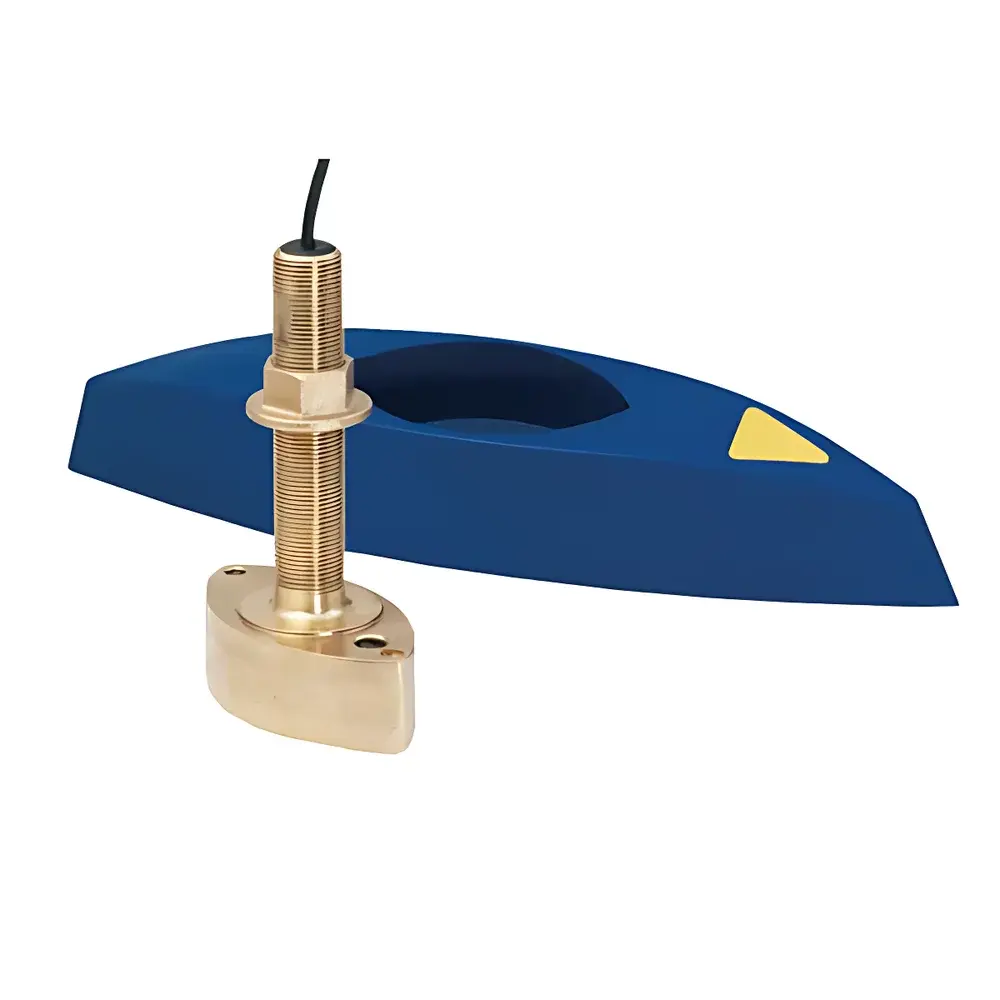
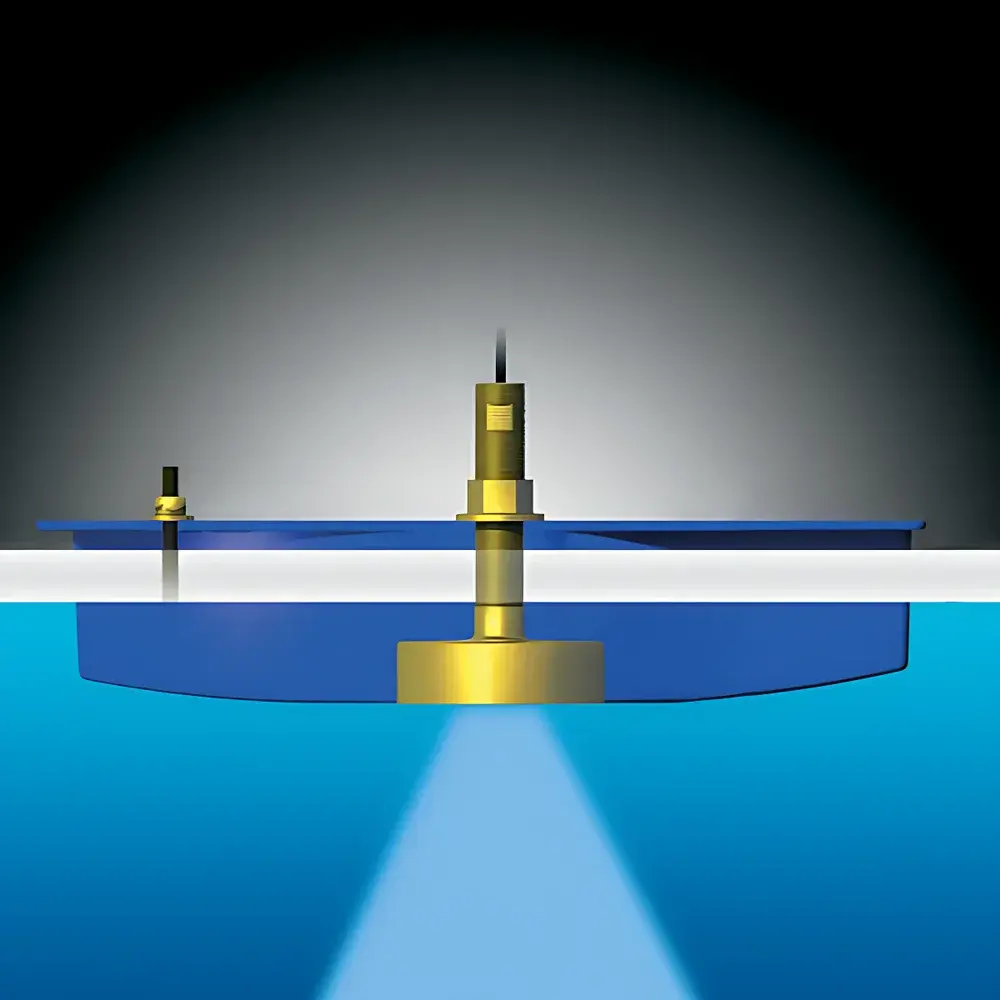
AirMar B45 Through-Hull Depth Sounder
| Brand | AirMar |
|---|---|
| Origin | USA |
| Model | B45 |
| Transducer Material | Bronze |
| Mounting Type | Through-Hull |
| Operating Frequencies | 50 kHz / 200 kHz |
| Beamwidth | 45° @ 50 kHz, 12° @ 200 kHz |
| Output Power | 600 W |
| Temperature Sensor Accuracy | ±0.2°C |
| Cable Length | 10 m |
| Housing Diameter (Hole Size) | 22 mm |
| Stem Length | 92 mm |
| Maximum Hull Tilt Angle | 26° |
| Acoustic Window Material | Polyurethane |
| Weight | 2.5 kg |
Overview
The AirMar B45 Through-Hull Depth Sounder is a compact, high-reliability echosounder transducer engineered for precise depth measurement and bottom contour mapping in marine environments. Utilizing dual-frequency pulse-echo ultrasonic principles—operating simultaneously at 50 kHz (long-range, wide-beam penetration) and 200 kHz (high-resolution, narrow-beam detail)—the B45 delivers robust acoustic performance across variable water column conditions. Its through-hull installation architecture eliminates external hull protrusions, minimizing drag and hydrodynamic interference while maintaining optimal acoustic coupling via direct metal-to-water contact through the bronze housing. Designed for integration with NMEA 2000 or analog depth display systems, the B45 complies with IEC 62288 (Maritime navigation and radiocommunication equipment – General requirements – Methods of testing and required test results) for underwater acoustic transducers used in safety-critical vessel instrumentation.
Key Features
- Ultra-compact through-hull form factor—smallest in AirMar’s marine transducer portfolio—enabling installation on vessels with limited internal hull space or structural constraints.
- Bronze housing provides superior corrosion resistance in saltwater and brackish environments, ensuring long-term dimensional stability and acoustic impedance matching.
- Dual-frequency operation (50/200 kHz) supports both deep-water profiling (up to 300 m at 50 kHz) and shallow-water high-definition seabed imaging (down to 1 m resolution at 200 kHz), configurable per host display unit.
- Integrated fast-response thermistor with ±0.2°C accuracy enables real-time water temperature compensation—critical for sound velocity correction in depth calculation algorithms per ISO 17025-compliant calibration protocols.
- Polyurethane acoustic window minimizes signal attenuation and cavitation noise, especially under high-speed planing conditions; compatible with optional AirMar high-performance fairings cut to match specific hull curvature profiles.
- Rated for hull tilt angles up to 26°—validated per ABYC H-27 (Boat Electrical Systems) mechanical mounting tolerances—ensuring consistent beam alignment without recalibration.
Sample Compatibility & Compliance
The B45 is validated for use on fiberglass, aluminum, and steel monohull vessels with planing or semi-displacement hull forms up to 9 m (30 ft) LOA. It is not recommended for wood-core or cored composite hulls without structural reinforcement around the mounting aperture. The transducer meets RoHS 2 (2011/65/EU) material restrictions and carries CE marking for EMC Directive 2014/30/EU compliance. Installation adheres to ISO 8846:1990 (Marine equipment — Electrical apparatus — Safety requirements) and supports traceable calibration documentation per ISO/IEC 17025 when paired with certified depth display units.
Software & Data Management
While the B45 itself is an analog/NMEA 2000 sensor (no embedded firmware or onboard storage), it interfaces seamlessly with chartplotter platforms including Garmin, Raymarine, Furuno, and Simrad that support NMEA 0183 depth sentence (DPT) and NMEA 2000 PGN 128259 (Water Depth). Raw echo data is accessible via proprietary vendor software (e.g., Garmin HomePort, Raymarine LightHouse) for post-mission bathymetric analysis, bottom hardness estimation, and temperature-depth profile generation. Audit trails for depth-derived operational logs are maintainable under GLP-aligned vessel monitoring systems where timestamped NMEA streams are archived.
Applications
- Commercial and recreational powerboat navigation—especially on high-speed planing craft where hydrodynamic stability and minimal drag are critical.
- Coastal survey support for small-vessel hydrographic teams performing nearshore bathymetry updates within harbor approaches and estuarine channels.
- Scientific buoy networks requiring low-power, corrosion-resistant depth sensing with integrated water temperature telemetry.
- Autonomous surface vehicle (ASV) integration where size, weight, and through-hull mechanical integrity are prioritized over broadband sonar capability.
- Regulatory compliance logging for inland waterway transit authorities requiring verified depth-under-keel (DUK) records during draft-sensitive lock transits.
FAQ
Can the B45 be installed on a cored fiberglass hull?
No—installation requires solid laminate or reinforced backing plate to prevent delamination under acoustic loading; consult ABYC TE-12 guidelines for core penetration reinforcement.
Is the temperature sensor calibrated to NIST-traceable standards?
The thermistor is factory-calibrated to ±0.2°C; full NIST-traceable recalibration requires third-party metrology lab service per ISO/IEC 17025.
Does the B45 support CHIRP or broadband frequency sweeping?
No—it operates at fixed 50 kHz and 200 kHz carrier frequencies only; CHIRP capability requires AirMar’s B260 or TM265 series transducers.
What is the minimum water speed for reliable echo return?
No minimum speed required—the transducer functions identically at zero speed (e.g., docking, anchoring) and at planing speeds up to 50 knots.
Can the polyurethane window be replaced in-field?
Yes—AirMar supplies replacement acoustic windows (P/N B45-WIN) with torque-specified installation instructions to preserve acoustic coupling integrity.