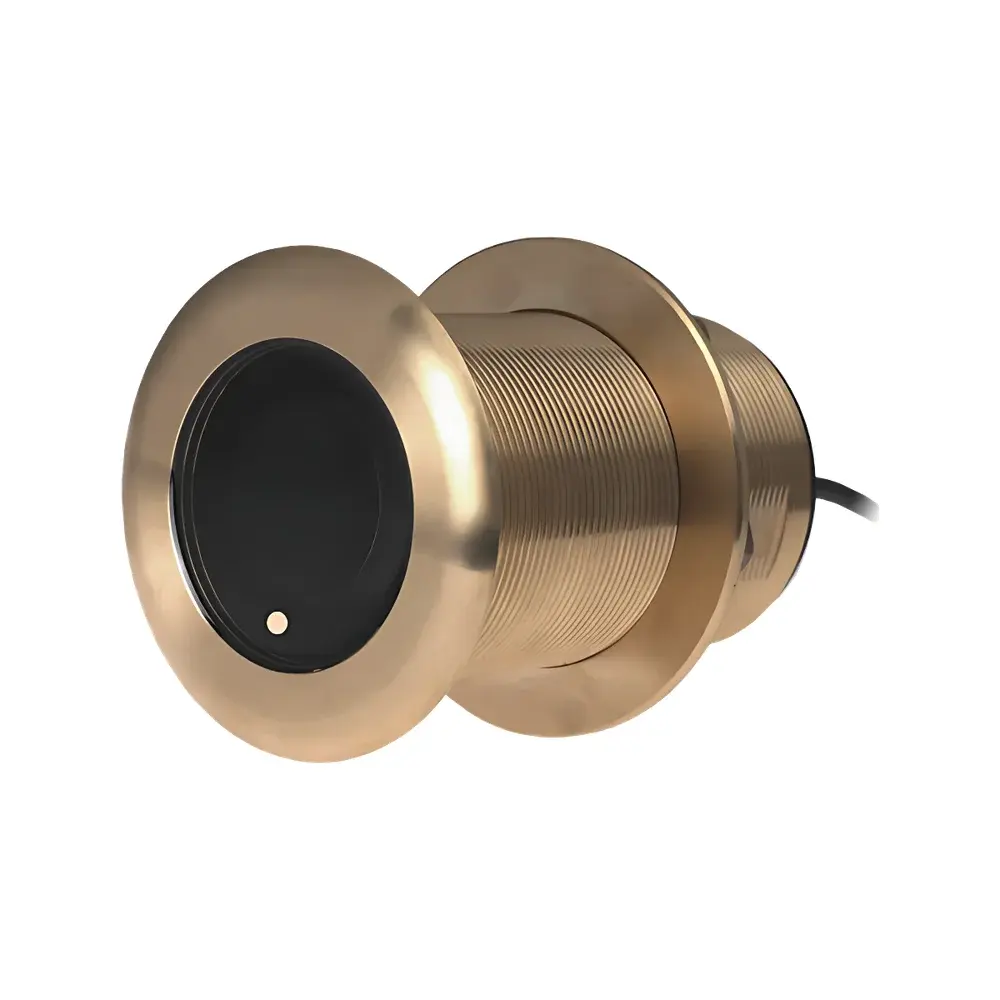
AirMar B60 Dual-Frequency Low-Profile Hull-Mounted Depth Sounder
| Brand | AIRMAR |
|---|---|
| Origin | USA |
| Model | B60 |
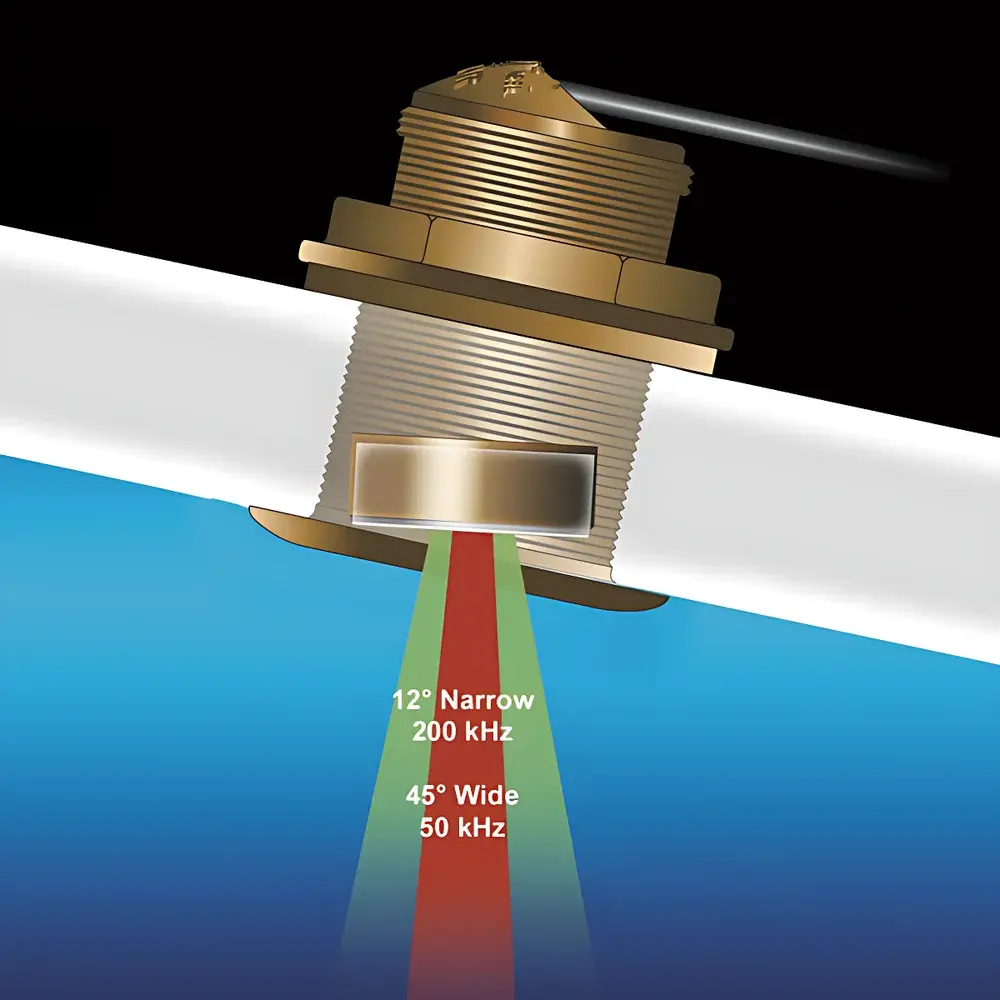
| Frequency Bands | 50 kHz / 200 kHz |
| Beam Width | 45° @ 50 kHz, 12° @ 200 kHz |
| Transmit Power | 600 W |
| Mounting Type | Flush-mount thru-hull |
| Housing Material | Bronze |
| Transducer Window | Polyurethane |
| Hole Diameter | 60 mm |
| Stub Length | 68.5 mm |
| Cable Length | 10 m |
| Integrated Tilt Compensation | Yes |
| Integrated Temperature Sensor | Yes |
| Maximum Hull Tilt Angle | 24° |
| Compatible Hull Size | Up to 8 m (25 ft) |
| Weight | 1.4 kg |
Overview
The AirMar B60 is a dual-frequency, low-profile, flush-mounted depth sounder transducer engineered for precision hydrographic performance on small to mid-sized vessels operating in coastal, offshore, and inland freshwater environments. Utilizing piezoceramic element technology, the B60 operates simultaneously at 50 kHz (for greater penetration and bottom detection in deeper or turbid waters) and 200 kHz (for high-resolution shallow-water imaging and target discrimination). Its unique tilt-compensated architecture—integrating a solid-state inclinometer and real-time beam steering logic—ensures consistent vertical beam alignment even on hulls inclined up to 24°, eliminating depth measurement error caused by vessel heel or trim. Unlike traditional protruding transducers, the B60’s near-flush design extends only 5 mm beyond the hull surface, minimizing hydrodynamic drag and eliminating cavitation risk at planing speeds. This geometry delivers acoustic performance comparable to fairing-equipped installations while maintaining structural integrity and ease of maintenance.
Key Features
- Dual-frequency operation (50/200 kHz) enables adaptive sonar profiling across variable water depths and sediment conditions.
- Integrated tilt compensation system dynamically adjusts beam orientation to maintain vertical incidence, ensuring repeatable depth accuracy independent of hull attitude.
- Low-profile flush-mount configuration (5 mm hull protrusion) reduces drag, prevents fouling accumulation, and eliminates flow-induced noise artifacts.
- Bronze housing provides excellent corrosion resistance in saltwater and brackish environments; stainless steel variant (SS60) available for aluminum or composite hulls.
- Integrated NTC temperature sensor supports real-time sound velocity correction, improving depth accuracy per ISO 17025-compliant calibration protocols.
- Polyurethane acoustic window offers broad bandwidth transmission, high durability, and immunity to marine growth adhesion.
- Optimized for vessels up to 8 m (25 ft) LOA with hull deadrise angles of 0°, 12°, or 20°—pre-calibrated mounting orientation indicated by molded arrow pointing toward keel line.
Sample Compatibility & Compliance
The B60 is compatible with all NMEA 2000–compliant chartplotters and multifunction displays (MFDs), including Raymarine, Garmin, Simrad, and Furuno systems. It meets UL 1106 marine electrical safety standards and complies with CE Directive 2014/30/EU (EMC) and 2011/65/EU (RoHS). Its pressure-rated housing (IP68) and polyurethane window are validated for continuous submersion at depths up to 100 m. The transducer supports GLP-aligned data traceability when paired with certified logging software, and its analog pulse output conforms to IEC 62289-2 for echo-sounder interface interoperability. Installation adheres to ABYC E-11 and ISO 8846 marine electrical standards.
Software & Data Management
The B60 outputs analog depth pulses and digital NMEA 2000 PGNs (including 127250 – Depth, 127251 – Environmental Parameters, and 127257 – Attitude) for seamless integration into vessel networks. When connected to compatible MFDs, users access real-time bottom contour mapping, fish arch rendering, and bottom hardness estimation. Raw echo data can be logged via third-party applications supporting NMEA 0183 or NMEA 2000 PC gateways, enabling post-mission analysis in MATLAB, Python (using pynmea2 or can-isobus libraries), or QGIS with bathymetric plugins. Firmware updates are performed through AirMar’s official utility software, which maintains full audit logs compliant with FDA 21 CFR Part 11 requirements for electronic records in regulated survey workflows.
Applications
- Coastal and offshore commercial fishing—real-time bottom tracking for trawl net positioning and gear optimization.
- Inland lake and reservoir fisheries management—high-resolution bathymetric surveys for habitat mapping and invasive species monitoring.
- Recreational angling support—identification of thermoclines, drop-offs, and submerged structures using dual-frequency gain differentiation.
- Small-vessel hydrographic surveying—integration into USACE or NOAA-approved low-cost bathymetry platforms for shoreline change assessment.
- Scientific limnology—long-term deployment for seasonal sedimentation rate studies using time-series depth variance analytics.
FAQ
What hull materials are compatible with the B60?
The bronze-housed B60 is optimized for fiberglass, wood, and cored composite hulls. For aluminum or stainless steel hulls, the SS60 stainless steel variant is recommended to prevent galvanic corrosion.
Does the B60 require external tilt sensing hardware?
No—the B60 incorporates a factory-calibrated MEMS inclinometer; no external gyro or motion reference unit is needed for tilt compensation.
Can the B60 be installed on a stepped hull or tunnel hull?
Yes, provided the installation location lies within the wetted surface area during normal operation and aligns with the specified deadrise angle options (0°, 12°, or 20°).
Is the polyurethane window replaceable in-field?
The polyurethane window is permanently bonded during manufacturing and is not user-replaceable; however, its chemical and abrasion resistance ensures service life exceeding 10 years in typical marine duty cycles.
How does the B60 handle air entrainment at high speed?
The low-protrusion design minimizes air ingestion, and the 50 kHz beam’s wider divergence provides robust signal return even under partial cavitation—verified per ASTM D7492 test methodology for sonar reliability under dynamic flow conditions.