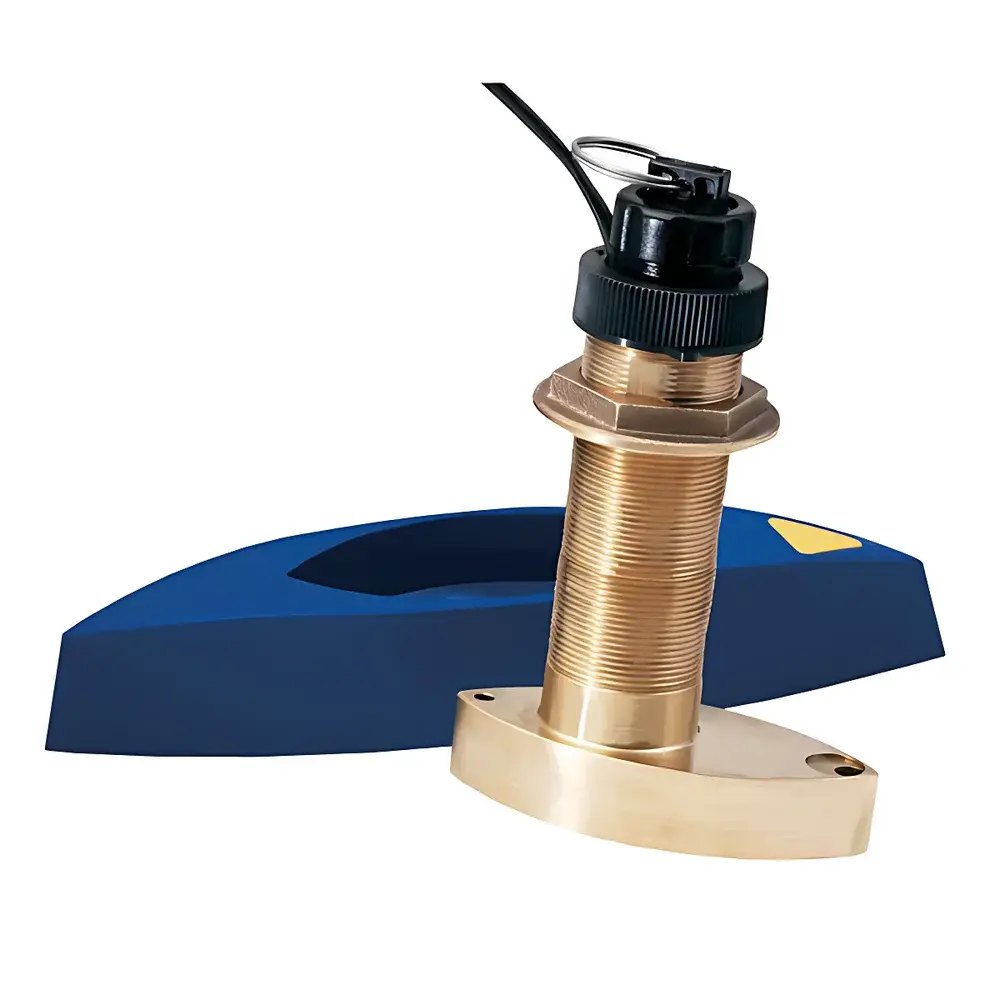
AirMar B744VL Through-Hull Tri-Transducer Depth, Speed & Temperature Sensor
| Brand | Airmar |
|---|---|
| Origin | USA |
| Model | B744VL |
| Frequency | 50 kHz / 200 kHz |
| Beamwidth | 45° @ 50 kHz |
| Transmit Power | 600 W |
| Maximum Depth Range | 235–353 m (50 kHz), 118–206 m (200 kHz) |
| Hull Penetration Diameter | 51 mm |
| Fixed Shaft Length | 140 mm |
| Cable Length | 10 m |
| Operating Speed Range | 1–45 knots |
| Maximum Hull Tilt Angle | 24° (with optional high-performance fairing) |
| Transducer Housing Material | Bronze |
| Lens Material | Polyurethane |
| Integrated Sensors | Depth (pressure-based), Water Speed (paddlewheel), Temperature (NTC thermistor) |
| Weight | 2.5 kg |
| Compliance | CE, FCC, RCM, UL 1800 |
Overview
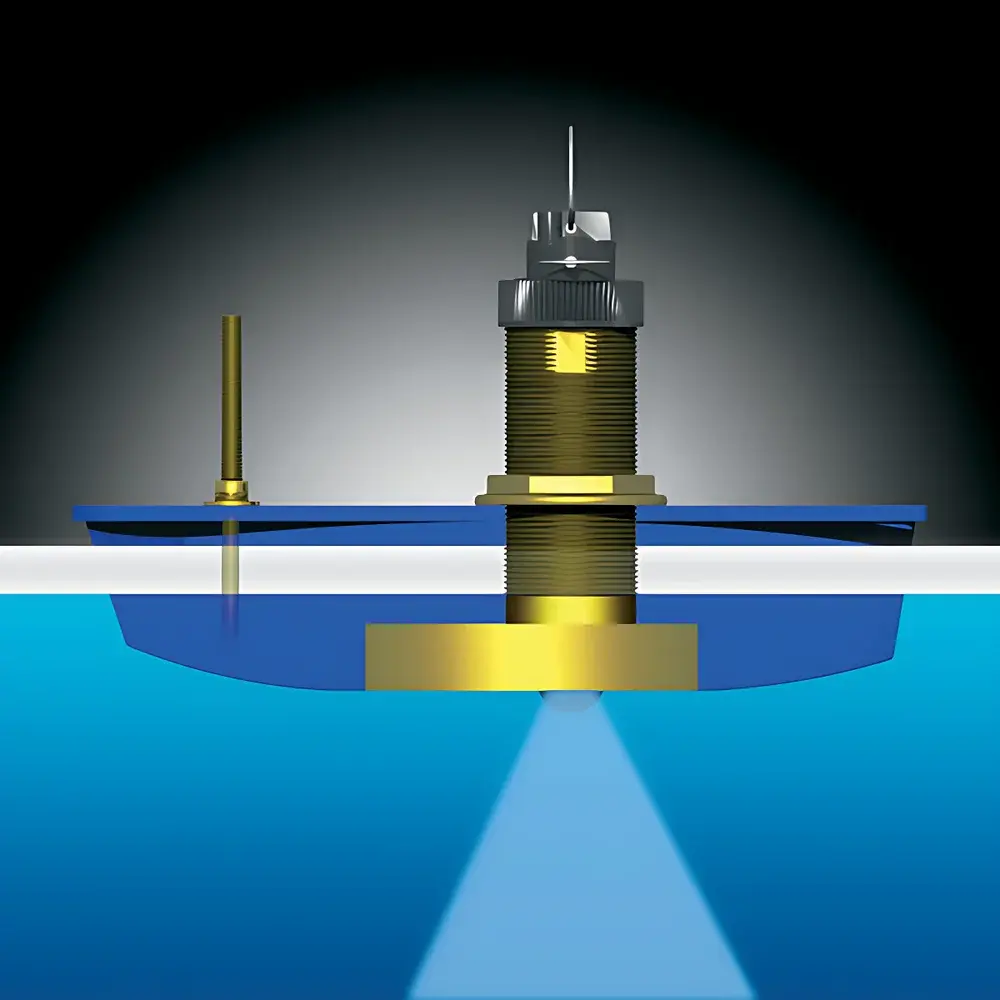
The AirMar B744VL is a through-hull tri-transducer sensor engineered for precision marine navigation and fisheries applications requiring simultaneous, synchronized measurement of water depth, vessel speed-through-water (STW), and seawater temperature. Unlike conventional single-function transducers, the B744VL integrates three distinct sensing modalities into a single, mechanically robust housing—eliminating the need for multiple hull penetrations while maintaining signal integrity across operational speeds up to 45 knots (52 mph). Its dual-frequency sonar architecture operates at 50 kHz (wide-beam, long-range profiling) and 200 kHz (narrow-beam, high-resolution bottom discrimination), enabling adaptive use in both shallow coastal zones and deeper inland lakes. The sensor employs pulse-compression echo processing and digital time-varied gain (TVG) compensation to ensure consistent bottom lock and target separation under variable salinity, turbidity, and vessel motion conditions. Designed for integration with 600W-rated fishfinders—including Furuno, Garmin, and Raymarine chartplotter ecosystems—the B744VL meets ISO 8726 (marine echosounder performance standards) and complies with IEC 62288 for maritime navigation equipment.
Key Features
- Tri-sensor integration: Simultaneous real-time acquisition of depth (via piezoresistive pressure transducer), speed-through-water (via calibrated stainless-steel paddlewheel with cross-flow correction vanes), and temperature (via embedded NTC thermistor with ±0.5°C accuracy over 0–35°C).
- Extended shaft design: 140 mm fixed-length bronze shaft accommodates thicker hulls (up to 9 m LOA vessels) and elevated mounting angles—optimized for planing hulls and deep-V configurations with tilt up to 24° when paired with AirMar’s high-speed fairing.
- Patented self-sealing valve mechanism: Enables safe removal of the internal transducer insert for cleaning or maintenance without flooding the hull interior—critical for commercial fishing and research vessels operating in biofouling-prone environments.
- Acoustic lens technology: Polyurethane sound window provides broadband impedance matching and minimizes signal attenuation across both 50 kHz and 200 kHz bands; resistant to UV degradation and mechanical abrasion.
- High-speed hydrodynamic housing: Streamlined bronze body and optional fairing reduce cavitation-induced noise and maintain beam coherence above 30 knots—verified per ASTM D7502 (hydroacoustic transducer performance testing).
Sample Compatibility & Compliance
The B744VL is compatible with all NMEA 2000-certified marine electronics platforms supporting PGN 128259 (Depth), PGN 128267 (Water Speed), and PGN 130311 (Environmental Parameters). It interfaces natively with Furuno TZtouch3, Garmin GPSMAP series, and Raymarine Axiom displays via standardized J1939/ISO 11783 message structures. The transducer conforms to EMC Directive 2014/30/EU (EN 60945), safety standard UL 1800 (Marine Electrical Equipment), and environmental compliance per RoHS 2011/65/EU and REACH Regulation (EC) No. 1907/2006. For GLP-aligned data logging workflows, raw sensor outputs support timestamped binary logging compliant with NMEA 0183 v4.10 sentence formats (DPT, VHW, MTW).
Software & Data Management
No proprietary software is required for basic operation; configuration and calibration are performed via device-level NMEA 2000 parameter groups or vendor-specific setup utilities (e.g., Furuno NavNet 3 Setup Tool, Garmin WebUpdater). For advanced analytics, logged NMEA streams can be parsed using open-source tools such as GPSBabel or custom Python scripts leveraging the pynmea2 library. Timestamped depth-speed-temperature triplets are suitable for post-mission bathymetric gridding (e.g., QGIS + GDAL), thermal layer profiling, and vessel performance modeling. All firmware updates follow secure signed-binary protocols validated against AirMar’s public key infrastructure—ensuring traceability and audit readiness per ISO/IEC 17025:2017 Clause 7.7 (Reporting of Results).
Applications
- Coastal and nearshore commercial fisheries: Real-time bottom contour mapping for trawl net positioning and habitat assessment in depths from 5 m to 350 m.
- Lake and reservoir surveying: High-resolution 200 kHz imaging for submerged structure identification and sediment classification in freshwater systems with low conductivity.
- Scientific platform integration: OEM-ready interface for autonomous surface vehicles (ASVs) and hydrographic survey launches requiring synchronized multi-parameter telemetry.
- Regulatory monitoring: Compliant data capture for NOAA Fisheries observer programs and EU Common Fisheries Policy (CFP) logbook reporting where STW and bottom depth are mandatory fields.
- Recreational tournament fishing: Adaptive frequency switching enables rapid transition between wide-area search (50 kHz) and precise lure-depth targeting (200 kHz) during high-speed trolling.
FAQ
What is the maximum recommended hull thickness for B744VL installation?
The 140 mm fixed shaft supports hulls up to 100 mm thick when installed with proper backing plate and sealant—verified per ABYC H-27 (Marine Electrical Systems) and ISO 10893-1 (Non-destructive testing of welds).
Can the B744VL operate reliably in brackish or low-salinity estuarine environments?
Yes. The dual-frequency architecture and automatic gain control compensate for reduced acoustic impedance in low-conductivity water; calibration offset tables are available in AirMar’s Technical Bulletin TB-2023-04.
Is the paddlewheel speed sensor affected by marine growth?
The stainless-steel rotor features self-cleaning geometry and is rated for continuous operation with ≤1 mm biofilm accumulation; periodic inspection every 200 operational hours is recommended per IMO Resolution A.1125(30).
Does the B744VL support NMEA 2000 fast-packet transmission for high-update-rate applications?
Yes. Depth and speed data are transmitted at 10 Hz via Fast Packet PGNs (128259, 128267); temperature updates at 2 Hz (PGN 130311) to balance bandwidth and resolution.
How is temperature drift compensated across the full operational range?
The NTC thermistor is factory-calibrated against NIST-traceable reference baths at 5°C, 15°C, 25°C, and 35°C; linearization coefficients are stored in non-volatile memory and applied in real time.