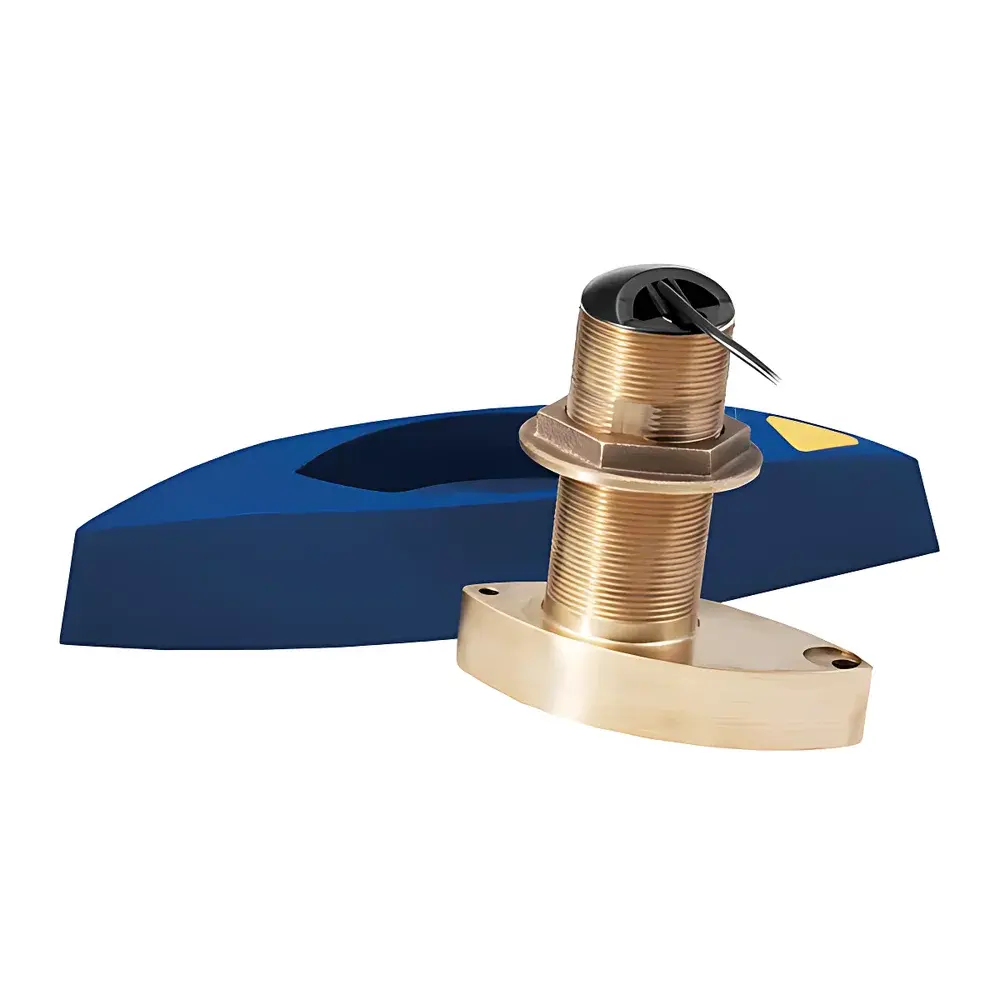
AirMar B765LH Dual-Frequency Chirp Depth Sounder
| Brand | AIRMAR |
|---|---|
| Origin | USA |
| Model | B765LH |
| Transducer Type | Through-Hull Dual-Beam Chirp Sonar |
| Low-Frequency Range | 40–75 kHz (300 W, Beamwidth 32°–21°) |
| High-Frequency Range | 130–210 kHz (600 W, Beamwidth 15°–9°) |
| Total Chirp Bandwidth | 115 kHz |
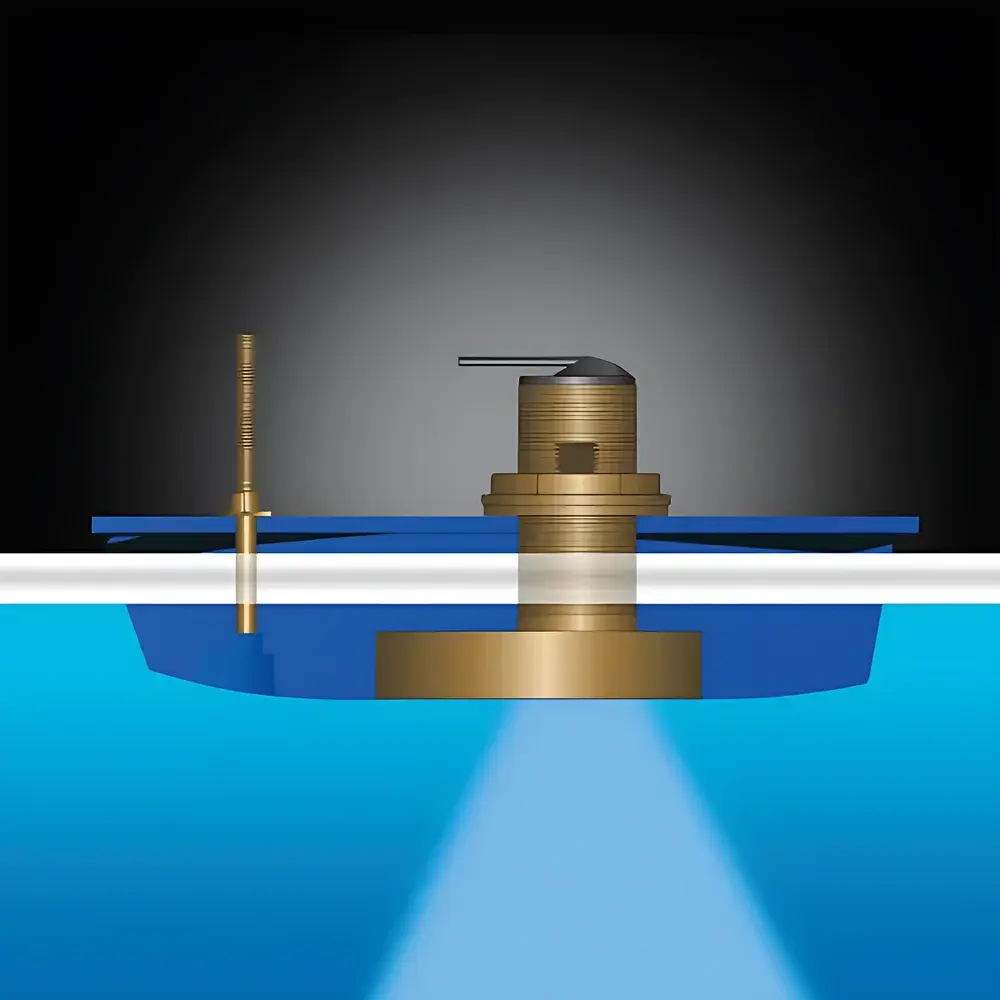
| Mounting | Through-Hull with Hydrodynamic Fairing |
| Hull Material Compatibility | Fiberglass or Wood |
| Maximum Hull Deadrise | 24° |
| Transducer Housing | Bronze (Body), Polyurethane (Fairing) |
| Thru-Hull Hole Diameter | 51 mm |
| Stub Length | 121 mm |
| Cable Length | 10 m |
| Integrated Temperature Sensor | Yes |
| Weight | 2.5 kg |
| Max Operating Depth | 3000 m |
Overview
The AirMar B765LH is a high-performance, dual-frequency through-hull Chirp depth sounder transducer engineered for marine navigation, commercial fishing, and hydrographic survey applications requiring simultaneous high-resolution bottom profiling and target discrimination. Unlike conventional fixed-frequency echo sounders, the B765LH employs broadband frequency-modulated (FM) chirp technology—transmitting continuous swept-frequency pulses across two distinct, non-overlapping bands: a low-frequency band (40–75 kHz) optimized for deep-water penetration and structural mapping, and a high-frequency band (130–210 kHz) delivering enhanced lateral resolution for fish-school separation and fine-bottom feature identification. This dual-band architecture enables coherent signal processing with improved signal-to-noise ratio (SNR), time-domain pulse compression, and significantly higher range resolution—up to 10× greater than legacy 50/200 kHz transducers—without sacrificing maximum detection range (rated to 3000 m). The transducer operates on the principle of time-of-flight acoustic propagation in seawater, calibrated using standard sound speed profiles (e.g., Mackenzie equation), and supports real-time water temperature compensation via an integrated, factory-calibrated thermistor.
Key Features
- Dual-band Chirp architecture: Independent low-band (40–75 kHz, 300 W) and high-band (130–210 kHz, 600 W) transmission channels enable concurrent deep-sounding and high-definition target imaging.
- Adaptive beam geometry: Low-band beamwidth narrows from 32° to 21° across its sweep; high-band beamwidth compresses from 15° to 9°, providing dynamic angular resolution matched to operational depth and target size.
- Patented Xducer ID® technology: Embedded digital memory stores transducer-specific calibration coefficients, beam pattern data, and serial traceability—enabling automatic configuration and firmware-matched gain compensation in compatible chartplotters and sonar processors.
- Robust through-hull mechanical design: Precision-machined bronze housing with corrosion-resistant passivation, paired with a hydrodynamically optimized polyurethane fairing that minimizes flow noise and cavitation at vessel speeds up to 35 knots.
- Integrated temperature sensing: High-stability NTC thermistor mounted within the acoustic window provides continuous, drift-compensated water temperature measurement referenced to IEC 60751 Class B tolerances.
- Universal hull compatibility: Designed for fiberglass and wood hulls with deadrise angles up to 24°; includes alignment jig and sealing kit compliant with ABYC E-11 and ISO 8846 marine electrical safety standards.
Sample Compatibility & Compliance
The B765LH is intended for use in saltwater, brackish, and freshwater environments where acoustic propagation characteristics remain within nominal sound speed ranges (1450–1540 m/s). It complies with FCC Part 15 Subpart B (Class B digital device emissions) and CE RED Directive 2014/53/EU for radio equipment. While not certified for direct GLP/GMP-regulated bathymetric survey reporting, its output data (depth, temperature, raw IQ samples) are compatible with third-party post-processing software validated per ISO/IEC 17025 for hydrographic data reduction workflows. The transducer meets IP68 ingress protection when installed per manufacturer torque specifications and sealed with approved marine-grade polysulfide sealant.
Software & Data Management
The B765LH outputs NMEA 2000 PGNs 128267 (Depth Below Transducer), 130311 (Water Temperature), and proprietary Chirp IQ data streams via optional NMEA 2000 gateway modules. Raw IQ data (I/Q sample pairs at 1–4 MHz sampling rates) can be captured for offline spectral analysis using AirMar’s PC-based SonarLog™ software or third-party tools supporting NMEA-TXT or binary .son formats. All firmware updates and transducer parameter adjustments are performed via AirMar’s WebConfig utility over Ethernet or USB-C interface, with audit logs retained per user-configurable retention policy—supporting traceability requirements under FDA 21 CFR Part 11 when deployed in regulated aquaculture monitoring systems.
Applications
- Commercial pelagic fisheries: Discrimination of baitfish layers, gamefish aggregations, and thermocline boundaries at depths exceeding 1000 m.
- Small-vessel hydrographic reconnaissance: Shallow-to-deep bathymetric profiling (0.5–3000 m) for coastal habitat mapping and dredging pre-survey.
- Scientific echosounder integration: Paired with scientific winch-controlled deployment frames for vertical profiling and multi-angle backscatter calibration.
- Marine infrastructure inspection: Detection and classification of submerged objects, wreck outlines, and pipeline corridors with sub-meter horizontal resolution.
- Regulatory compliance monitoring: Real-time temperature-depth profiling for NOAA Fisheries observer programs and EPA Section 404 permit verification.
FAQ
What is the maximum recommended vessel speed for optimal B765LH performance?
For minimal flow noise and consistent bottom lock, AirMar recommends sustained operation below 35 knots with proper fairing installation and hull surface preparation.
Does the B765LH support CHIRP data export for third-party GIS or MATLAB analysis?
Yes—raw IQ data packets (with timestamp, frequency bin, and amplitude/phase metadata) are accessible via NMEA 2000 gateway or direct USB-C capture using SonarLog™, enabling MATLAB, Python (scipy.signal), or QGIS-based spectral decomposition and target strength modeling.
Is the integrated temperature sensor traceable to NIST standards?
The thermistor is factory-calibrated against NIST-traceable reference baths at three points (5°C, 25°C, 45°C); full calibration certificate is available upon request with transducer serial number.
Can the B765LH be used on aluminum or steel hulls?
No—this model is explicitly rated for fiberglass and wood hulls only. Aluminum or steel hulls require alternative mounting methods (e.g., transom or trolling motor brackets) due to acoustic coupling limitations and potential galvanic corrosion risks.
How does Xducer ID® improve system setup accuracy?
Xducer ID® eliminates manual entry errors by auto-populating beam angle, frequency response curve, and power rating into compatible MFDs—reducing commissioning time and ensuring gain settings align with actual transducer physics rather than generic lookup tables.