AirMar B785M Medium-Frequency Chirp Transducer
| Brand | AIRMAR |
|---|---|
| Origin | USA |
| Model | B785M |
| Operating Frequency Range | 80–130 kHz |
| Output Power | 600 W |
| Beamwidth | 24°–16° (variable with frequency) |
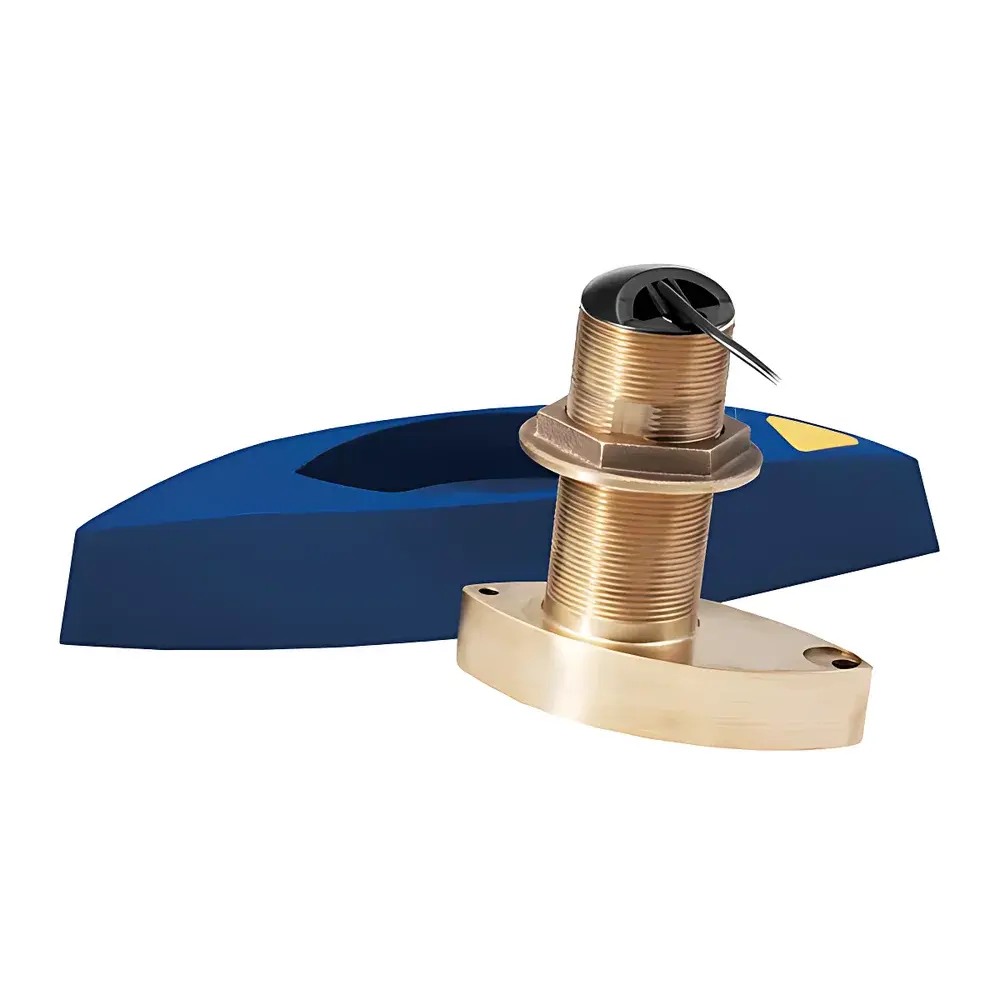
| Housing Material | Bronze |
| Transducer Window | Polyurethane |
| Temperature Sensor | Integrated, Fast-Response |
| Cable Length | 10 m |
| Weight | 2.5 kg |
| Recommended Hull Length | Up to 9 m |
| Hull Angle Tolerance | 2°–20° |
| Aperture Diameter | 51 mm |
| Shaft Length | 121 mm |
| Maximum Depth Detection | 3,000 m (10,000 ft) |
| Compliance | IP68, RoHS, CE |
Overview
The AirMar B785M is a through-hull mounted, single-beam medium-frequency Chirp transducer engineered for high-resolution depth sounding and real-time water temperature profiling in marine and freshwater environments. Unlike conventional pulsed echo sounders, the B785M employs broadband frequency-modulated (FM) chirp technology—transmitting a continuous swept-frequency signal across the 80–130 kHz band—enabling superior signal-to-noise ratio, enhanced target separation, and significantly improved range resolution. This physical principle leverages time-frequency correlation processing to compress wideband returns into narrow pulses, yielding up to 10× greater vertical and horizontal resolution compared to legacy 50/200 kHz transducers. Designed for vessels up to 9 meters in length, the B785M delivers optimal performance in moderate-depth coastal, estuarine, and inland lake applications—particularly where turbidity, thermocline interference, or dense baitfish layers challenge conventional sonar interpretation.
Key Features
- Medium-frequency Chirp operation (80–130 kHz) optimized for balanced penetration and resolution in depths up to 275 m (900 ft) and extended detection to 3,000 m under ideal conditions
- Integrated fast-response NTC thermistor providing calibrated water temperature measurements synchronized with depth data
- Variable beamwidth (24° at lower frequencies, narrowing to 16° at higher frequencies) enabling adaptive focus without mechanical adjustment
- 600 W peak acoustic output power supporting robust signal return in sediment-laden or highly attenuating water columns
- Patented Xducer ID® technology enabling automatic transducer recognition and configuration by compatible multifunction displays (MFDs) and sonar processors
- Pressure-rated bronze housing with polyurethane acoustic window offering corrosion resistance, cavitation resilience, and stable acoustic impedance matching
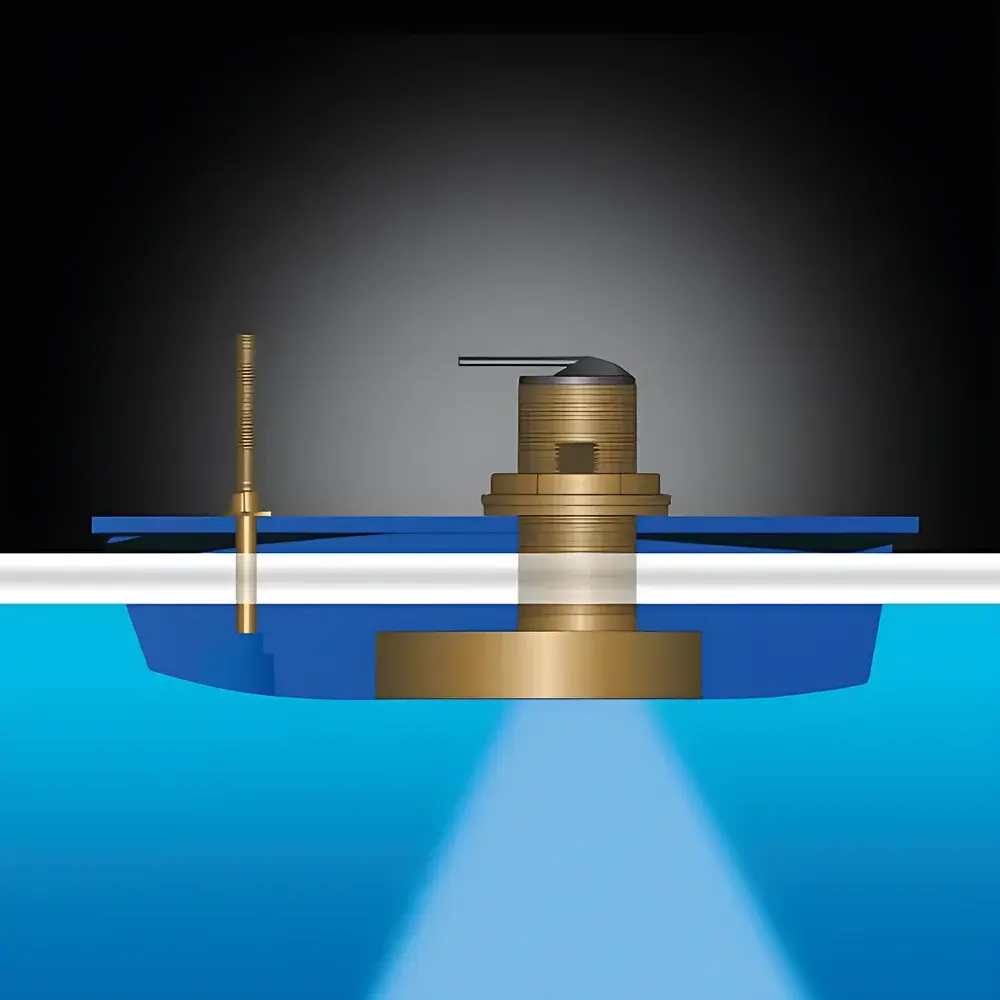
- Through-hull installation with 51 mm aperture and 121 mm shaft length—compatible with standard hull thicknesses and tilt angles from 2° to 20°
Sample Compatibility & Compliance
The B785M is designed for use with NMEA 2000-compatible sonar processors and multifunction displays from leading marine electronics manufacturers including Garmin, Raymarine, Simrad, and Furuno. Its analog CHIRP output conforms to NMEA 2000 PGN 128267 (Depth, Temperature, and Water Speed), ensuring interoperability within certified vessel networks. The transducer meets IP68 ingress protection standards for permanent submersion, complies with RoHS Directive 2011/65/EU for hazardous substance restrictions, and carries CE marking for electromagnetic compatibility (EMC Directive 2014/30/EU) and marine equipment safety (MED Directive 2014/90/EU). While not intended for GLP/GMP-regulated hydrographic surveying, its repeatable depth accuracy (±0.2% of full scale, typical) and thermal drift compensation support routine fisheries monitoring, bathymetric mapping, and navigational safety applications aligned with IHO S-44 Special Order specifications for non-survey-grade echosounders.
Software & Data Management
The B785M operates as a sensor node within modern digital marine networks—delivering raw CHIRP IQ data streams and processed depth/temperature values via NMEA 2000. When paired with supported MFD firmware (e.g., Garmin Panoptix LiveScope™ Ready systems or Raymarine Axiom Pro with CHIRP Sonar Suite), users access real-time spectral analysis, bottom discrimination algorithms, and split-screen overlays integrating GPS position, heading, and AIS targets. All logged data—including timestamped depth profiles, temperature gradients, and echo envelope traces—is stored in industry-standard NMEA 0183/NMEA 2000 binary formats, enabling post-processing in third-party hydrographic software (e.g., QPS Qimera, Hypack MAX) or custom Python/Matlab toolchains using open-source NMEA parsing libraries. Firmware updates are delivered via manufacturer-provided tools; no proprietary cloud dependency or subscription licensing is required.
Applications
- Recreational and commercial nearshore fishing—discriminating baitfish schools, game fish arches, and submerged structures (rock piles, wrecks, vegetation edges) with sub-meter target separation
- Freshwater lake and reservoir management—mapping thermoclines, identifying oxygen depletion zones, and quantifying sediment accumulation rates over time
- Small-craft navigation safety—real-time shallow-water detection and ground proximity alerts in tidal channels, river deltas, and uncharted coves
- Scientific field studies—supporting limnological surveys, invasive species tracking, and baseline benthic habitat characterization where cost-effective, deployable CHIRP capability is required
- ROV and autonomous surface vehicle (ASV) integration—leveraging compact form factor and low-power NMEA 2000 interface for modular sensor payloads
FAQ
Is the B785M compatible with non-Chirp-ready chartplotters?
No. It requires a CHIRP-enabled processor capable of interpreting FM-swept signals and performing matched-filter pulse compression. Legacy 50/200 kHz-only units cannot decode its output.
Can it be installed on fiberglass or aluminum hulls?
Yes—provided the hull material is solid (no core voids) and within the specified tilt tolerance (2°–20°). Installation kits include hull-specific sealants and torque specifications per ABS and ISO 8846 marine standards.
Does the integrated temperature sensor require calibration?
The NTC thermistor is factory-calibrated to ±0.5°C across 0–35°C and includes linearization coefficients embedded in Xducer ID® memory; field recalibration is not supported or necessary under normal operating conditions.
What is the minimum water speed required for accurate temperature measurement?
No minimum flow velocity is required—the sensor measures static water temperature at the transducer face; however, prolonged stationary operation in stratified water may delay thermal equilibration by up to 90 seconds.
Is the 10-meter cable serviceable or field-replaceable?
The molded cable is not user-serviceable; replacement requires factory-certified termination and continuity testing to maintain IP68 integrity and NMEA 2000 impedance compliance (120 Ω ±5%).