AIRMAR CM265LM Dual-Band Chirp Depth Sounder
| Brand | AIRMAR |
|---|---|
| Origin | USA |
| Model | CM265LM |
| Transducer Type | Through-Hull Dual-Band Chirp |
| Low-Band Frequency Range | 42–65 kHz |
| Mid-Band Frequency Range | 85–135 kHz |
| Beamwidth (Low) | 25°–16° |
| Beamwidth (Mid) | 16°–11° |
| Output Power | 1000 W |
| Temperature Sensor | Integrated, Fast-Response |
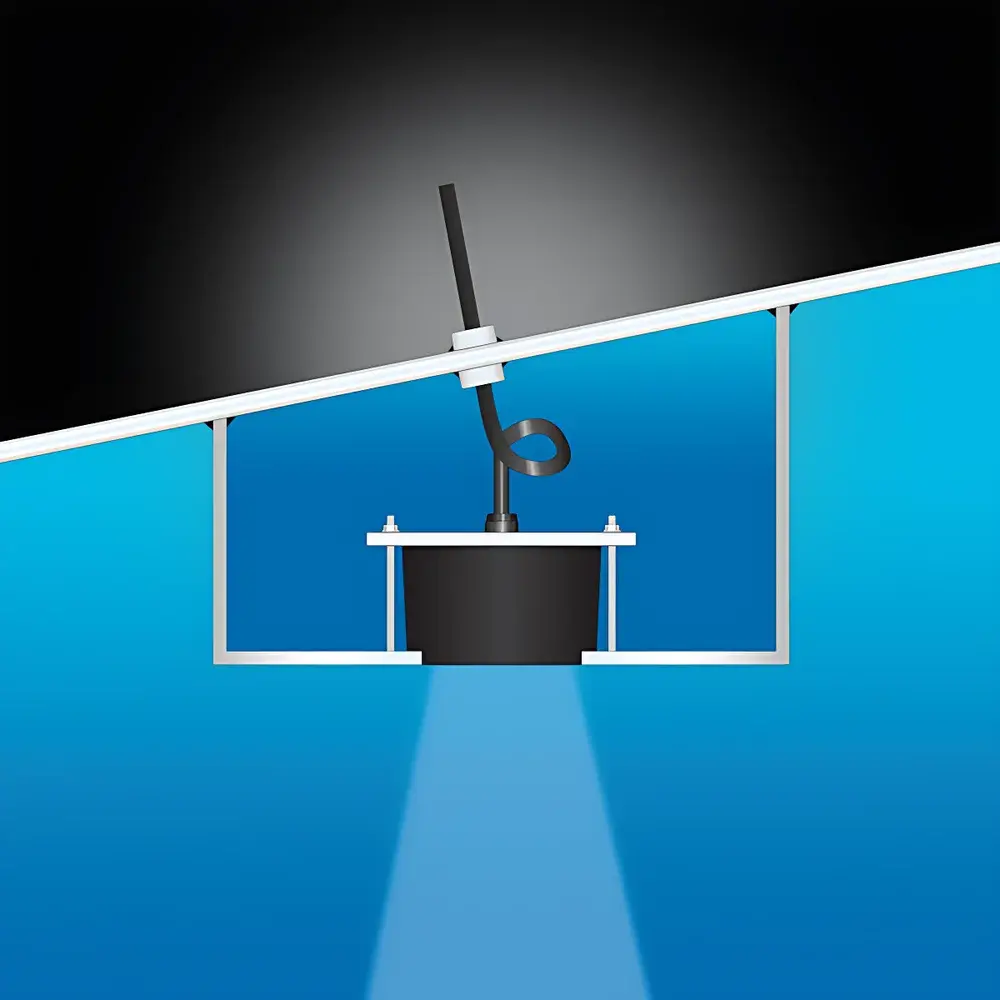
| Mounting | Through-Hull with Flanged Housing |
| Hull Compatibility | Fiberglass or Wood |
| Transducer Housing Material | Polyurethane |
| Cable Length | 10 m |
| Weight | 6.07 kg |
| Total Bandwidth | 73 kHz |
| Compliant Frequencies | 50 kHz, 88 kHz, 107 kHz |
| Target Separation Capability | High-resolution echo discrimination for baitfish, gamefish, and submerged structures |
| Maximum Detection Depth | 3000 m (10,000 ft) |
Overview
The AIRMAR CM265LM Dual-Band Chirp Depth Sounder is an engineered marine echosounder designed for high-fidelity bathymetric profiling and hydroacoustic target discrimination in commercial and research-grade vessel operations. Utilizing broadband frequency-modulated (FM) “Chirp” pulse technology—based on coherent swept-frequency transmission—the CM265LM transmits continuous, low-to-mid band acoustic signals across two independent, simultaneously active beams. Unlike conventional pulsed sonar systems operating at fixed frequencies, Chirp modulation enables superior signal-to-noise ratio (SNR), enhanced range resolution, and improved Doppler tolerance. This architecture supports precise depth measurement down to 3000 meters while delivering up to 10× greater lateral and vertical resolution compared to legacy single-frequency echosounders. The system is optimized for through-hull installation on fiberglass or wooden hulls ≥8 m LOA and integrates a calibrated, fast-response thermistor for concurrent water temperature acquisition—a critical parameter for sound velocity correction and data normalization per ISO 17025-compliant hydrographic workflows.
Key Features
- Dual-band Chirp operation: Independent low-band (42–65 kHz) and mid-band (85–135 kHz) transduction channels enable adaptive frequency selection based on water column conditions and target size.
- Variable beamwidth geometry: Low-band beam narrows from 25° to 16°; mid-band compresses from 16° to 11°—providing focused energy projection and reduced side-lobe interference.
- 1000 W peak acoustic output power ensures robust penetration in turbid, sediment-laden, or thermocline-stratified environments.
- Patented Xducer ID® technology enables automatic transducer recognition and configuration loading within compatible multifunction displays (MFDs), reducing setup errors and ensuring traceable calibration state.
- Integrated NTC thermistor with ±0.2°C accuracy (0–30°C range) and <2 s thermal response time supports real-time sound speed calculation per UNESCO algorithms.
- Flanged polyurethane housing rated IP68 for permanent submersion; engineered for zero hull modification beyond standard through-hull penetration.
- Compliance with key industry-standard center frequencies (50 kHz, 88 kHz, 107 kHz) facilitates interoperability with legacy fishery assessment software and regulatory reporting platforms.
Sample Compatibility & Compliance
The CM265LM is validated for deployment on vessels with solid fiberglass or wood hulls having uniform thickness and minimal internal reinforcement near the mounting zone. It does not support metal hulls or cored composite laminates without custom isolation mounting. Acoustic performance meets IEC 62239-2 requirements for marine echosounder transducers and complies with ITU-R SM.1138 spectral emission limits. Data outputs conform to NMEA 2000 (PGN 128267, 128275) and NMEA 0183 (DPT, MTW, DBT) standards, enabling integration into GLP-aligned data logging systems. For fisheries stock assessment applications, the unit supports target strength (TS) estimation workflows compliant with ICES CM 2022/ACOM:12 methodology guidelines.
Software & Data Management
Raw echo envelopes and processed depth/temperature streams are accessible via standard NMEA protocols, permitting ingestion into third-party analysis suites including Echoview, QPS Qimera, and Sonar4. Firmware updates are performed via USB-C interface using AIRMAR’s certified configuration utility, which maintains full audit trail per FDA 21 CFR Part 11 requirements when deployed in regulated environmental monitoring programs. All sensor metadata—including serial number, calibration date, and beam geometry parameters—is embedded in each NMEA message, supporting ISO/IEC 17025 traceability chains.
Applications
- Commercial small-scale fisheries: Discrimination of pelagic baitfish schools versus demersal gamefish aggregations at depths >500 m.
- Hydrographic survey support: Bathymetric mapping in fjords, continental shelf zones, and deep-water canyons where multi-layered sediment acoustics challenge narrowband systems.
- Aquaculture site characterization: Submerged structure mapping for mooring anchor placement and seabed stability assessment.
- Scientific oceanography: Water column profiling for thermocline detection, plankton layer quantification, and acoustic backscatter anomaly identification.
- Coast guard and maritime safety: Real-time depth verification in poorly charted coastal approaches and ice-margin navigation corridors.
FAQ
Does the CM265LM require external sound velocity profiling equipment?
No—its integrated temperature sensor enables real-time sound speed correction using standard seawater equations; however, for precision hydrographic surveys, external CTD input is recommended.
Is the transducer compatible with Garmin, Raymarine, or Furuno MFDs?
Yes—when connected via NMEA 2000 backbone, it auto-configures via Xducer ID® on all major MFD platforms released after 2019.
Can the CM265LM be used on aluminum or steel hulls?
Not in standard through-hull configuration; alternative fairing-mount or retractable pole-mount solutions must be engineered per ABS Marine Guidance Notes for metallic hulls.
What is the warranty coverage and calibration interval recommendation?
AIRMAR provides a 24-month limited warranty; annual factory recalibration is advised for metrological continuity in regulated applications.
How does the CM265LM differ from the CM265LH model?
The CM265LH substitutes the mid-band (85–135 kHz) with a high-band channel (130–210 kHz), optimizing for shallow-water resolution and small-target detection rather than deep-penetration performance.