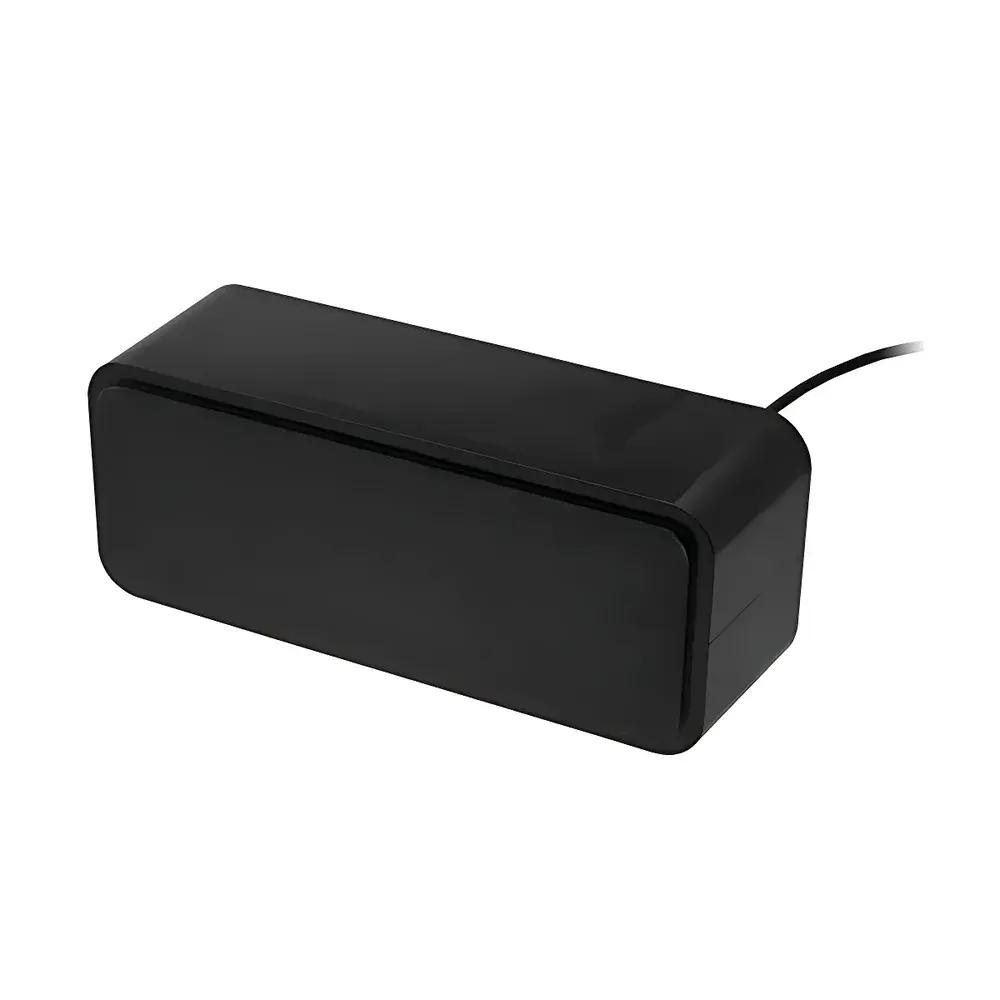
AIRMAR CM599LM Dual-Band Chirp Echo Sounder
| Brand | AIRMAR |
|---|---|
| Origin | USA |
| Model | CM599LM |
| Frequency Bands | Low Band 28–60 kHz (Beamwidth 23°–9°), Medium Band 80–130 kHz (Beamwidth 13°–8°) |
| Total Bandwidth | 82 kHz |
| Output Power | 2000–3000 W |
| Mounting Type | In-Tank (Hull-Mounted) |
| Housing Material | Epoxy-Encapsulated Composite |
| Hull Compatibility | Solid Fiberglass |
| Cable Length | 10 m |
| Weight | 13.73 kg |
| Temperature Sensor | Not Integrated |
| Compliance | CE, FCC, RoHS |
Overview
The AIRMAR CM599LM Dual-Band Chirp Echo Sounder is an engineered marine acoustic measurement instrument designed for high-fidelity bathymetric profiling and hydroacoustic target discrimination in commercial, research, and fisheries survey applications. Operating on the principle of frequency-modulated continuous-wave (FMCW) sonar—commonly referred to as “Chirp” technology—the CM599LM transmits swept-frequency pulses across two discrete, non-overlapping bands: a low band (28–60 kHz) optimized for deep-water penetration and bottom detection up to 3,000 meters, and a medium band (80–130 kHz) tuned for enhanced lateral resolution and species-level echo separation in mid-water columns. Unlike conventional pulsed echosounders, Chirp processing delivers superior signal-to-noise ratio (SNR), improved range resolution (~0.3–0.5 m typical), and significantly higher target detection probability—particularly critical when resolving dense pelagic aggregations, distinguishing baitfish from gamefish, or mapping submerged geological features with sub-meter fidelity.
Key Features
- Dual-band Chirp architecture enabling simultaneous operation at 28–60 kHz and 80–130 kHz, supporting both deep-water bathymetry and fine-scale biological target classification
- Adaptive beamwidth control: low-band beam narrows from 23° to 9° across frequency sweep; medium-band compresses from 13° to 8°, enhancing angular resolution with depth
- 82 kHz total instantaneous bandwidth, covering internationally standardized fishery acoustics frequencies—including 28 kHz (deep demersal surveys), 38 kHz (standard pelagic biomass estimation), 50 kHz (shallow coastal work), and 88/107 kHz (high-resolution near-bottom or juvenile fish studies)
- Epoxy-resin encapsulated transducer housing rated for permanent immersion, corrosion-resistant and pressure-stable to 30 bar (equivalent to ~300 m static head)
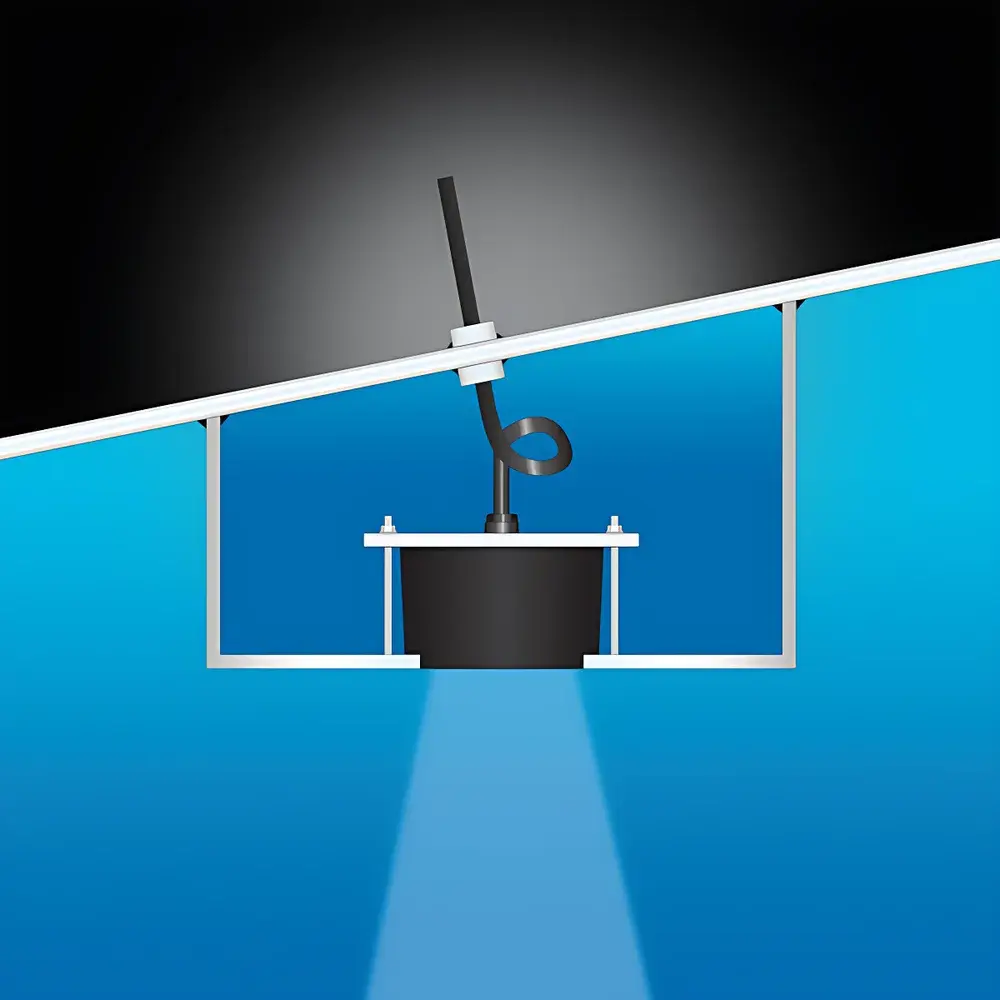
- Optimized for solid fiberglass hulls: integrated mounting interface ensures minimal acoustic coupling loss and eliminates air-gap artifacts common with through-hull installations
- Patented Xducer ID® technology enables automatic transducer identification and firmware-matched calibration profile loading within compatible display systems (e.g., Simrad, Garmin, Raymarine)
Sample Compatibility & Compliance
The CM599LM is intended for installation in dedicated in-tank cavities or flush-mounted recesses in solid fiberglass hulls—excluding cored composites, aluminum, steel, or wood due to acoustic impedance mismatch and signal attenuation risks. It complies with international electromagnetic compatibility standards (EN 55032 Class B, EN 61000-6-2), radio emissions directives (FCC Part 15 Subpart B), and environmental safety regulations (RoHS 3, REACH SVHC). While not intrinsically certified for GLP/GMP or ISO/IEC 17025-accredited laboratory use, its output data format (NMEA 2000, Ethernet UDP raw IQ data) supports traceable integration into validated hydroacoustic data acquisition chains meeting ASTM D6473 (Standard Guide for Acoustic Doppler Current Profiler Use) and ICES Cooperative Research Report No. 335 (Acoustic Survey Protocols for Pelagic Fish Stocks).
Software & Data Management
Raw echo data from the CM599LM is accessible via high-speed Ethernet (100BASE-TX) in quadrature (IQ) format for post-processing in industry-standard platforms including Echoview®, Sonar4/5, and QPS Qimera. NMEA 2000 output provides real-time depth, temperature (when paired with external PT100 sensor), and status telemetry compatible with marine network architectures. Firmware updates are performed using AIRMAR’s proprietary Transducer Configuration Utility (TCU), which logs calibration history, operational hours, and hardware revision metadata—supporting audit-ready documentation per FDA 21 CFR Part 11 requirements when deployed in regulated aquatic resource monitoring programs.
Applications
- Commercial fisheries stock assessment: multi-frequency target strength analysis for species identification and biomass quantification
- Oceanographic bathymetric mapping: high-accuracy seafloor morphology reconstruction in continental shelf and slope environments
- Aquaculture site characterization: sediment profiling, cage integrity verification, and net-pen biofouling monitoring
- Environmental impact studies: pre- and post-construction baseline surveys for offshore wind farms, dredging operations, or pipeline corridors
- Scientific echosounder calibration reference: used as a stable broadband source in intercomparison trials with scientific echosounders (e.g., SIMRAD EK80, BioSonics DT-X)
FAQ
Does the CM599LM include an integrated water temperature sensor?
No. The CM599LM does not embed a temperature transducer; external PT100 or thermistor probes must be connected via compatible NMEA 2000 gateways for concurrent thermal profiling.
Is the CM599LM suitable for aluminum or steel hulls?
No. Its acoustic design assumes impedance matching with solid fiberglass. Installation on metal or cored hulls requires custom acoustic isolation mounts and performance validation—not supported under warranty.
What is the maximum recommended operating depth for continuous duty?
The transducer is pressure-rated to 30 bar (≈300 m static depth); however, effective bottom detection extends to 3,000 m in optimal conditions due to Chirp pulse compression gain—subject to water column absorption, noise floor, and receiver sensitivity settings.
Can the CM599LM operate simultaneously on both bands?
Yes. Dual-band interleaved transmission is supported in all standard operating modes, with independent gain, pulse length, and sample interval configuration per band via NMEA 2000 command set or Ethernet API.
Is raw IQ data export supported for third-party processing?
Yes. Full complex baseband IQ streams are available over Ethernet at configurable decimation rates (up to 2 MS/s), enabling spectral analysis, beamforming, and machine learning–based target classification pipelines.