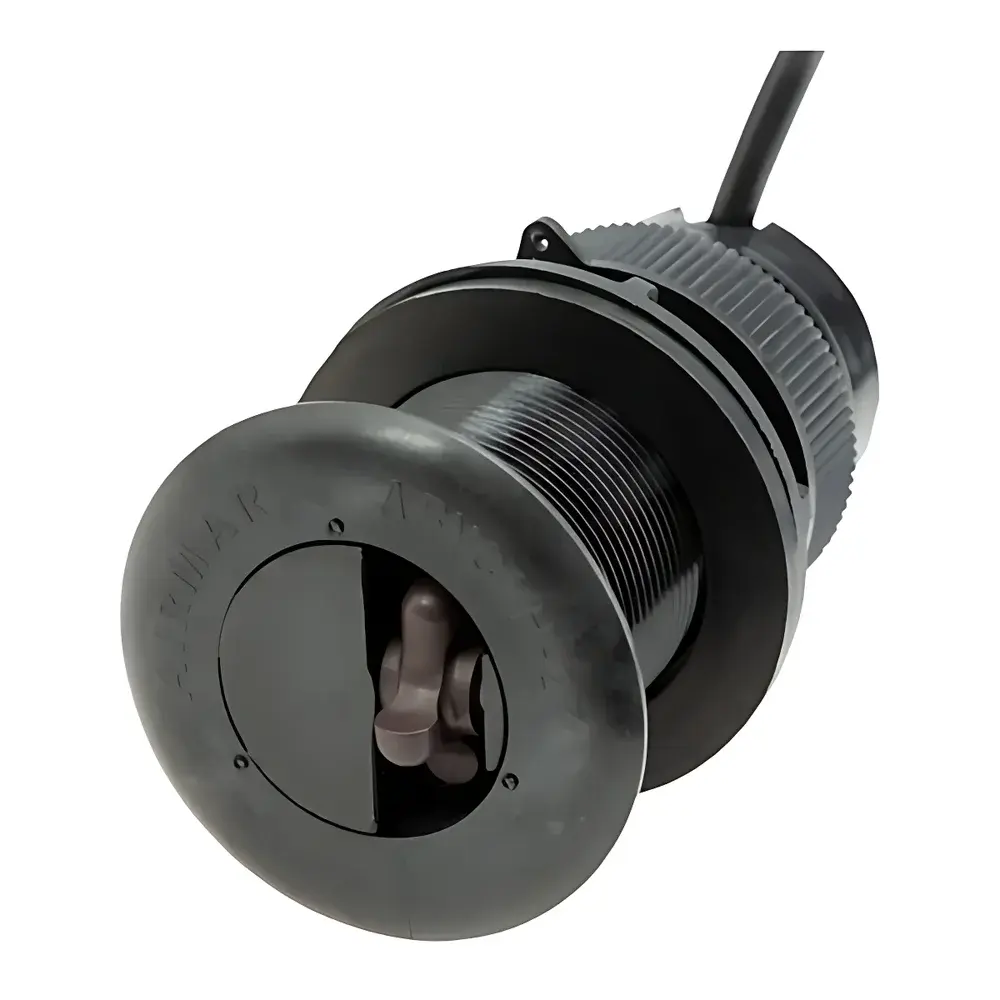
Airmar DST810 Smart Multifunction Transducer
| Brand | Airmar |
|---|---|
| Origin | USA |
| Model | DST810 |
| Weight (Plastic Housing) | 0.9 kg (2.0 lb) |
| Weight (Copper Housing) | 1.6 kg (3.5 lb) |
| Weight (Stainless Steel Housing) | 1.9 kg (4.2 lb) |
| Sonar Frequency | 235 kHz |
| Depth Range | 0.5–100 m |
| Depth Update Rate | 1 Hz |
| Water Speed Output Rate | 5 Hz |
| Tilt Measurement Update Rate | 10 Hz |
| Tilt Accuracy | ±1° (calibrated) |
| Speed Range | 0–45 knots |
| Operating Voltage | 9–16 VDC (NMEA 2000) |
| Current Draw | <200 mA |
| Pressure Rating | 3 m (10 ft) |
| Temperature Range | −10°C to +40°C |
| Temp Accuracy | ±0.5°C |
| Wireless Protocol | Bluetooth Low Energy (BLE) |
| BLE Range | up to 9 m (30 ft) |
| NMEA 2000 LEN | 3 |
| Compliance | IEC 60945 |
Overview
The Airmar DST810 Smart Multifunction Transducer is an integrated ultrasonic sensor engineered for high-fidelity marine performance monitoring and precision speed-through-water (STW) measurement. Utilizing a 235 kHz broadband echosounder, the DST810 simultaneously acquires depth, water temperature, vessel attitude (pitch and roll), and Doppler-derived speed-through-water data—each sampled at purpose-optimized rates: depth at 1 Hz, attitude at 10 Hz, and STW at 5 Hz. Its embedded MEMS-based inertial measurement unit (IMU) enables real-time tilt compensation, eliminating installation-induced errors caused by non-level mounting on hulls. Unlike legacy transducers that rely on external displays or PC-based utilities for calibration, the DST810 stores all configuration parameters—including NMEA PGN enablement, speed offset values, output frequency settings, and multi-point tilt-compensated calibration tables—directly in onboard non-volatile memory. This architecture ensures consistent, display-agnostic operation across heterogeneous NMEA 2000 networks, supporting interoperability with chartplotters, autopilots, and VDR systems from Raymarine, Garmin, Furuno, B&G, and others.
Key Features
- 5 Hz Doppler STW output: Delivers significantly smoother and more responsive speed data than conventional 1 Hz transducers—critical for dynamic maneuvering, sail trim optimization, and autopilot feed-forward control.
- Integrated 3-axis attitude sensing: Measures pitch and roll with ±1° calibrated accuracy up to ±22° hull inclination, enabling robust tilt compensation across the full 0–45 knot operational range.
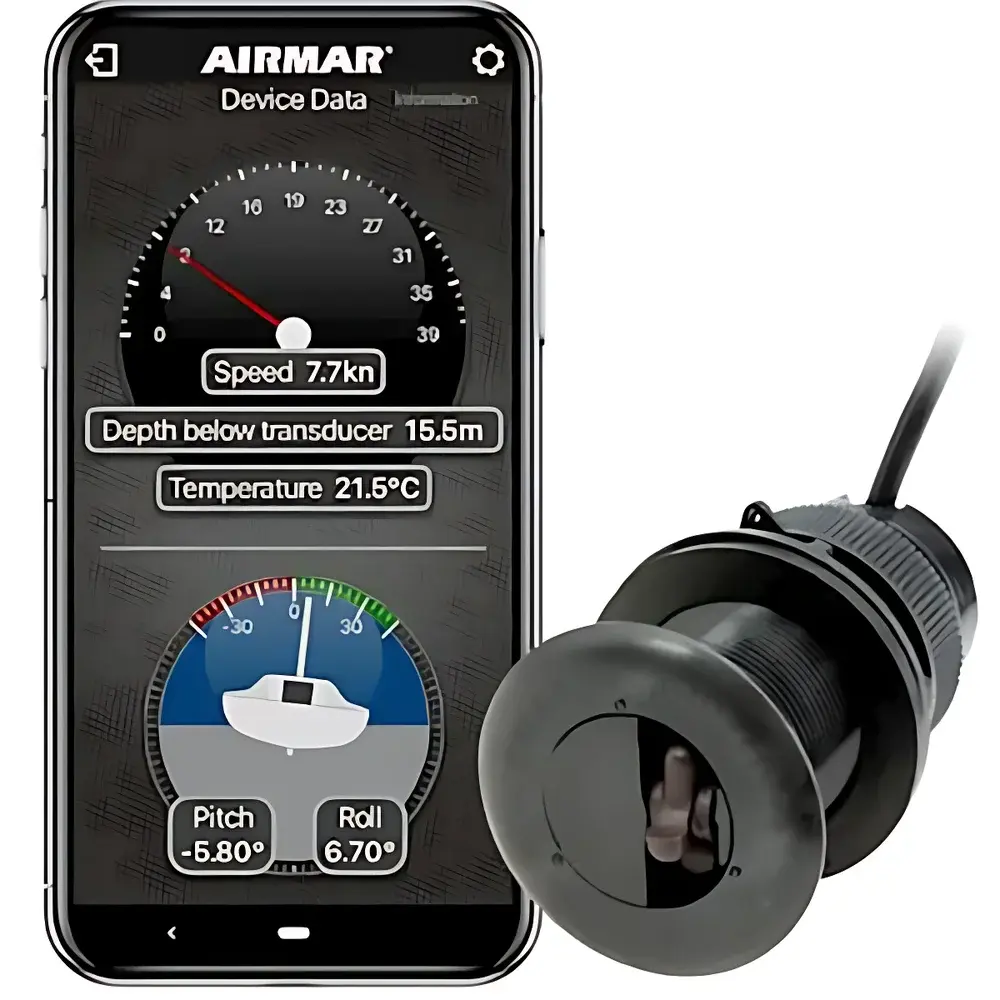
- Airmar CAST™ mobile application (iOS/Android): Provides wireless BLE configuration and calibration without requiring proprietary hardware or PC software—reducing commissioning time and eliminating dependency on vendor-specific toolchains.
- Multi-point STW calibration: Supports manual entry of up to 10 discrete speed points across multiple tilt angles—enabling empirical correction of hydrodynamic flow distortion effects unique to each hull form.
- Self-contained NMEA 2000 configuration storage: All calibration coefficients, PGN selections, and offset parameters reside within the transducer—not the display—ensuring configuration persistence during display replacement or network reconfiguration.
- Triple-material housing options: Available in plastic (0.9 kg), copper (1.6 kg), and stainless steel (1.9 kg) variants to match acoustic coupling requirements, corrosion resistance needs, and hull material compatibility (e.g., fiberglass, aluminum, or steel).
Sample Compatibility & Compliance
The DST810 is designed for permanent through-hull or flush-mount installation on planing, displacement, and semi-displacement hulls, including both power and sailing vessels. Its polyurethane acoustic window ensures optimal impedance matching with seawater while resisting biofouling adhesion. The transducer complies with IEC 60945 maritime equipment standards for electromagnetic compatibility (EMC), environmental resilience (IPX8 submersion rating to 3 m), and mechanical shock/vibration tolerance. It operates within the NMEA 2000® physical and data-link layer specifications (ISO 11898-2/3), carrying PGNs 127250 (Water Speed), 128259 (Depth), 127257 (Attitude), and 130311 (Environmental Parameters). Configuration via CAST App adheres to NMEA 2000 Parameter Group Number (PGN) 126208 (Configuration Information) and supports firmware updates compliant with NMEA 2000 TP1—ensuring traceability and audit readiness in GLP/GMP-aligned marine operations.
Software & Data Management
The Airmar CAST App implements a secure, BLE-based configuration interface that communicates directly with the DST810’s embedded microcontroller over standardized NMEA 2000 transport protocols. All calibration data—including tilt-compensated speed lookup tables, depth zero-offset adjustments, and user-defined PGN transmission schedules—is written to EEPROM with CRC-32 integrity verification. No cloud synchronization or remote telemetry occurs; all operations are local and offline. The app logs calibration timestamps and operator notes locally on the mobile device, supporting post-deployment review and regulatory documentation requirements. For integration into vessel management systems, raw NMEA 2000 messages are fully compatible with third-party data loggers (e.g., Actisense NGT-1, Maretron USB100) and support standard N2KAnalyzer parsing workflows.
Applications
- Sailing yachts: Enables precise STW measurement under heel—critical for true wind vector calculation, VMG optimization, and race-course performance analytics. The 5 Hz update rate resolves transient flow separation effects during tacking and gybing.
- Commercial workboats: Supports shallow-water navigation and dredging operations where accurate depth and attitude-corrected speed improve positioning fidelity and reduce groundings.
- Research vessels: Serves as a field-deployable reference sensor for validating ADCP profiles, calibrating CTD casts, and synchronizing multi-sensor data acquisition platforms.
- Fishing fleets: Enhances bottom contour mapping accuracy by correlating real-time depth, attitude, and speed data to correct sonar beam geometry distortions.
FAQ
Does the DST810 require external power beyond the NMEA 2000 bus?
No—the DST810 draws power exclusively from the NMEA 2000 backbone (9–16 VDC) and consumes less than 200 mA under nominal operation.
Can CAST App calibration data be exported or backed up?
Calibration parameters are stored permanently in the transducer’s internal memory; the CAST App does not export configuration files, but it retains local session history for reference.
Is the DST810 compatible with older NMEA 0183 displays?
No—it is NMEA 2000–only. A gateway (e.g., Actisense NGW-1) is required to translate its PGNs to NMEA 0183 sentences.
What is the maximum allowable hull deadrise angle for accurate STW measurement?
The DST810 supports installations with up to ±22° of static deadrise; dynamic tilt compensation remains effective within this envelope when calibrated using CAST App’s multi-angle routine.
How is temperature measurement integrated into speed calibration?
Water temperature (−10°C to +40°C, ±0.5°C accuracy) is used internally to adjust sound velocity assumptions in the Doppler processing algorithm—improving STW accuracy across varying thermal stratification conditions.