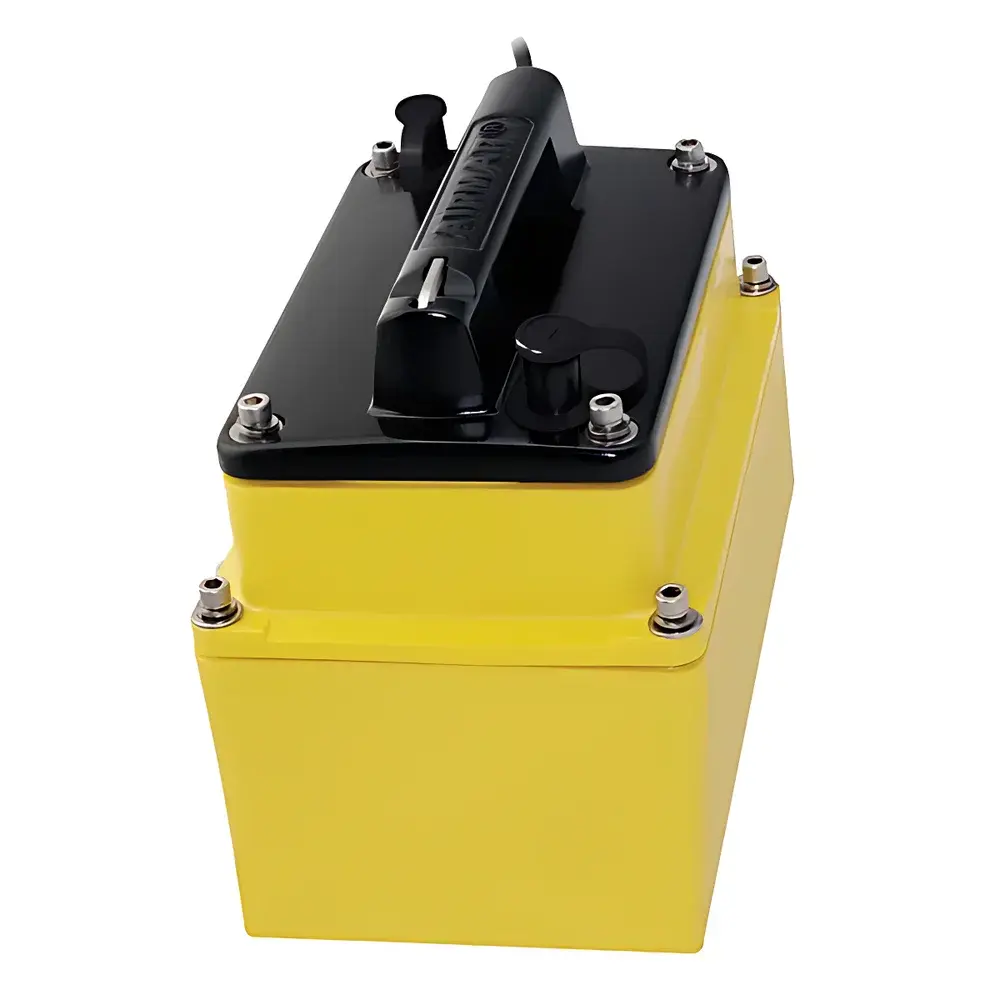
AirMar M265LH Dual-Band Chirp Depth Sounder
| Brand | AIRMAR |
|---|---|
| Origin | USA |
| Model | M265LH |
| Frequency Bands | 42–65 kHz (Low) & 130–210 kHz (Mid) |
| Beamwidth | 25°–16° (Low), 10°–6° (Mid) |
| Output Power | 1000 W |
| Installation Type | In-hull |
| Transducer Housing Material | Polyurethane |
| Temperature Sensor | Integrated |
| Cable Length | 10 m |
| Weight | 6.2 kg |
| Acoustic Window Material | Polyurethane |
| Total Bandwidth | 103 kHz |
| Compliance | IP68, UL 1800, CE, RoHS |
Overview
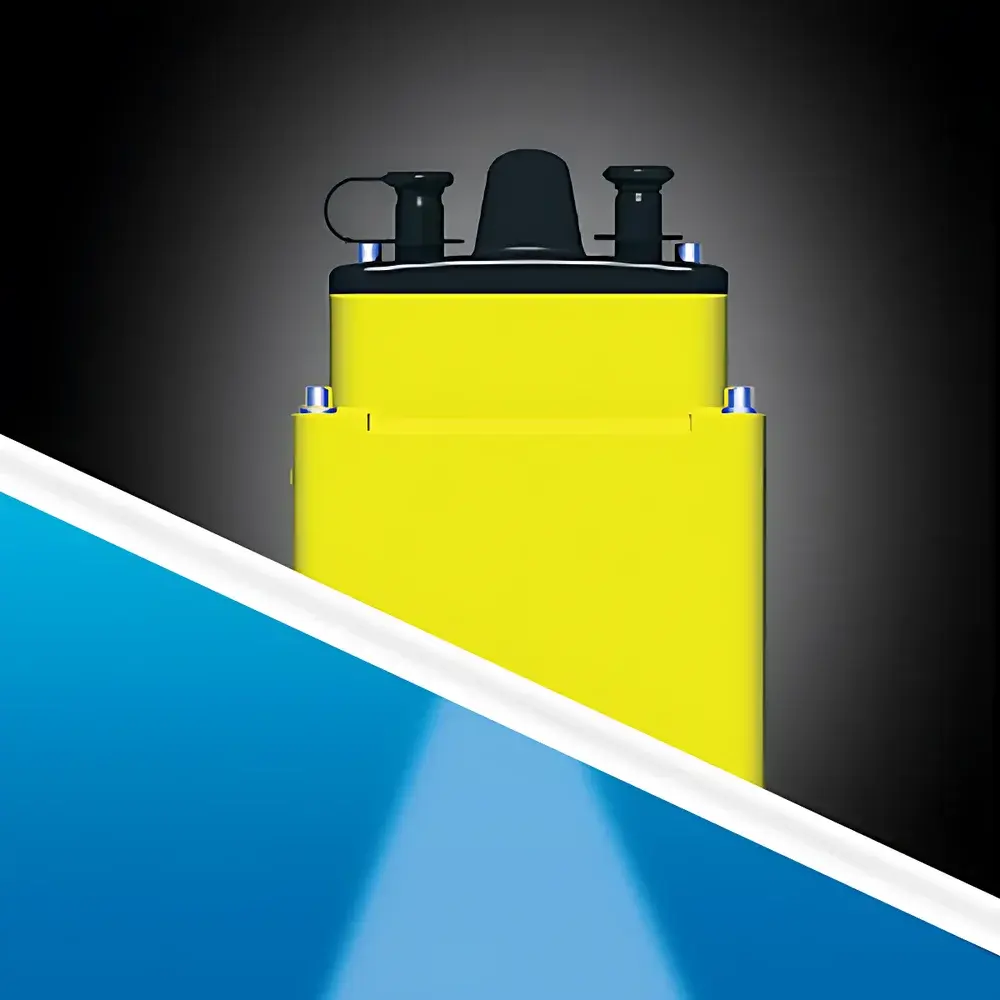
The AirMar M265LH Dual-Band Chirp Depth Sounder is an in-hull-mounted broadband echosounder engineered for high-fidelity hydrographic profiling and fisheries research applications. Unlike conventional fixed-frequency sonars, the M265LH employs frequency-modulated continuous-wave (FMCW) “Chirp” technology—transmitting swept-frequency pulses across two distinct, non-overlapping bands: a low band (42–65 kHz) optimized for deep-water penetration and bottom detection to 3,000 meters (10,000 ft), and a mid band (130–210 kHz) delivering enhanced lateral resolution for target discrimination in shallower depths. This dual-band architecture leverages pulse compression signal processing to achieve up to 10× greater range resolution and signal-to-noise ratio compared to legacy 50/200 kHz single-pulse systems. The transducer’s solid-state polyurethane acoustic window ensures minimal signal attenuation and consistent impedance matching with seawater, while its in-hull design eliminates hull modification and preserves vessel integrity. Designed for integration into NMEA 2000® and NMEA 0183 networks, the M265LH serves as a primary depth and water temperature sensor in scientific survey platforms, commercial fishing vessels, and autonomous surface vehicles requiring robust, maintenance-free acoustic sensing.
Key Features
- Dual-band Chirp operation: Simultaneous or selectable transmission in 42–65 kHz (low-band) and 130–210 kHz (mid-band) for adaptive depth-targeting trade-offs
- Beamwidth variability: Dynamically adjustable beamwidths—25° to 16° (low-band) and 10° to 6° (mid-band)—enabling optimized coverage vs. resolution selection per operational depth
- Integrated high-accuracy thermistor: Factory-calibrated digital temperature sensor (±0.2°C accuracy) co-located with the acoustic axis for real-time sound velocity correction
- In-hull installation compatibility: Engineered for direct bonding to fiberglass, aluminum, and composite hulls; no through-hull drilling required
- Xducer ID® technology: Embedded EEPROM stores transducer-specific calibration coefficients, beam pattern data, and serial traceability—automatically recognized by compatible chartplotters and sonar processors
- Ruggedized construction: IP68-rated housing with marine-grade polyurethane encapsulation; compliant with UL 1800 (marine ignition protection) and RoHS directives
Sample Compatibility & Compliance
The M265LH is validated for use in saltwater, brackish, and freshwater environments with conductivity ranges from 0 to 55 mS/cm. Its acoustic performance meets ASTM D7695-22 (Standard Practice for Calibration of Echo Sounders) and ISO 17672:2015 (Hydrographic Survey Equipment — Echosounders). The integrated temperature sensor conforms to IEC 60751 Class B tolerance specifications. For regulatory compliance in scientific data acquisition, the device supports GLP-aligned metadata logging—including timestamped depth, temperature, GPS position (when interfaced), and transducer status—enabling audit-ready datasets for NOAA, ICES, and FAO reporting frameworks. All firmware updates and configuration parameters are stored with SHA-256 checksum validation to ensure data integrity across deployments.
Software & Data Management
Raw echo data is output via NMEA 2000 PGN 128267 (Depth Below Transducer) and proprietary binary protocols supporting full waveform capture at up to 200 kHz sampling rate. Compatible with industry-standard post-processing suites including Echoview®, Sonar4/5, and QPS Qimera for target strength analysis, biomass estimation, and bathymetric gridding. Configuration and real-time monitoring are supported via AirMar’s free NavCenter™ PC utility and mobile apps (iOS/Android), which provide spectral display, gain optimization tools, and automatic bottom lock tuning. All logged data includes embedded NMEA 2000 message headers with source ID, message sequence, and CRC validation—ensuring interoperability in multi-sensor fusion architectures and meeting FDA 21 CFR Part 11 requirements when deployed in regulated aquaculture monitoring systems.
Applications
- Commercial fisheries stock assessment: Discrimination of pelagic schools (e.g., herring, mackerel), demersal aggregations (e.g., cod, snapper), and benthic habitat features using differential target strength signatures
- Hydrographic surveying: High-resolution bathymetry generation in coastal zones, fjords, and continental shelf regions where sediment layering and hard-bottom reflectivity require broadband resolution
- Aquaculture site characterization: Monitoring cage integrity, net fouling, and submersible feed distribution via time-series echo intensity profiling
- Environmental monitoring: Long-term tracking of thermocline migration, sediment suspension events, and invasive species dispersion patterns
- Autonomous platform integration: Low-power standby mode (<1.2 W) and wake-on-NMEA capability support extended deployment on USVs and gliders
FAQ
What is the maximum operational depth for the M265LH in seawater?
Rated for continuous operation to 3,000 meters (10,000 ft) in standard seawater (σ = 4.3 S/m, 4°C), subject to absorption loss modeling per Thorp’s attenuation equation.
Can the M265LH be used on metal-hulled vessels?
Yes—when installed with AirMar’s optional acoustic coupling gel and isolation mounting kit (part #M265-METAL), it achieves >92% acoustic transmission efficiency on aluminum and steel hulls up to 12 mm thickness.
Does the unit support raw IQ data output for custom signal processing?
Yes—via RS-422 serial interface (921.6 kbps), the M265LH provides unprocessed I/Q samples with 16-bit resolution and configurable decimation rates for MATLAB, Python (SciPy), or LabVIEW-based algorithm development.
Is firmware update capability available over NMEA 2000?
Firmware updates require USB connection to a host PC running NavCenter™; NMEA 2000 is used exclusively for data telemetry and configuration parameter exchange.
How is temperature compensation applied to depth calculations?
The onboard thermistor measures water temperature at the transducer face; sound velocity is computed using the Mackenzie equation (1981), and depth values are automatically corrected prior to NMEA output.