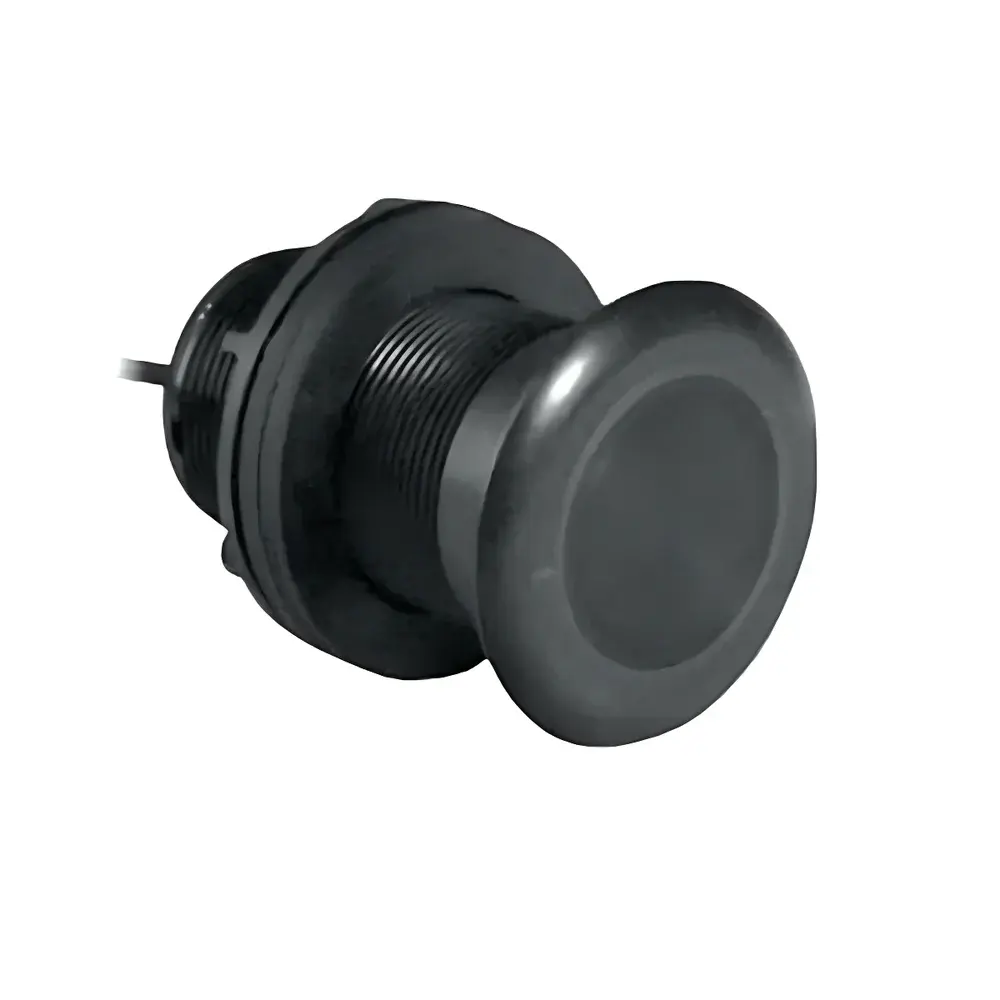
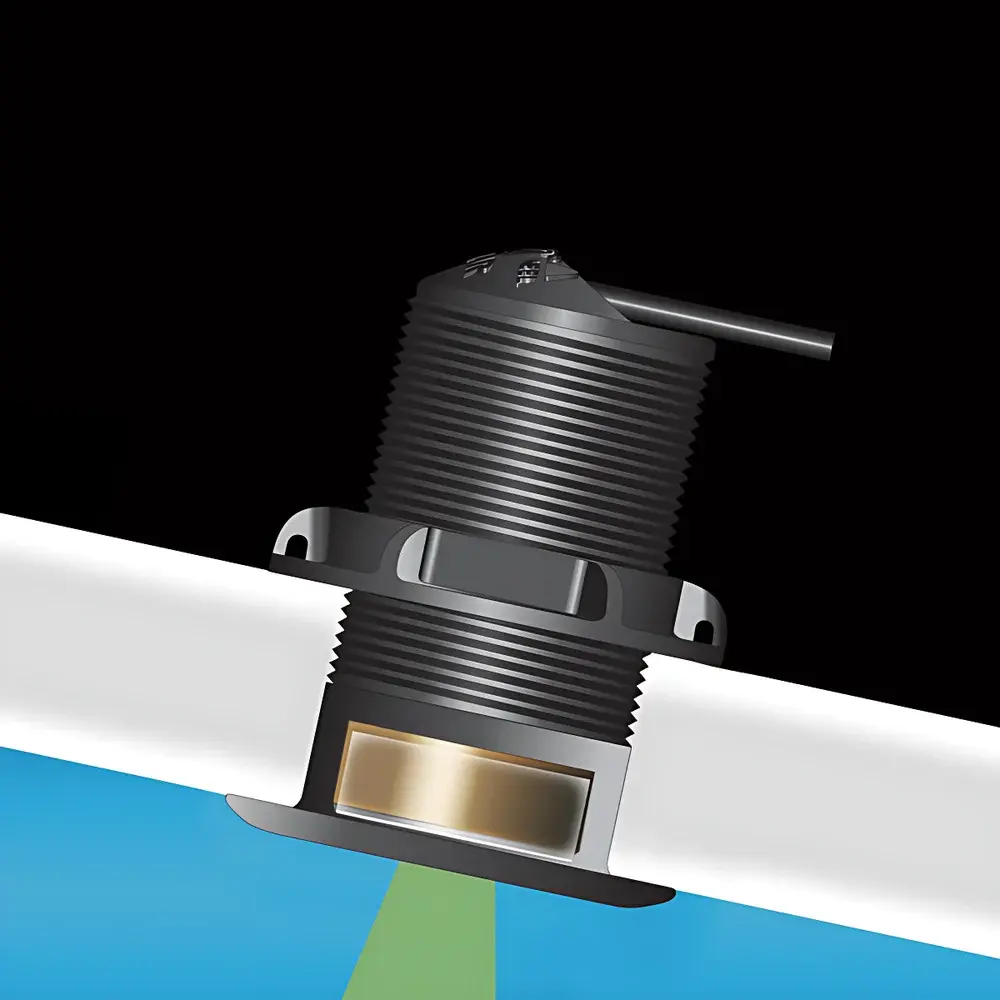
Airmar P319 Low-Profile Through-Hull Depth Sounder
| Brand | Airmar |
|---|---|
| Origin | USA |
| Model | P319 |
| Power Output | 600 W |
| Operating Frequencies | 50 kHz / 200 kHz |
| Beamwidth | 45° @ 50 kHz, 12° @ 200 kHz |
| Mounting Type | Low-Profile Through-Hull |
| Housing Material | Polyurethane |
| Transducer Window Material | Polyurethane |
| Hole Diameter | 51 mm |
| Stem Length | 94 mm |
| Cable Length | 10 m |
| Integrated Temperature Sensor | Yes |
| Tilt Compensation | Yes (Max. 8° Hull Tilt) |
| Weight | 0.9 kg |
Overview
The Airmar P319 is a compact, low-profile through-hull depth sounder engineered for precision hydrographic measurement in marine environments. Utilizing dual-frequency pulsed echo sounding at 50 kHz and 200 kHz, the P319 operates on the principle of time-of-flight acoustic propagation—transmitting short-duration pressure waves into the water column and measuring the elapsed time between transmission and return echo to calculate water depth. At 200 kHz, the transducer delivers high-resolution target definition ideal for shallow-water applications (typically ≤ 100 m), while the 50 kHz channel provides enhanced bottom tracking performance in deeper or acoustically attenuating conditions (up to 300+ m, depending on sediment composition and water clarity). Its near-flush mounting geometry—protruding only 5 mm beyond the hull—minimizes hydrodynamic drag and cavitation risk, making it suitable for planing and semi-displacement vessels 8 meters (25 feet) and longer. The polyurethane housing and acoustic window ensure broad compatibility with fiberglass, aluminum, and wood hulls, while eliminating galvanic corrosion concerns associated with metal housings.
Key Features
- Industry-standard low-profile through-hull design with 5 mm external protrusion for minimal drag and improved vessel efficiency
- Dual-frequency operation (50/200 kHz) enables adaptive depth profiling across varying water column conditions
- Integrated temperature sensor supports real-time sound velocity correction in depth calculations per ISO 17025-compliant workflows
- Onboard tilt compensation (±8° max hull inclination) maintains beam alignment and depth accuracy on non-level hull surfaces
- XducerID® technology enables automatic transducer identification and configuration recall within compatible chartplotters (Furuno, Garmin, Lowrance, Raymarine)
- ABYC H-27–certified housing ensures compliance with U.S. marine electrical and mechanical safety standards for transducer installation
- Pre-installed rubber gasket accommodates minor hull surface irregularities during through-hull nut tightening
- Right-angle cable exit reduces strain on the connector under vibration and minimizes routing interference in confined engine compartments
Sample Compatibility & Compliance
The P319 is validated for use on monohull and multihull vessels with hull materials including fiberglass-reinforced polymer (FRP), aluminum, and solid wood—provided the hull thickness falls within the specified mounting envelope (minimum 6 mm, maximum 38 mm). It is not recommended for cored composite hulls without structural reinforcement at the mounting location. The transducer meets ABYC H-27 requirements for underwater transducer mechanical integrity, electrical isolation, and pressure resistance up to 30 m static head. While not inherently certified to IEC 60945 or EN 62288, its electrical interface conforms to NMEA 0183 v3.0 and NMEA 2000 (via optional adapter) signal protocols, supporting integration into Class-approved bridge systems where transducer data contributes to navigational safety functions. No regulatory certification for use in SOLAS or IMO GMDSS contexts is claimed; users must verify suitability per vessel classification society requirements.
Software & Data Management
The P319 does not incorporate onboard firmware storage or user-accessible configuration software. Instead, it relies on host system integration via standard NMEA interfaces. When connected to compatible MFDs (e.g., Furuno TZtouch3, Garmin GPSMAP 8000 series), transducer parameters—including frequency selection, gain, noise rejection, and depth range—are managed entirely within the display unit’s menu architecture. XducerID® ensures persistent recognition across power cycles and eliminates manual setup errors during system reconfiguration. For fleet operators maintaining GLP/GMP-aligned maintenance logs, the transducer’s Airmar part number (e.g., 31-653-3-01) serves as a traceable asset identifier in calibration and service records. Raw echo data is not exposed externally; depth and temperature outputs are transmitted as standardized NMEA sentences (DPT, MTW, DBT), ensuring interoperability with third-party data logging platforms compliant with IEC 61162-1.
Applications
- Commercial fishing vessel depth monitoring and bottom contour mapping
- Recreational powerboat navigation in coastal and inland waterways
- Scientific survey support for bathymetric baseline studies (when paired with GNSS positioning)
- Marina and harbor infrastructure inspection where shallow-water resolution is critical
- Autonomous surface vehicle (ASV) integration for unmanned hydrographic missions
- Training vessel instrumentation for maritime academy navigation labs
FAQ
Is the P319 suitable for metal-hulled vessels?
Yes—its polyurethane housing prevents galvanic coupling with aluminum or steel hulls. For bronze-hulled vessels, Airmar recommends the B117 model instead.
Does the P319 require a separate temperature probe?
No—the temperature sensor is integrated into the transducer housing and shares the same cable assembly.
Can the P319 be installed on a cored fiberglass hull?
Only if the core material is locally removed and replaced with solid laminate or epoxy-filled reinforcement at the mounting location to prevent delamination under hydrostatic load.
What is the maximum operating depth for reliable bottom detection?
Under typical seawater conditions (15°C, 35 ppt salinity), reliable bottom lock is achieved to approximately 280 m at 50 kHz and 65 m at 200 kHz, assuming moderate seabed reflectivity (sand/mud).
Is the 10-meter cable length field-serviceable?
The cable is permanently molded to the transducer housing and not designed for field replacement; Airmar offers custom-length cables ordered at time of purchase.