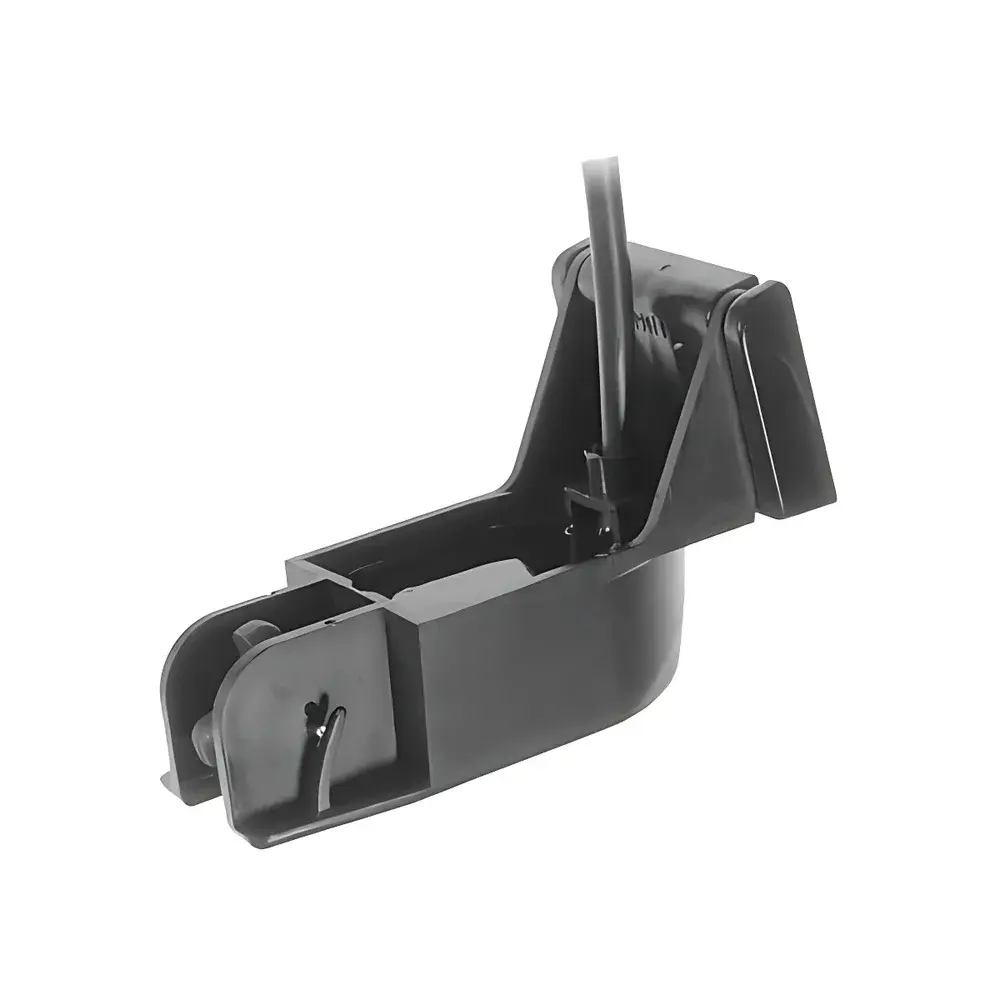
AirMar P32 Multifunctional Depth Sounder with Integrated Water Temperature and Flow Velocity Sensing
| Brand | AIRMAR |
|---|---|
| Origin | USA |
| Model | P32 |
| Weight | 0.5 kg (1.1 lb) |
| Beam Angle | 3°–20° |
| Transducer Window Material | Layered Plastic Epoxy (LPE) |
| Housing | Chemically Resistant & Impact-Resistant Plastic |
| Mounting | Removable Vertical-Adjustable Bracket (19 mm / 3/4″ range) |
| Sensor Type | Combined Echo-Sounder, Thermistor, and Paddle-Wheel Flow Sensor |
Overview
The AirMar P32 is a discontinued but historically significant multifunctional acoustic measurement instrument engineered for compact marine environments. Designed as an integrated echo-sounder, water temperature probe, and mechanical flow velocity sensor, the P32 operates on pulse-echo sonar principles for depth determination—emitting short-duration ultrasonic pulses (typically in the 100–200 kHz range) and measuring the time-of-flight to the seabed. Simultaneously, it incorporates a calibrated thermistor for continuous water temperature monitoring and a precision-machined square-blade paddle-wheel assembly for volumetric flow velocity measurement. Its layered plastic epoxy (LPE) transducer window ensures optimal acoustic coupling while minimizing signal distortion from boundary layer effects. Though no longer in production, the P32 remains referenced in legacy marine instrumentation documentation due to its robust integration architecture and field-proven performance in shallow-water hydrographic surveys and small-vessel navigation support.
Key Features
- Triple-parameter sensing capability: simultaneous real-time acquisition of water depth, temperature, and flow velocity
- Compact form factor (0.5 kg) with modular mechanical design optimized for retrofitting on small craft
- Removable vertical-adjustable mounting bracket (19 mm travel range) enabling precise transducer alignment relative to hull geometry
- Chemically inert and impact-resistant polymer housing rated for prolonged exposure to saltwater, fuel vapors, and UV radiation
- Square-profile paddle-wheel rotor engineered to improve linearity across low-to-moderate flow ranges (typical operational span: 0.2–5 m/s), reducing slip error common in curved-blade designs
- Smooth-surface impeller geometry minimizes entanglement risk with aquatic debris and biofouling accumulation
- LPE transducer window provides broadband acoustic transmission with minimal internal reflection and thermal expansion mismatch
Sample Compatibility & Compliance
The P32 is intended for installation on rigid-hull vessels including outboard-powered runabouts, inflatable boats (RIBs), and small research platforms operating in freshwater or brackish environments. It is not rated for high-speed (>35 knots) or deep-ocean deployment. While the device predates modern regulatory frameworks such as IMO Resolution MSC.337(91) for echo-sounders or IEC 62287-1:2017 for marine navigation equipment, its analog NMEA 0183 output (depth, temperature, speed-through-water) conforms to legacy vessel integration standards. The thermistor complies with ASTM E1112-17 for immersion-type temperature sensors, and the paddle-wheel flow element meets ISO 748:2007 guidelines for open-channel velocity measurement methodology when used in controlled calibration tanks.
Software & Data Management
The P32 outputs asynchronous serial data via RS-422 or RS-232 interfaces using standard NMEA 0183 sentence formats—including DPT (depth), MTW (mean water temperature), and VHW (velocity through water). No proprietary firmware or configuration software is required; raw data streams are compatible with third-party chartplotters, logging systems (e.g., Actisense NGT-1), and custom Python/Matlab acquisition scripts. Because the unit lacks onboard memory or timestamping, external synchronization (e.g., GPS PPS signal) is recommended for time-critical hydrographic profiling. While the P32 does not support FDA 21 CFR Part 11 or GLP audit trails (as it is not a regulated laboratory instrument), its deterministic analog-to-digital conversion path ensures traceable repeatability under stable environmental conditions.
Applications
- Shallow-water bathymetric mapping on survey dinghies and autonomous surface vehicles (ASVs)
- Real-time depth and temperature logging for limnological studies in lakes and estuaries
- Calibration reference for larger multi-beam echosounders during pre-deployment checks
- Flow velocity verification in controlled flume experiments where compact sensor footprint is critical
- Training platforms for maritime academy students learning fundamental hydroacoustic principles
- Emergency backup depth/temperature telemetry on auxiliary vessels lacking integrated bridge systems
FAQ
Is the AirMar P32 still supported by the manufacturer?
No—AIRMAR officially discontinued the P32 in 2015 and ceased technical support, firmware updates, and spare-part availability after 2018.
Can the P32 be interfaced with modern NMEA 2000 networks?
Not natively; it requires an NMEA 0183-to-NMEA 2000 gateway (e.g., Actisense NGW-1) for protocol translation.
What is the typical depth measurement range of the P32?
Based on beam angle and transducer sensitivity, the practical range is 0.3 m to 60 m in freshwater, with reduced accuracy below 0.5 m due to near-field interference.
Does the paddle-wheel sensor require periodic recalibration?
Yes—mechanical flow sensors degrade over time due to bearing wear and biofilm accumulation; annual recalibration against a certified flow bench is recommended.
Is the LPE transducer window replaceable in the field?
No—the LPE window is permanently bonded during manufacturing; replacement requires factory service or full transducer unit substitution.