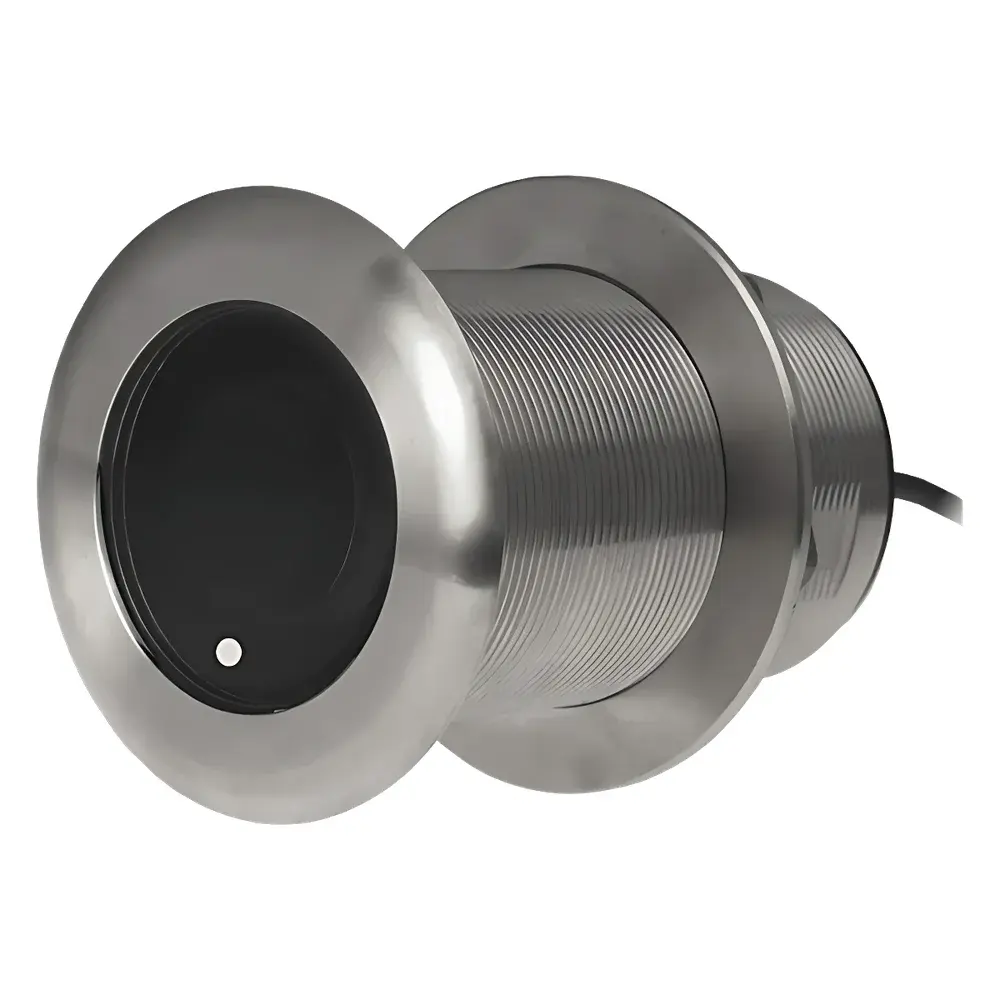
AIRMAR SS175MW Chirp-Ready Medium-Widebeam Through-Hull Sonar Transducer
| Brand | AIRMAR |
|---|---|
| Origin | USA |
| Model | SS175MW |
| Power Output | 1 kW |
| Operating Frequency Range | 60–100 kHz |
| Beamwidth | 57°–73° (port/starboard), avg. 16° (fore/aft) |
| Maximum Depth Rating | 400 m |
| Housing Material | Marine-grade stainless steel |
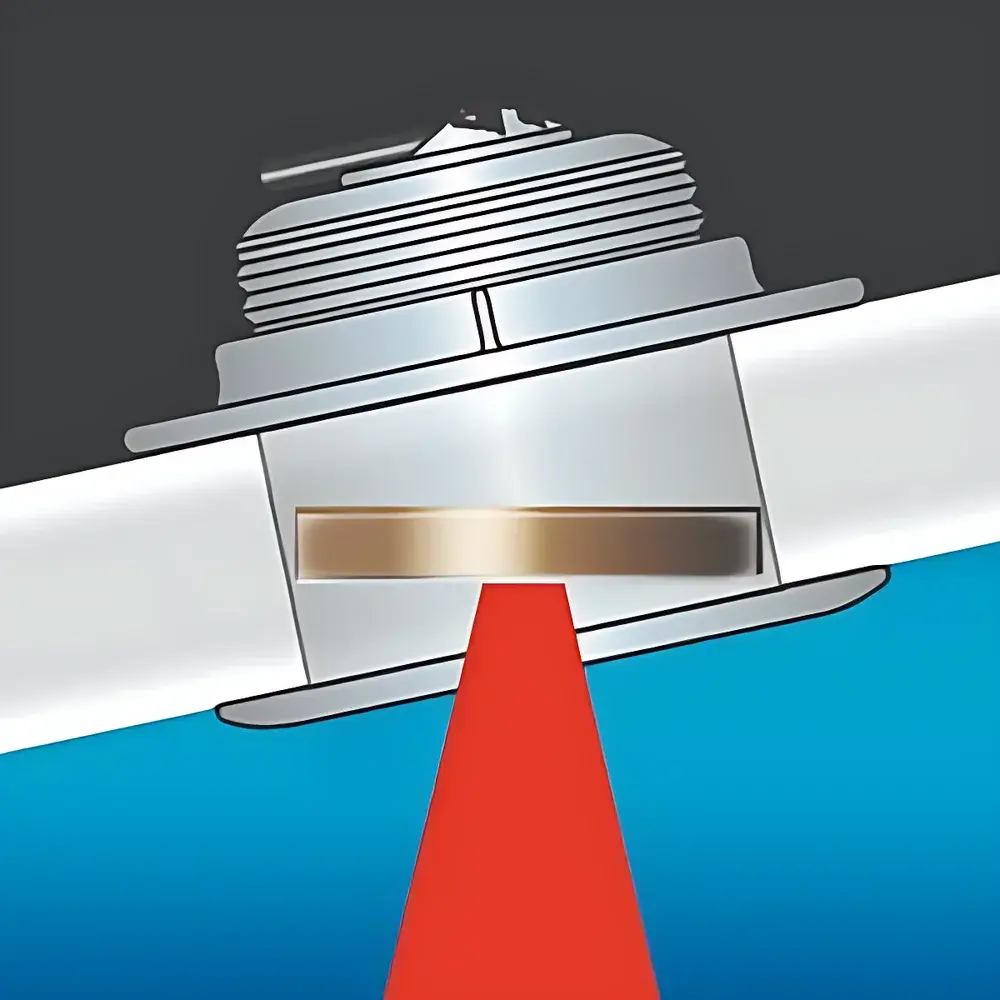
| Installation Type | Through-hull with tilt-element compensation |
| Tilt Options | 0°, 12°, or 20° fixed ceramic element orientation |
| Transducer Window Material | Polyurethane |
| Hull Cutout Diameter | 95 mm (fiberglass/wood), 105 mm (metal) |
| Hull Angle Compensation Range | 0°–24° |
| Cable Length | 9 m |
| Weight | 2.7 kg |
| Integrated Sensors | Depth and fast-response water temperature |
Overview
The AIRMAR SS175MW is a high-performance, chirp-ready medium-widebeam through-hull sonar transducer engineered for precision hydrographic mapping, commercial and recreational fisheries monitoring, and mid-water target discrimination in marine environments. Unlike conventional single-frequency transducers, the SS175MW operates across a continuous 40 kHz bandwidth (60–100 kHz), enabling compatibility with modern broadband CHIRP sonar processors that leverage pulse compression for enhanced signal-to-noise ratio, improved range resolution, and superior target separation—particularly critical for identifying pelagic species in the water column. Its tilt-element architecture compensates for hull deadrise angles up to 24°, ensuring the piezoceramic element remains vertically aligned relative to the water surface regardless of vessel geometry. This mechanical correction maximizes acoustic coupling efficiency and minimizes beam distortion, directly contributing to consistent echo return amplitude and angular accuracy in both depth and target localization measurements.
Key Features
- 1 kW peak power output supporting reliable detection at depths up to 400 m (1,300 ft) under typical seawater conditions
- Medium-widebeam radiation pattern: 57°–73° horizontal beamwidth (port/starboard) and ~16° vertical beamwidth (fore/aft), optimized for broad-area coverage without sacrificing mid-depth sensitivity
- Integrated dual-sensor module providing simultaneous analog depth and fast-response water temperature outputs (±0.5°C accuracy, <1 s thermal time constant)
- Marine-grade 316 stainless steel housing with polyurethane acoustic window—corrosion-resistant and acoustically transparent across the operating band
- Three factory-set tilt-element configurations (0°, 12°, 20°) matched to common hull deadrise angles; eliminates need for field shimming or custom mounting brackets
- Xducer ID® digital identification protocol enabling automatic transducer parameter recall and firmware-matched calibration in compatible CHIRP displays and processors
- Low-profile through-hull design with minimal internal protrusion—reducing drag and facilitating installation on vessels up to 11 m LOA
Sample Compatibility & Compliance
The SS175MW is certified for use on all hull materials—including fiberglass, wood, aluminum, and steel—when installed per AIRMAR’s published mechanical and electrical specifications. Its polyurethane window exhibits stable acoustic impedance matching across salinities from 0 to 40 ppt and temperatures from −2°C to +35°C. The transducer meets IEC 60529 IP68 ingress protection requirements when properly sealed, and its electrical interface complies with NMEA 2000 (Device Class: Transducer) and NMEA 0183 v4.10 standards for depth and temperature data transmission. While not intrinsically certified for Class I Div 1 hazardous locations, it is routinely deployed in offshore fishing, research survey, and coastal monitoring applications adhering to ISO 17635:2010 (non-destructive testing of welds) and ASTM D7504/D7504M (sonar-based bathymetric validation protocols).
Software & Data Management
The SS175MW interfaces seamlessly with industry-standard CHIRP-capable chartplotters and sonar processors (e.g., Simrad NSS/evo3, Garmin GPSMAP series, Raymarine Axiom+, Furuno TZtouch). Xducer ID® enables plug-and-play configuration: upon connection, host systems auto-detect transducer model, frequency range, tilt angle, and recommended gain/sensitivity profiles. Raw IQ data output supports post-processing in third-party hydroacoustic software such as Echoview, QPS Qimera, and Sonar4/5 for quantitative biomass estimation, target strength analysis, and multi-beam alignment verification. All sensor telemetry—including depth, temperature, and transducer status—is timestamped and logged with millisecond precision, satisfying traceability requirements under GLP-aligned data acquisition workflows.
Applications
- Commercial pelagic fisheries: Real-time detection and classification of schooling fish (e.g., herring, mackerel, anchovy) within the upper 200 m water column
- Scientific echosounding: Calibration reference transducer for multi-frequency acoustic surveys targeting zooplankton, mesopelagic layers, and fish stock assessment
- Small-vessel navigation safety: High-resolution bottom profiling in shallow coastal zones and estuarine environments where traditional narrow-beam transducers suffer from blind zones
- ROV/AUV integration: Compact footprint and low electromagnetic signature support auxiliary deployment on unmanned platforms requiring passive acoustic sensing
- Aquaculture site monitoring: Detection of net integrity issues, predator intrusion, and cage deformation via anomaly recognition in backscatter patterns
FAQ
Is the SS175MW compatible with non-CHIRP sonar systems?
Yes—it functions as a conventional 75 kHz or 85 kHz single-frequency transducer when connected to legacy pulse-compression–incapable displays, though full bandwidth utilization and advanced target discrimination require a CHIRP-enabled processor.
What is the recommended minimum vessel length for optimal performance?
The SS175MW is validated for vessels between 5 m and 11 m LOA; installations on shorter hulls may require additional attention to keel clearance and turbulence management to avoid flow-induced noise artifacts.
Does the transducer require external temperature compensation?
No—the integrated fast-response thermistor provides real-time water temperature input to the host system, enabling automatic sound velocity correction per UNESCO 1983 algorithm or user-defined salinity/temperature profiles.
Can the tilt angle be adjusted after installation?
No—the tilt is factory-fixed per model variant (0°, 12°, or 20°); selection must be based on measured hull deadrise prior to purchase.
Is firmware update capability supported?
Firmware resides in the host display or processor—not the transducer—and Xducer ID® ensures persistent parameter mapping across system updates and hardware replacements.