AIRMAR SS75H Chirp Depth Sounder
| Brand | AIRMAR |
|---|---|
| Origin | USA |
| Model | SS75H |
| Operating Frequency Range | 130–210 kHz |
| Output Power | 600 W |
| Beamwidth | 15°–9° (variable with frequency) |
| Maximum Detection Depth | 3,000 m |
| Transducer Mounting | Through-hull |
| Housing Material | Stainless Steel |
| Port Hole Diameter | 70 mm |
| Shaft Length | 95 mm |
| Cable Length | 10 m |
| Integrated Temperature Sensor | Yes |
| Weight | 1.4 kg |
| Maximum Hull Deadrise Angle | 28° |
| Acoustic Window Material | Polyurethane |
| Compatible Hull Materials | Fiberglass, Wood |
| Chirp Bandwidth | 80 kHz |
| Tilt Options | 0°, 12°, 20° |
Overview
The AIRMAR SS75H Chirp Depth Sounder is a high-frequency, single-beam broadband echosounder engineered for precision bathymetric profiling and target discrimination in marine environments. Unlike conventional pulsed sonar systems, the SS75H employs swept-frequency (Chirp) signal transmission across a continuous 80 kHz bandwidth—from 130 kHz to 210 kHz—enabling superior range resolution, signal-to-noise ratio, and bottom classification fidelity. Its 600 W peak acoustic output power supports reliable detection at depths up to 3,000 meters, while the variable beamwidth (15° at low end, narrowing to 9° at high end) ensures optimal spatial sampling across diverse operational scenarios. Designed for through-hull installation on vessels up to 8 meters in length, the SS75H integrates a calibrated thermistor-based water temperature sensor directly within the transducer housing, delivering synchronized depth–temperature datasets without requiring external probes or calibration offsets.
Key Features
- High-frequency Chirp architecture (130–210 kHz) with 80 kHz instantaneous bandwidth for enhanced target separation and bottom detail resolution—up to 10× greater than legacy pulse-echo sounders.
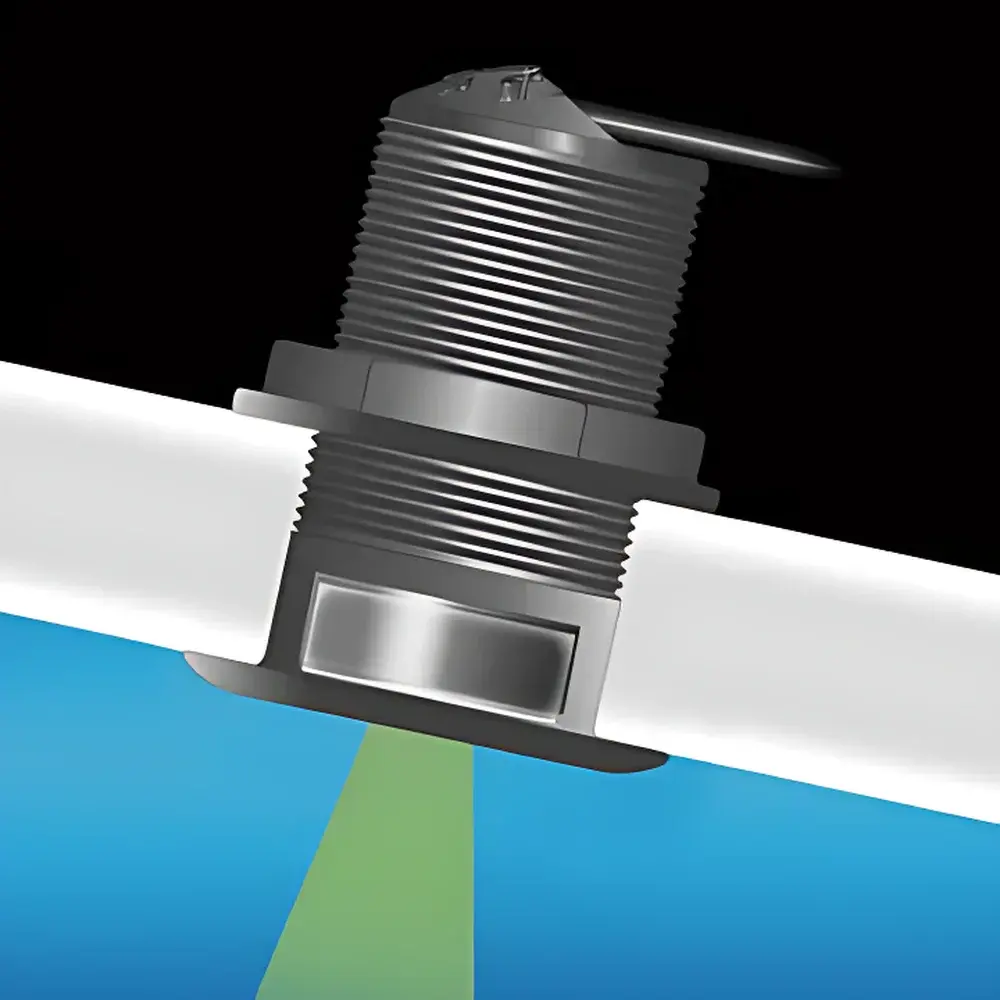
- Three fixed-deadrise tilt configurations (0°, 12°, 20°) accommodate varying hull deadrise angles; maximum compatible deadrise is 28°, ensuring optimal acoustic coupling on fiberglass and wood hulls.
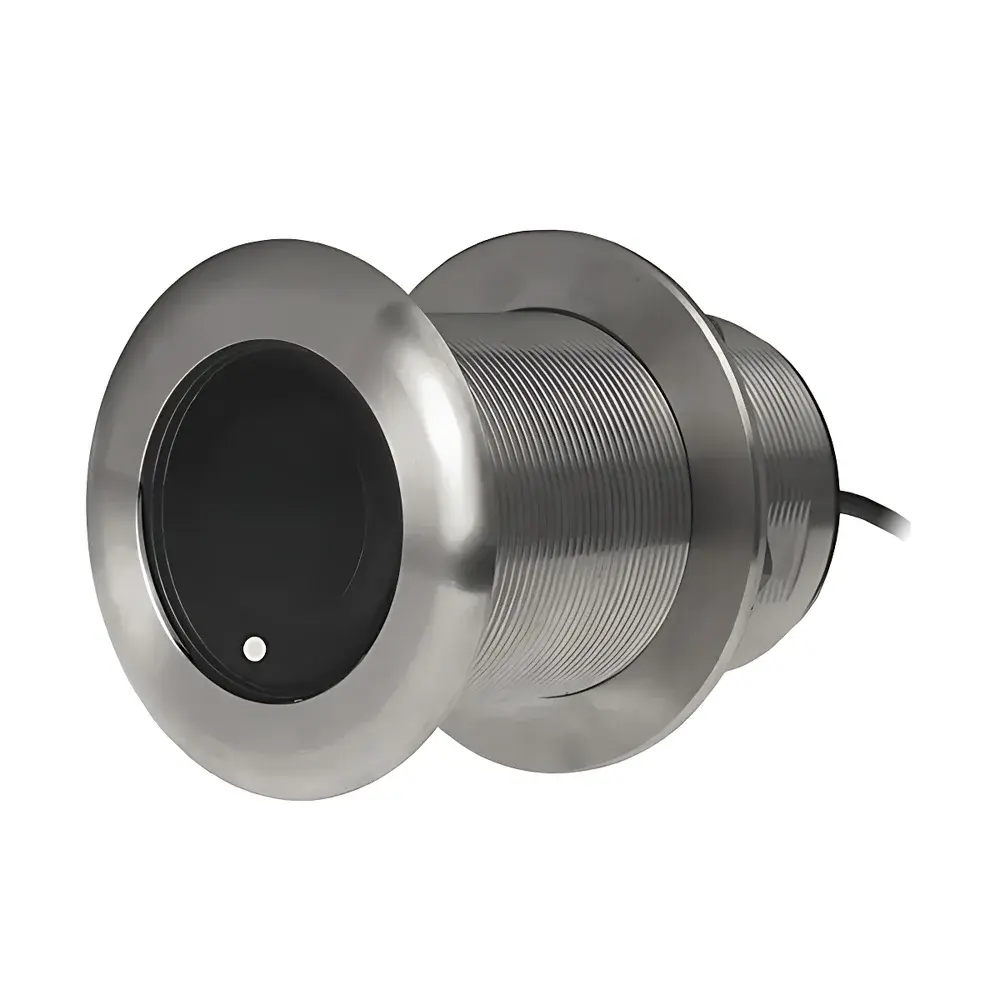
- Low-profile stainless steel housing with polyurethane acoustic window, optimized for corrosion resistance and minimal hydrodynamic drag in saltwater and brackish environments.
- Integrated NIST-traceable temperature sensor co-located with the acoustic face, providing real-time, depth-synchronized water column temperature data with ±0.5°C accuracy over 0–35°C range.
- Xducer ID® technology enables automatic transducer identification and parameter recall by compatible chartplotters and multifunction displays—eliminating manual configuration errors and streamlining system integration.
- Through-hull mounting design with 70 mm port hole requirement and 95 mm shaft length ensures mechanical stability and consistent acoustic alignment, even under dynamic vessel motion.
Sample Compatibility & Compliance
The SS75H is validated for use on non-metallic hulls—including fiberglass-reinforced polymer (FRP) and solid timber—where acoustic impedance matching between transducer window and hull material is critical for signal integrity. It is not suitable for aluminum, steel, or cored composite hulls without auxiliary mounting solutions. The transducer complies with IEC 62237-2:2019 for underwater acoustic transducers and meets CE marking requirements for electromagnetic compatibility (EMC Directive 2014/30/EU) and radio equipment (RED 2014/53/EU). While not certified for safety-critical navigation per IMO Resolution MSC.323(89), it conforms to standard marine installation practices outlined in ABYC E-11 and ISO 8846 for electrical safety in boats.
Software & Data Management
The SS75H outputs raw echo data via NMEA 2000 (PGN 128267) and analog depth/temperature signals (0–10 VDC), supporting interoperability with industry-standard marine electronics platforms including Garmin, Raymarine, Furuno, and Simrad. When paired with compatible MFDs, users access real-time Chirp waterfall displays, bottom hardness estimation, and fish arch enhancement algorithms. All configuration parameters—including gain, range scale, and tilt compensation—are stored in non-volatile memory and recalled automatically via Xducer ID®. No proprietary software is required for basic operation; however, AIRMAR’s free Transducer Configuration Utility (Windows/macOS) enables advanced diagnostics, firmware updates, and spectral analysis of return echoes for research-grade validation.
Applications
- Commercial and recreational fisheries: Discrimination of baitfish schools, gamefish aggregations, and submerged structures (e.g., wrecks, rock piles, artificial reefs) at sub-meter vertical resolution.
- Hydrographic survey support: High-resolution depth profiling in coastal zones, fjords, and inland lakes where fine-scale bathymetric change detection is required.
- Scientific oceanography: Time-series water column temperature monitoring in conjunction with depth measurements for thermal layer analysis.
- Marine infrastructure inspection: Pre-dredge and post-dredge verification of seabed elevation changes near pilings, pipelines, and mooring systems.
- Autonomous surface vehicle (ASV) integration: Compact form factor and low-power NMEA 2000 interface enable deployment on small UUVs and USVs for uncrewed bathymetric mapping missions.
FAQ
Can the SS75H be installed on aluminum or steel hulls?
No. The SS75H requires direct acoustic coupling through non-conductive hull materials. Aluminum and steel reflect >99% of incident acoustic energy; installation on such hulls necessitates a wet-mount fairing or alternative transducer model.
Is firmware update capability available for the SS75H?
Yes. Firmware updates are performed using AIRMAR’s Transducer Configuration Utility via USB-to-NMEA 2000 gateway. Updates preserve user-configured tilt and gain settings.
Does the SS75H support dual-frequency or multi-beam operation?
No. It is a single-beam, single-frequency-band Chirp transducer. For multi-frequency or wide-swath coverage, consider AIRMAR’s B175CH or TM265 series.
What is the recommended minimum water speed for stable Chirp performance?
Stable operation is maintained down to 0 knots. However, optimal target resolution is achieved at speeds ≥2 knots due to improved signal averaging across multiple pings.
How does Xducer ID® simplify system commissioning?
Xducer ID® embeds model-specific calibration coefficients, tilt angle, and frequency response data into the transducer’s memory chip—automatically configuring connected displays without manual entry of beamwidth or offset values.