
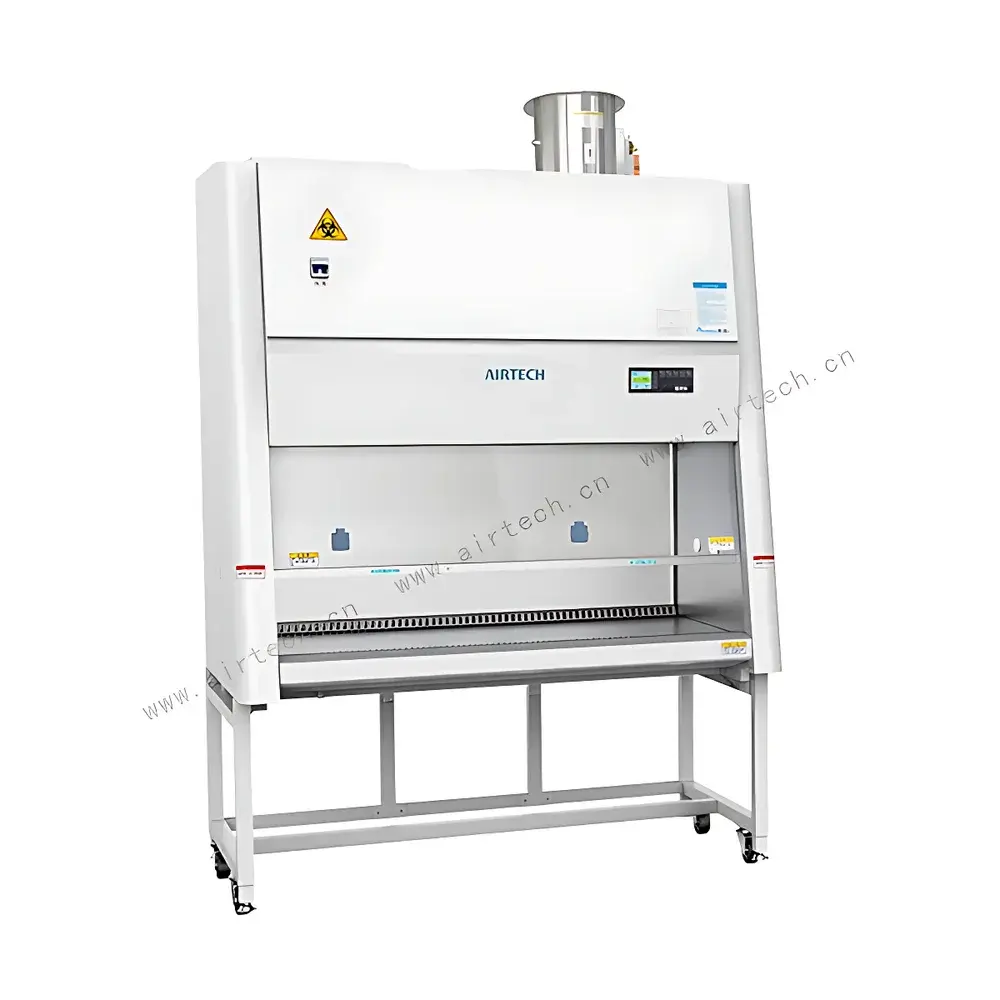
AIRTECH BSC-1004/1304/1604/1804IIB2 Series Class II Type B2 Biological Safety Cabinet
| Brand | AIRTECH |
|---|---|
| Origin | Jiangsu, China |
| Cabinet Type | Class II, Type B2 (Total Exhaust, Non-Recirculating) |
| Models | BSC-1004IIB2, BSC-1304IIB2, BSC-1604IIB2, BSC-1804IIB2 |
| External Dimensions (L×W×H, mm) | 1200/1500/1800/2000 × 795 × 2050 |
| Internal Work Area Dimensions (L×W×H, mm) | 1004/1304/1604/1804 × 630 × 630 |
| ULPA Filter Efficiency | ≥99.9995% @ 0.12 µm |
| Airflow Control | Brushless DC Constant-Flow Fan with Intelligent Compensation |
| Filter Leak Integrity | Dual “Leak-Resistant” Sealing Technology for Supply & Exhaust Filters |
| Cleanliness Class | ISO 4 (equivalent to Federal Standard 209E Class 10) |
| Power Management | Power-Fail Memory & Standby Mode with Sash-Closure Trigger |
Overview
The AIRTECH BSC-1004/1304/1604/1804IIB2 Series is a certified Class II, Type B2 biological safety cabinet designed for personnel, product, and environmental protection in high-containment life science applications. As a total-exhaust (non-recirculating) system, it draws air through the front sash opening, passes it across the work surface, and expels 100% of the contaminated airflow externally via dedicated ducting—eliminating any recirculation risk. This architecture complies fully with NSF/ANSI 49–2022 and EN 12469:2000 standards for Type B2 cabinets. The unit employs a dual-ULPA filtration strategy: supply air is purified by a ULPA filter delivering ≥99.9995% efficiency at 0.12 µm particle size, while exhaust air undergoes secondary ULPA filtration prior to safe external discharge. Integrated airflow sensors, real-time differential pressure monitoring, and microprocessor-based control ensure stable inflow velocity (≥0.5 m/s) and downflow velocity (≥0.3 m/s), maintaining ISO 4 (Class 10) cleanroom conditions within the work area.
Key Features
- Brushless DC constant-flow fan system engineered for energy efficiency—reducing power consumption by >40% versus conventional AC motor designs, while maintaining ±10% airflow stability even as supply filter resistance increases by up to 50%.
- Full-color high-resolution LCD interface providing real-time visualization of sash position, inflow/downflow velocities, filter differential pressure, fan status, and predictive filter life estimation based on cumulative runtime and resistance trends.
- Human-centered structural design: fully articulating tempered glass sash enabling complete interior surface access for decontamination; removable stainless-steel work surface with integrated lifting handles and support brackets; dual recessed GFCI-protected 120 VAC outlets (left/right); dual utility pass-through ports per side (water and gas) with ISO-KF compatible fittings.
- No-exposed-thread leveling feet for smooth, stable placement on laboratory flooring; seamless welded 304 stainless-steel interior surfaces with radiused corners to prevent microbial retention.
- Intelligent operational memory: automatic transition to low-speed standby mode upon sash closure—preserving laminar flow integrity and minimizing cross-contamination risk during procedural pauses; full state restoration—including sash height, airflow setpoints, and alarm history—following unexpected power interruption.
Sample Compatibility & Compliance
The BSC-IIB2 series supports a broad range of biosafety Level 2 (BSL-2) and select BSL-3 agents when used in conjunction with appropriate facility engineering controls (e.g., dedicated exhaust plenums, negative-pressure lab environments). Its non-recirculating configuration makes it suitable for handling volatile toxic chemicals alongside biological materials—common in cytotoxic drug compounding (e.g., IV admixture preparation), recombinant DNA work, and mycobacterial culture. All models are certified to NSF/ANSI 49–2022 Annex D for Type B2 performance validation, including containment verification via potassium iodide (KI) discrete particle testing, tracer gas (SF6) leakage assessment, and airflow smoke visualization. ULPA filters meet IEST-RP-CC001.4 requirements for leak integrity and are qualified per MIL-STD-288C for structural robustness and low borosilicate content—ensuring minimal outgassing in sensitive cell culture environments.
Software & Data Management
The embedded controller logs timestamped operational data—including sash position, airflow velocity, filter pressure drop, fan RPM, and alarm events—for ≥30 days onboard. Optional RS-485 or Ethernet interfaces enable integration into centralized laboratory infrastructure management systems (LIMS/LabVantage) and support audit-trail generation compliant with FDA 21 CFR Part 11 requirements when paired with validated third-party middleware. Calibration and certification reports—including initial factory certification, annual recertification templates, and user-defined SOPs—are exportable in PDF/CSV format. Firmware updates are performed via secure USB protocol with cryptographic signature verification to maintain regulatory integrity.
Applications
- Compounding sterile preparations in hospital pharmacy IV admixture centers (USP and compliant configurations available).
- Cell culture operations involving primary human cells, stem cells, or genetically modified organisms requiring ISO 4 background cleanliness.
- Molecular biology workflows including plasmid transfection, CRISPR editing, and lentiviral vector production where chemical-biological co-handling is required.
- Biosafety Level 2+ applications involving aerosol-generating procedures with moderate-risk pathogens (e.g., Staphylococcus aureus, Escherichia coli BL2 strains, Candida albicans).
- Quality control microbiology in pharmaceutical manufacturing environments operating under cGMP Annex 1 (2022) guidelines.
FAQ
What distinguishes a Type B2 cabinet from Type A2 or Type C1?
Type B2 cabinets provide total exhaust with zero air recirculation, making them mandatory for volatile toxic chemical use alongside biological agents. Unlike Type A2 units (70% recirculated), or Type C1 (dual-mode recirculation/exhaust), B2 systems require dedicated hard-ducted exhaust and are not compatible with canopy or thimble connections.
Is annual certification required?
Yes—per NSF/ANSI 49, all Class II cabinets must undergo performance certification annually by an accredited第三方 agency (e.g., IEST-certified technicians), including containment, airflow, and filter integrity testing.
Can this cabinet be installed without external ductwork?
No. Type B2 cabinets must be connected to a dedicated, negatively pressurized exhaust system capable of sustaining ≥150 Pa static pressure loss. Recirculation or bypass configurations are prohibited.
What maintenance intervals are recommended for ULPA filters?
Supply and exhaust ULPA filters should be replaced every 5–7 years under typical BSL-2 usage, or sooner if differential pressure exceeds 500 Pa above baseline—monitored continuously via the onboard sensor suite.
Does the unit support GLP/GMP documentation requirements?
Yes—the controller’s event log, configurable user permissions, electronic signature capability (via optional middleware), and exportable calibration records align with GLP (OECD 1998) and GMP (ICH Q7, EU Annex 11) data integrity expectations.



