
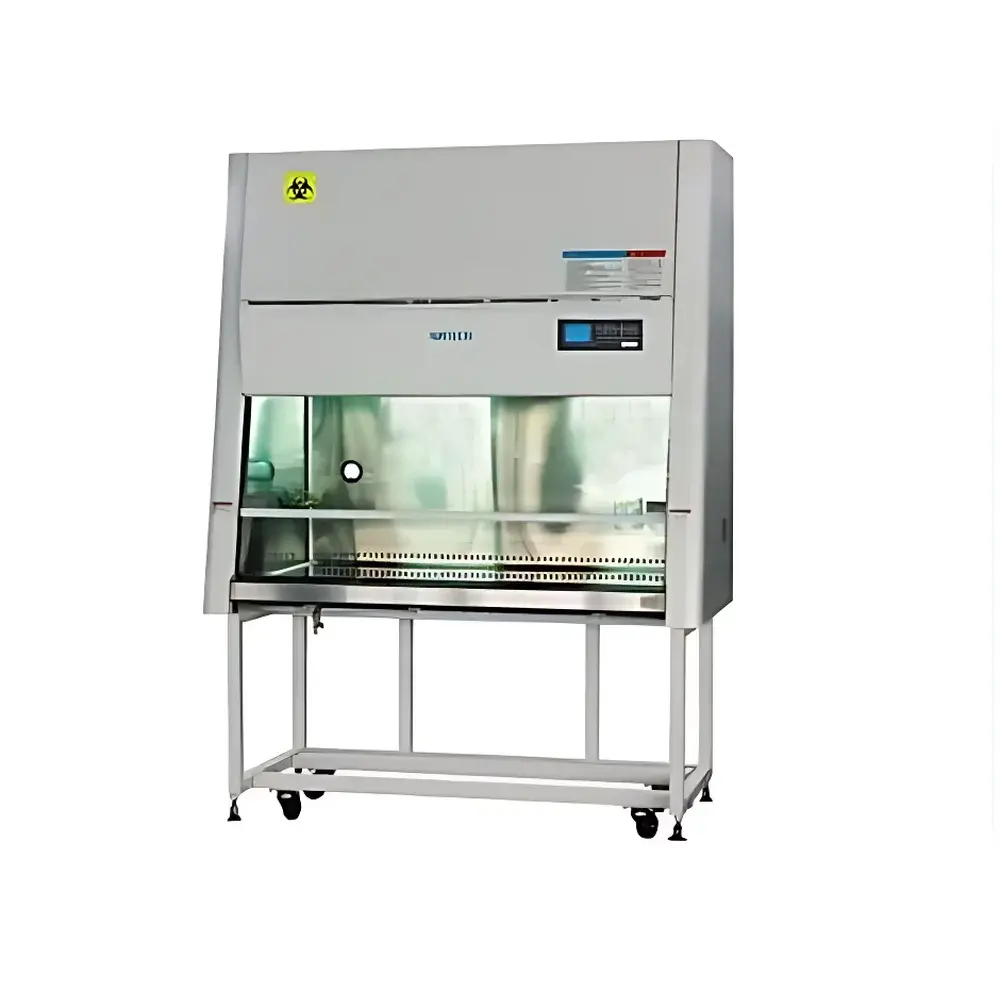
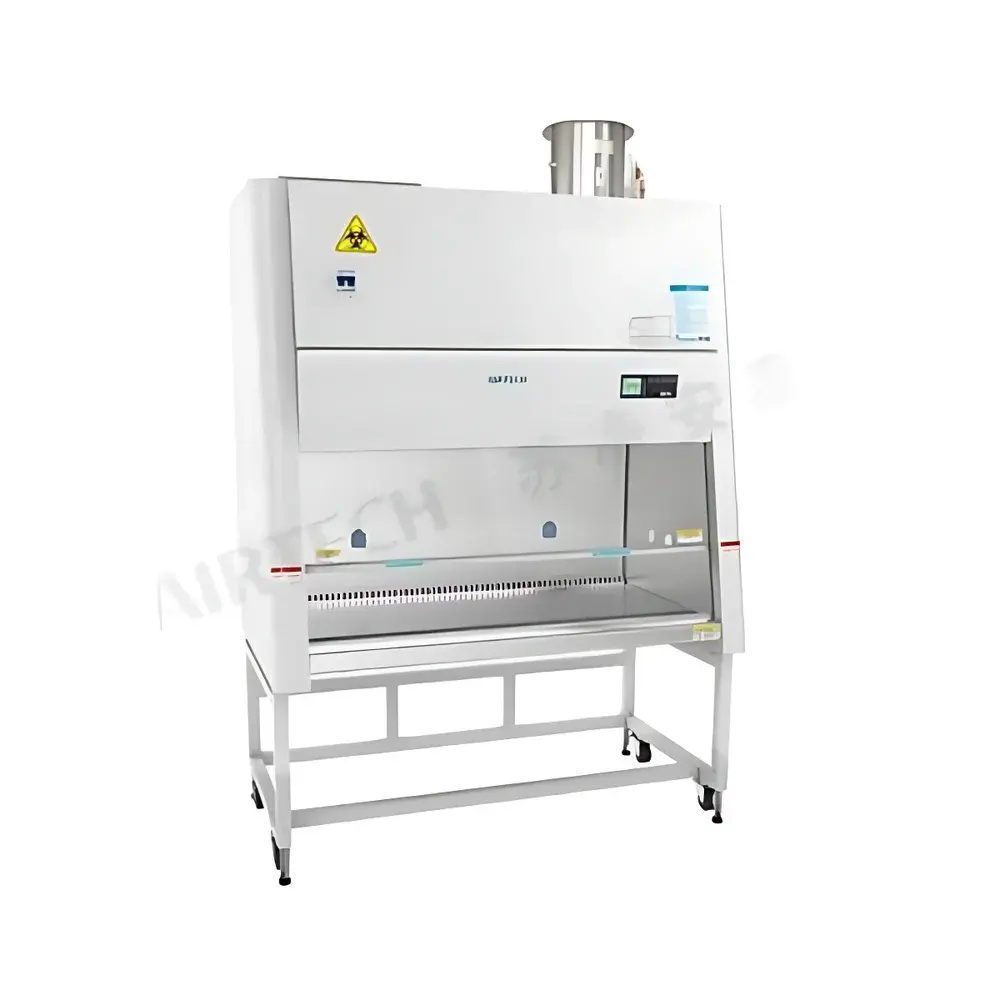
AIRTECH BSC-1004II-B2 Class II Type B2 Biosafety Cabinet
| Brand | AIRTECH (Suzhou Antai) |
|---|---|
| Origin | Jiangsu, China |
| Instrument Type | Class II, Type B2 (Total Exhaust) Biosafety Cabinet |
| External Dimensions (L×W×H) | 1500 × 790 × 2050 mm |
| Internal Work Area Dimensions (L×W×H) | 1270 × 600 × 620 mm |
| HEPA Filter Efficiency | ≥99.995% @ 0.3 µm |
| ULPA Filter Efficiency | ≥99.9995% @ 0.12 µm |
| Downflow Velocity | 0.35 m/s |
| Inflow Velocity | 0.55 m/s |
| Noise Level | ≤65 dB(A) |
| Power Supply | AC 220 V, 1φ, 50 Hz |
| Rated Power | 1.65 kW |
| Weight | 270 kg |
| Air Cleanliness Class | ISO 4 (equivalent to Federal Standard 209E Class 10) |
| Personnel Protection | ≤5 CFU/plate (slit sampler) |
| Product Protection | ≤2 CFU/plate |
| Cross-Contamination Protection | ≤5 CFU/plate (impact sampler), ≤5 CFU/plate (slit sampler) |
| Lighting | 24.5 W LED, ≥900 lx uniformity |
| UV Lamp | 25 W, germicidal |
| Exhaust Direction | Top-mounted ducted exhaust |
Overview
The AIRTECH BSC-1004II-B2 is a certified Class II, Type B2 biosafety cabinet—commonly referred to as a total-exhaust or “hard-ducted” cabinet—engineered for containment of low-to-moderate risk biological agents (BSL-1 to BSL-2+), including those requiring protection from volatile toxic chemicals or radionuclides. Unlike Type A2 cabinets, the BSC-1004II-B2 recirculates zero air to the work area; 100% of the inflow and downflow air is exhausted externally via dedicated ductwork, eliminating any risk of chemical or particulate re-entrainment. Its aerodynamic design adheres strictly to NSF/ANSI 49–2022 and EN 12469:2020 standards, ensuring validated airflow patterns: a uniform downward laminar downflow (0.35 m/s) across the work surface, an inward-facing inflow (0.55 m/s) at the sash opening, and zero recirculation volume. The cabinet maintains ISO Class 4 (10-class) cleanroom air quality within the work area—verified by particle counters and microbial challenge testing—making it suitable for aseptic cell culture, molecular diagnostics, and pharmaceutical secondary packaging where absolute environmental control is mandated.
Key Features
- ULPA-grade filtration system with dual-stage filtration: supply air passes through a ULPA filter (≥99.9995% efficiency @ 0.12 µm) delivering ISO 4–class air to the work surface; exhaust air is filtered through a second ULPA filter prior to external discharge, meeting stringent containment requirements for hazardous aerosols.
- Intelligent DC brushless constant-volume blower system: delivers stable airflow even as filter resistance increases up to 50%, maintaining velocity tolerance within ±10%—critical for uninterrupted personnel and product protection during extended operational cycles.
- Full-color high-resolution LCD interface with real-time monitoring: displays dynamic status of fan speed, sash position, filter differential pressure, remaining filter life estimation, and audible/visual alarms for airflow deviation, UV lamp failure, or sash height violation.
- Ergonomic structural design: fully cleanable tempered glass sash with inner-and-outer surface access; removable stainless-steel work surface with integrated lift handles and support brackets; dual utility pass-throughs on each side (two gas/water ports + two grounded 230 V/10 A sockets); recessed leveling feet with no exposed threads for seamless floor cleaning and ISO-compliant facility integration.
- Power-resilient operational logic: automatic transition to energy-saving standby mode (<30% power draw) upon sash closure—preserving work area sterility without interrupting experiments; full state recovery post-power interruption ensures continuity of safety-critical parameters (fan speed, sash memory, alarm history) per GLP/GMP-aligned operational continuity protocols.
Sample Compatibility & Compliance
The BSC-1004II-B2 accommodates standard tissue culture flasks (T-75 to T-225), Petri dishes, centrifuge tubes, pipette racks, and benchtop analytical instruments up to 620 mm height. Its 1270 mm work depth supports multi-step sterile manipulations without compromising inflow integrity. All materials in contact with the airstream—including 304 stainless-steel interior surfaces, epoxy-coated steel chassis, and silicone-sealed ULPA housings—are non-porous, corrosion-resistant, and compatible with common disinfectants (70% ethanol, 10% bleach, hydrogen peroxide vapor). Certification documentation includes full NSF/ANSI 49–2022 test reports (airflow visualization, microbial containment, personnel/product protection validation), CE marking under Directive 2014/34/EU (ATEX not applicable), and conformity to ISO 14644-1:2015 (cleanroom classification) and ISO 14698-1:2003 (biocontamination control). It supports FDA 21 CFR Part 11–compliant audit trails when integrated with AIRTECH’s optional LabLink™ data logging module.
Software & Data Management
The embedded microcontroller firmware logs all operational events—including sash position timestamps, filter pressure differentials, fan runtime hours, alarm triggers, and UV exposure cycles—with local storage capacity exceeding 12 months of continuous data. Optional USB export enables CSV-formatted reports for internal QA review or regulatory submission. When connected to AIRTECH’s centralized LabManager™ platform (via Ethernet or Wi-Fi), the cabinet supports remote monitoring, predictive filter replacement alerts, multi-unit fleet calibration synchronization, and electronic signature-enabled SOP execution logs—fully aligned with ALCOA+ data integrity principles and GxP audit readiness requirements.
Applications
- Aseptic handling of primary human cell lines and stem cells under BSL-2 containment
- Preparation of radiolabeled tracers and cytotoxic drug formulations requiring chemical + biological hazard isolation
- Quality control testing of sterile injectables per USP and Ph. Eur. 5.1.1
- CRISPR-Cas9 genome editing workflows involving lentiviral vectors
- Environmental monitoring sample processing in pharmaceutical cleanrooms (ISO 5–8 classified zones)
- Diagnostic assay development involving high-consequence pathogens under institutional biosafety committee oversight
FAQ
Is the BSC-1004II-B2 certified to NSF/ANSI 49?
Yes—it is independently tested and certified to NSF/ANSI 49–2022 for Class II, Type B2 performance, including full containment validation using Bacillus atrophaeus spores and Phi-X174 virus surrogates.
Does it require external ducting?
Yes. As a total-exhaust cabinet, it must be hard-ducted to an exterior vent or dedicated exhaust manifold; flexible ducting is prohibited per ANSI 49 airflow stability requirements.
Can it be used with volatile organic solvents?
Yes—its 100% exhaust configuration and corrosion-resistant interior make it appropriate for limited use of ethanol, acetone, and isopropanol; however, solvent concentration monitoring and explosion-proof auxiliary equipment may be required per local fire codes.
What is the expected ULPA filter service life under typical lab usage?
Under continuous operation with standard laboratory particulate loading, the ULPA filters typically achieve 5–7 years of service life; the onboard differential pressure sensor and algorithm-driven lifetime estimator provide proactive replacement guidance.
Is IQ/OQ/PQ documentation available?
Comprehensive Installation Qualification (IQ), Operational Qualification (OQ), and Performance Qualification (PQ) protocols—including test scripts, acceptance criteria, and blank execution records—are supplied with each unit and validated against ISO 13485–certified manufacturing processes.





