
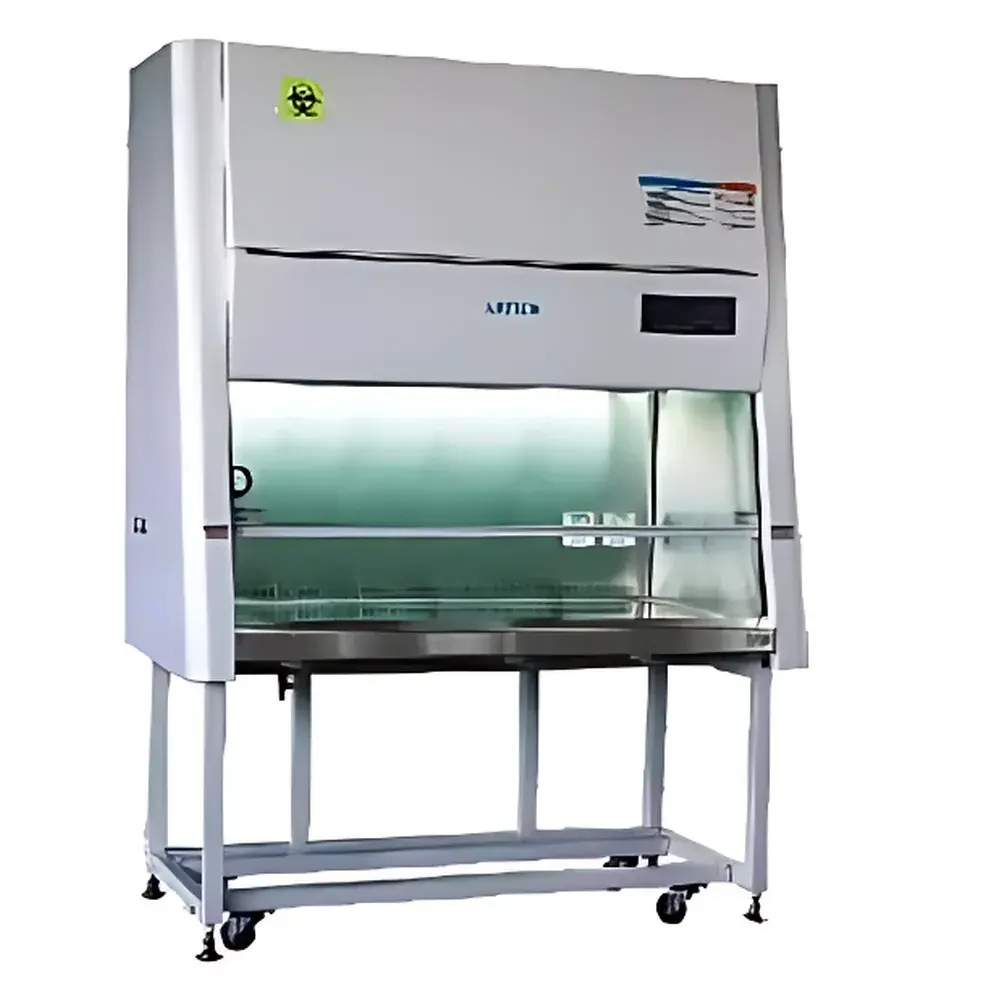
AIRTECH BSC-1600IIA2 Class II Type A2 Biological Safety Cabinet
| Brand | AIRTECH (Suzhou Jintan Airtech) |
|---|---|
| Origin | Jiangsu, China |
| Model | BSC-1600IIA2 |
| Instrument Type | Class II, Type A2 Biological Safety Cabinet |
| External Dimensions (L×W×H) | 1800 × 790 × 2050 mm |
| Internal Work Area Dimensions (L×W×H) | 1600 × 600 × 620 mm |
| Filtration Efficiency | HEPA ≥99.995% @ 0.3 µm |
| Downflow Velocity | 0.35 m/s |
| Inflow Velocity | 0.55 m/s |
| Noise Level | ≤62 dB(A) |
| Lighting Intensity | ≥800 lx |
| Power Consumption | 2.0 kW |
| Weight | 360 kg |
| Compliance | YY 0569–2011 (China), NSF/ANSI 49–2022 (USA) |
Overview
The AIRTECH BSC-1600IIA2 is a certified Class II, Type A2 biological safety cabinet engineered for reliable personnel, product, and environmental protection in biosafety level 2 (BSL-2) laboratories. It operates on the principle of inward airflow (inflow) for operator protection, downward laminar airflow (downflow) for product protection, and recirculation of 70% of filtered air within the work area—while exhausting 30% of air through a dedicated ducted or thimble-connected system. This configuration meets the stringent aerodynamic and containment requirements defined in both YY 0569–2011 (the Chinese national standard for biological safety cabinets) and NSF/ANSI 49–2022 (the U.S. benchmark for performance certification). The cabinet employs a dual-fan system with intelligent airflow compensation to maintain stable inflow and downflow velocities despite increasing filter resistance—ensuring consistent containment integrity throughout filter service life.
Key Features
- Dual-layer negative-pressure chassis with full-welded SUS304 stainless steel construction and seamless, radius-formed interior corners for enhanced cleanability and reduced microbial retention.
- Patented zero-leakage HEPA or ULPA filtration system (ZL200820109130.9) installed in both supply and exhaust pathways; certified to ISO 5 (Class 100) with HEPA or ISO 4 (Class 10) with ULPA filtration.
- Imported Japanese suspension-type sash mechanism with ≥5 mm tempered safety glass, enabling smooth, frictionless vertical positioning and full-seal closure for decontamination cycles.
- Ergonomic 10° inclined front access panel and removable curved forearm rest to reduce operator fatigue during extended procedures.
- Unobstructed rear air intake design (ZL200520140353.8) minimizes turbulence and ensures uniform inflow velocity across the entire working aperture.
- Integrated microprocessor-based control system with backlit LCD interface displaying real-time parameters: inflow/downflow velocity, filter differential pressure, fan status, cumulative runtime, and predictive filter life estimation.
- Interlocked UV lamp (20 W × 1) and fluorescent lighting (36 W × 3) with automatic shutoff upon sash opening; built-in audible/visual alarm for sash height deviation beyond safe operational limits.
- Stainless steel liquid collection tray (≥4 L capacity) and multiple utility ports—including splash-proof power outlets and gas valve connections—installed within the work chamber.
Sample Compatibility & Compliance
The BSC-1600IIA2 supports a broad range of microbiological, cell culture, and molecular biology applications involving low-to-moderate risk biological agents (e.g., Escherichia coli K-12, Bacillus subtilis, mammalian cell lines). Its validated containment performance satisfies international biosafety testing protocols: personnel protection ≤10 CFU per test (impactor sampling) or ≤5 CFU (slit sampler); product protection ≤5 CFU; cross-contamination protection ≤2 CFU. Cabinet leakage is verified at 500 Pa static pressure with no detectable leakage. Scannable filters undergo DOP/PAO scanning to confirm ≤0.01% local penetration; non-scannable filters meet ≤0.005% penetration criteria. The unit complies with ISO 14644-1 Class 5 (100) for HEPA mode and Class 4 (10) for ULPA mode, and supports GLP-aligned documentation workflows including audit trails for operational events.
Software & Data Management
The embedded controller logs all critical operational events—including sash position changes, UV activation cycles, filter pressure differentials, and fault codes—with timestamped records stored onboard for ≥12 months. While the interface is menu-driven and localized in Chinese, data export is supported via RS-232 serial output for integration into laboratory information management systems (LIMS). All alarms and status transitions are traceable and align with basic 21 CFR Part 11 principles for electronic record integrity, though formal validation support requires third-party IQ/OQ documentation packages. Filter replacement alerts include remaining service life estimation based on cumulative runtime and measured pressure drop trends.
Applications
This cabinet is routinely deployed in academic research labs, pharmaceutical QC environments, clinical diagnostics facilities, and biotechnology pilot-scale operations where open handling of non-volatile, low-aerosol-risk biological materials is required. Typical use cases include sterile transfer of cell cultures, preparation of diagnostic reagents, plasmid transfection workflows, mycological isolation procedures, and compounding of non-hazardous parenterals. It is not intended for use with volatile toxic chemicals, radionuclides, or high-consequence pathogens requiring BSL-3 containment.
FAQ
Does the BSC-1600IIA2 require external ducting?
Yes—Type A2 cabinets must be connected either to a dedicated hard-ducted exhaust system or a thimble-type canopy that safely captures and expels the 30% exhaust stream.
Can ULPA filters be retrofitted in place of HEPA?
Yes—the cabinet’s filtration housing is mechanically compatible with both HEPA and ULPA modules, though ULPA installation requires recalibration and re-certification per NSF/ANSI 49.
What maintenance intervals are recommended?
Pre-filters should be inspected weekly and replaced every 3–6 months; main HEPA/ULPA filters require annual integrity testing and replacement every 5–7 years depending on usage intensity and particulate load.
Is the unit compliant with FDA or EU GMP Annex 1 requirements?
While not inherently GMP-certified, its ISO 5/4 cleanroom performance, leak-tight construction, and documented airflow validation make it suitable for Grade A/B environments when integrated into a qualified facility infrastructure.
How is user training and certification support provided?
AIRTECH provides factory-issued operation manuals, commissioning reports, and optional on-site IQ/OQ protocol execution by authorized field engineers—subject to regional service agreements.




