
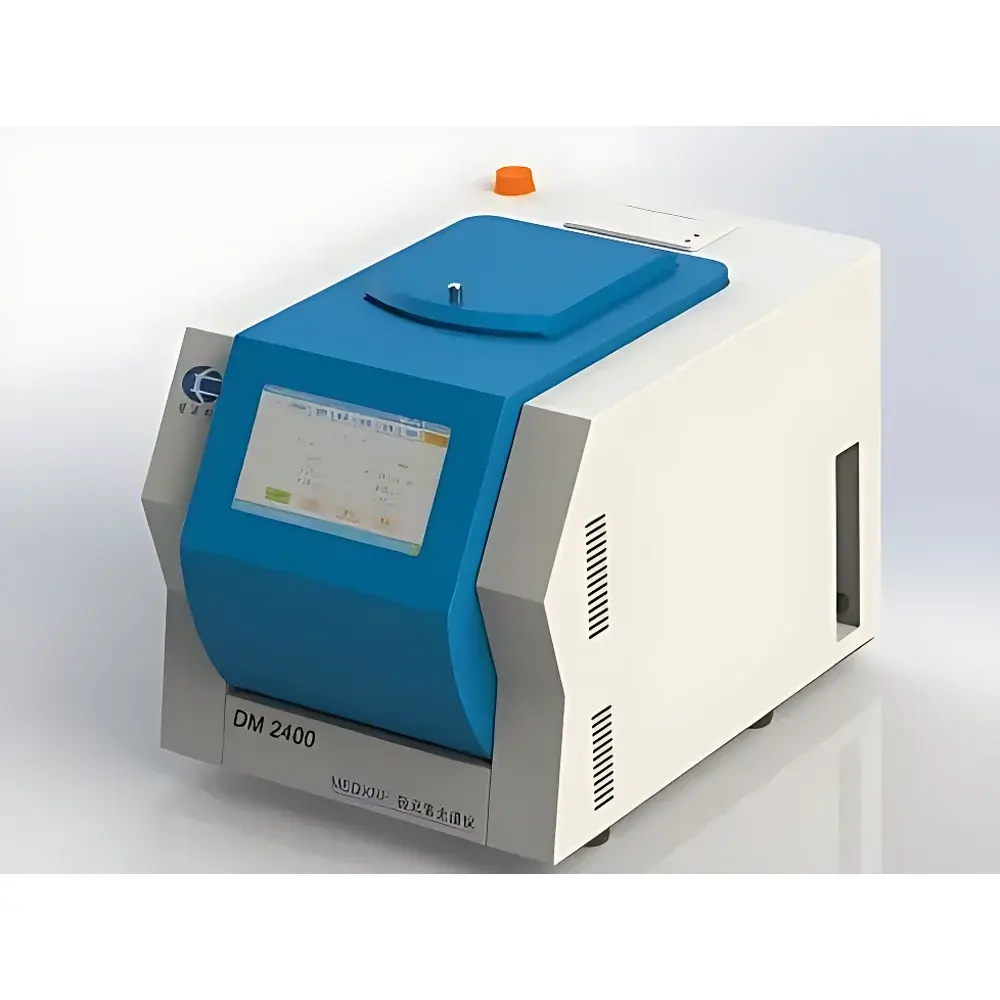
Aisite DM2400 Monochromatic Excitation Energy Dispersive X-Ray Fluorescence Spectrometer for Light Elements (Si, P, S, Cl)
| Brand | Aisite/ST |
|---|---|
| Origin | Shanghai, China |
| Manufacturer Type | Authorized Distributor |
| Product Origin | Domestic (China) |
| Model | DM2400 |
| Price Range | USD 42,000–70,000 |
| Form Factor | Benchtop/Floor-Standing |
| Industry Application | Energy & Petrochemicals |
| Elemental Range | F (Z=9) to Cl (Z=17) |
| Quantification Range | 1 ppm – 10 wt% |
| Energy Resolution | <135 eV (Mn Kα) |
| Repeatability (S) | 0.3 ppm (RSD ≤ 2.7% at 1 ppm S level) |
Overview
The Aisite DM2400 is a high-performance monochromatic excitation energy dispersive X-ray fluorescence (MEDXRF) spectrometer engineered for ultra-trace quantification of light elements—specifically silicon (Si), phosphorus (P), sulfur (S), and chlorine (Cl)—in liquid hydrocarbon matrices. It implements a fundamentally optimized detection architecture that decouples spectral background from analytical sensitivity: by combining a logarithmic spiral doubly curved crystal (LSDCC) monochromator with a high-resolution silicon drift detector (SDD), the system achieves sub-ppm detection limits without requiring high-power (>1 kW) X-ray sources or vacuum environments. Unlike conventional EDXRF systems, where bremsstrahlung continuum dominates the background and degrades signal-to-noise, the DM2400 utilizes selective monochromatic excitation—tuned to energies just above the absorption edges of target elements—to maximize fluorescence yield while suppressing scattered radiation. This principle enables compliance with stringent regulatory thresholds such as China’s GB/T 11140 (for S in gasoline/diesel), ISO 20884, ASTM D2622, and ASTM D7039—where detection limits below 0.2 ppm S (300 s counting) are mandatory for Tier VI fuel certification.
Key Features
- Monochromatic excitation via patented DM30L logarithmic spiral doubly curved crystal (LSDCC), delivering >3× higher integrated diffraction efficiency than natural crystals and enabling point-to-point focusing with ≤2 mm focal spot size
- High-resolution VITUS H20 CUBE SDD detector (KETEK, Germany): 20 mm² active area, ≤123 eV resolution at Mn Kα (5.9 keV), maximum count rate 2 Mcps, 8 µm Be entrance window (AP3.3 option available for F–O analysis)
- 50 W micro-focus X-ray tube with Ag anode (Mo/Rh/Cr/Pd options configurable), thin Be window, and digitally optimized kV/mA settings for element-specific excitation efficiency
- Digital pulse processing with real-time PHA adjustment, automatic gain stabilization, and spectral drift correction—ensuring long-term calibration stability over weeks without manual intervention
- Benchtop or floor-standing configuration; fully shielded enclosure meeting IEC 61000-6-3 and national exemption-level radiation safety requirements (no licensing required for operation)
- Integrated touchscreen interface with one-button measurement workflow: sample cup insertion → press “Start” → auto-acquisition, quantification, and report generation
Sample Compatibility & Compliance
The DM2400 accepts standard 32 mm or 40 mm diameter sample cups (polyethylene or Mylar-bottomed) for direct analysis of neat liquids including gasoline, diesel, jet fuel, lubricants, additives, and residual oils. Solid samples (e.g., polymers, catalysts, powders) may be analyzed after homogenization and pelletization under binder-free conditions. The instrument complies with international standards governing elemental testing in fuels and petrochemicals: ASTM D2622 (S in petroleum products), ASTM D7039 (S in middle distillates), ASTM D7220 (S in low-sulfur diesel), ASTM D7757 (Si in fuels), ASTM D7536 (Cl in hydrocarbons), ISO 15597 (Cl in crude oil), and SH/T 0842 (ultra-low S in gasoline). All calibrations follow GLP-aligned procedures, with full audit trail support for data integrity in regulated laboratories.
Software & Data Management
The embedded firmware and PC-based SpectraQuant™ software provide full traceability per FDA 21 CFR Part 11 requirements: electronic signatures, user access levels, version-controlled method files, and immutable raw spectrum storage. Quantitative analysis employs fundamental parameter (FP) algorithms corrected for matrix effects using empirical coefficients derived from certified reference materials (CRMs). Calibration curves for Si, P, S, and Cl exhibit correlation coefficients ≥0.999 across 1 ppm–10% concentration ranges. Data export supports CSV, PDF, and XML formats compatible with LIMS integration. Optional remote diagnostics and firmware updates are supported via secure HTTPS channel.
Applications
- Ultra-low sulfur monitoring in refinery streams and finished transportation fuels (meeting China VI, Euro 6, and U.S. EPA Tier 3 specifications)
- Phosphorus additive quantification in engine oils and transmission fluids per ASTM D6481
- Chlorine contamination screening in feedstocks and process intermediates to prevent catalyst poisoning
- Silicon wear metal analysis in turbine oils and hydraulic fluids (ASTM D7757)
- Quality control of biodiesel blends, biofuels, and synthetic lubricants
- Research applications in catalysis, battery electrolyte impurity profiling, and polymer halogen screening
FAQ
What is the difference between MEDXRF and conventional EDXRF?
MEDXRF uses a crystal monochromator to isolate a narrow-band excitation line—reducing background by up to two orders of magnitude versus polychromatic EDXRF. This yields significantly lower detection limits without increasing source power.
Can the DM2400 measure fluorine (F) or oxygen (O)?
Yes—with the optional AP3.3 ultra-thin polymer window SDD and Mo or Cr anode tube, detection down to F (Z=9) is achievable. Standard configuration begins at Si (Z=14).
Is helium purge required for light element analysis?
No. The instrument operates in air for Si–Cl analysis. Helium or internal gas-fill mode is optional for enhanced F–P sensitivity.
How is calibration maintained over time?
Automatic daily background normalization, multi-point drift correction, and hardware-based gain stabilization ensure calibration stability for ≥30 days without recalibration.
Does the system support multi-element analysis beyond Si, P, S, Cl?
Yes. With appropriate crystal and tube selection, the platform supports quantitative analysis from B (Z=5) to Cl (Z=17), including Al, Mg, Na, and Ca in specialized configurations.





