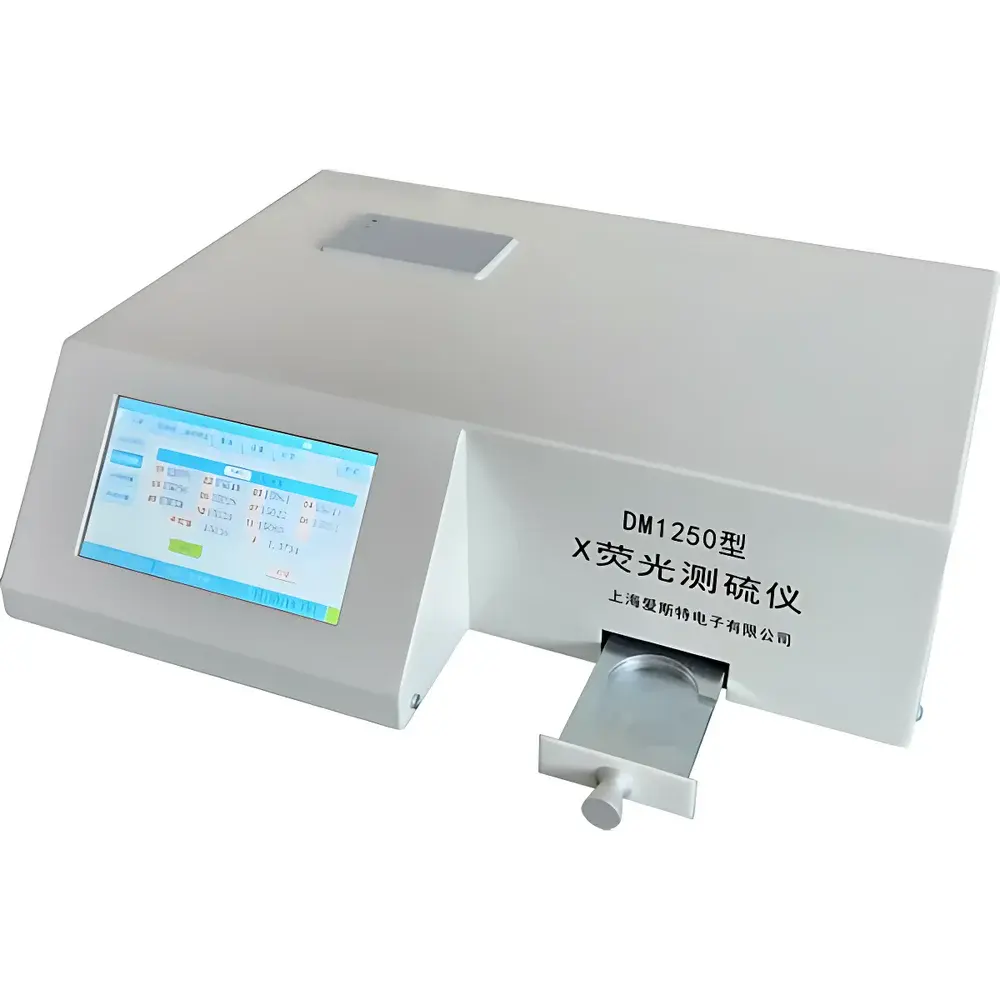
Aist DM1250 Energy-Dispersive X-Ray Fluorescence (EDXRF) Sulfur Analyzer for Cement and Coal Industries
| Brand | Aist / ST |
|---|---|
| Origin | Shanghai, China |
| Manufacturer Type | Authorized Distributor |
| Country of Origin | China |
| Model | DM1250 |
| Detection Principle | Energy-Dispersive X-Ray Fluorescence (EDXRF) |
| Measurement Target | SO₃ in solid/powder samples |
| Analysis Time | 30–60 s per sample |
| X-ray Tube | ≤10 kV, ≤0.5 mA, ≤5 W |
| Detector | Ultra-thin beryllium-window proportional counter |
| SO₃ Range | Adjustable via calibration |
| SO₃ Precision | σ ≤0.03 wt% (3σ) |
| Compliance | GB/T 176–2017, JC/T 1085–2008, JB/T 11145–2011 |
| Operating Temp | 5–40 °C |
| Humidity | ≤85% RH at 30 °C |
| Power | 220 V ±20 V, 50 Hz, ≤50 W |
| Dimensions | 470 × 365 × 130 mm (W×D×H) |
| Weight | 15 kg |
Overview
The Aist DM1250 Energy-Dispersive X-Ray Fluorescence (EDXRF) Sulfur Analyzer is a dedicated benchtop instrument engineered for rapid, non-destructive quantification of sulfur trioxide (SO₃) in heterogeneous solid and powdered materials—primarily cement raw meal, clinker, finished cement, coal, carbon black, and industrial minerals. It operates on the fundamental principle of EDXRF spectroscopy: primary X-rays from a low-power micro-focus X-ray tube (≤10 kV, ≤5 W) excite characteristic Kα and Kβ fluorescence emissions from sulfur atoms in the sample; these photons are collected by an ultra-thin beryllium-window proportional counter, spectrally resolved using a digital multi-channel pulse height analyzer (MCA), and quantified via calibrated intensity-to-concentration algorithms. Unlike combustion-based or wet-chemical methods, the DM1250 requires no reagents, no sample digestion, no gas supply, and introduces zero chemical waste—making it compliant with ISO 14001 environmental management frameworks and aligned with green laboratory practices. Its downward-beam geometry eliminates detector contamination risk from loose powders—a critical design advantage for high-dust environments typical in cement plants and coal handling facilities.
Key Features
- Touch-enabled 7-inch color TFT LCD interface with intuitive icon-driven workflow—eliminates external keyboard and reduces operator training time.
- Digital signal processing architecture based on FPGA, CPLD, and DSP cores replaces legacy 80C31 microcontrollers, delivering >99.98% system uptime and eliminating firmware-related lockups.
- Integrated variable-gain digital pulse amplifier and real-time dead-time correction ensure long-term spectral stability across ambient temperature fluctuations (5–40 °C).
- Secondary filter system combined with optimized collimation and beam path geometry enhances peak-to-background ratio for sulfur K-lines (2.307 keV), improving detection limits and minimizing matrix interference.
- Thermal line printer replaces impact mechanism—reducing mechanical wear, acoustic noise, and paper jam frequency in continuous plant-floor operation.
- Surface-mount technology (SMT) PCB assembly enables consistent manufacturing tolerances, reduced thermal drift, and field-proven MTBF >15,000 hours.
Sample Compatibility & Compliance
The DM1250 accepts pressed pellets (Ø32–40 mm, thickness 3–5 mm) prepared from homogenized, dried, and ground samples (≤75 µm particle size). It supports direct analysis of unaltered cement feedstocks without dilution or fluxing—fully satisfying the sample preparation requirements of GB/T 176–2017 Clause 8.3. Instrument validation adheres to ISO/IEC 17025:2017 principles for testing laboratories, with documented traceability to NIST SRM 2684c (Cement Clinker) and CRM-CCM-1 (Chinese Cement Standard Reference Material). Calibration verification follows ASTM E1361–22 “Standard Practice for Calibration of X-Ray Fluorescence Spectrometers” using 11 certified cement raw meal standards; linear regression yields R² ≥0.9997 for SO₃. The system meets radiation safety exemption criteria under IEC 61010-1:2010 and complies with China’s GBZ 188-2014 occupational exposure limits for sealed X-ray sources.
Software & Data Management
Embedded firmware supports on-device storage of ≥10,000 measurement records with full metadata (date/time, operator ID, sample ID, calibration ID, raw spectrum checksum). All data persist through power loss via industrial-grade EEPROM. USB 2.0 host port enables direct export of CSV-formatted results—including raw counts, net peak area, background-subtracted intensity, and final SO₃ concentration—to Windows PCs. Audit trail functionality logs all parameter modifications, calibration events, and user logins—supporting GLP-compliant environments where 21 CFR Part 11 electronic record integrity is required. Optional Ethernet module (DM1250-NET) enables integration into DCS or MES platforms via Modbus TCP, providing real-time SO₃ values to配料 control systems (“Analyzer → PLC → Belt Scale” loop).
Applications
- Cement manufacturing: Real-time SO₃ monitoring in raw meal to prevent sulfate-induced volume instability in clinker; final cement QC to meet ASTM C150 Type I/II specifications (SO₃ ≤3.5 wt%).
- Coal quality assurance: Rapid screening of total sulfur content in pulverized coal prior to boiler feed—correlating with ASTM D3177 sulfur by XRF protocols.
- Power generation: In-line analysis of fly ash and desulfurization gypsum for CaSO₄·2H₂O content verification.
- Building materials: SO₃ quantification in limestone additives, slag cements, and supplementary cementitious materials (SCMs) per EN 196-2.
- Geological surveying: Field-deployable sulfur mapping in sedimentary rock cores and mine tailings—compatible with portable sample carriers meeting IP54 ingress protection.
FAQ
Does the DM1250 require vacuum or helium purge for sulfur analysis?
No. The ultra-thin Be window (≤8 µm) and optimized low-energy X-ray optics enable efficient detection of sulfur Kα (2.307 keV) in air atmosphere—eliminating need for gas purging or vacuum pumps.
Can the instrument be recalibrated in-house without service engineer support?
Yes. Calibration routines are accessible via administrator mode; users may load new standard sets and regenerate calibration curves using built-in least-squares regression tools—validated against reference materials with certified uncertainty <0.02 wt% SO₃.
What is the minimum detectable SO₃ concentration under routine operating conditions?
Based on 60-second measurements on homogenized cement raw meal (n=10), the 3σ limit of detection (LOD) is 0.012 wt%, verified per ISO 11843-1:2021.
Is spectral interference from chlorine or potassium corrected automatically?
Yes. The MCA firmware applies empirical matrix correction using Compton normalization and inter-element coefficient tables derived from NIST Monte Carlo simulations—validated across SiO₂–Al₂O₃–CaO–Fe₂O₃–SO₃–K₂O–Cl⁻ compositional space.
How frequently must the X-ray tube be replaced?
Rated lifetime exceeds 10,000 hours at nominal 0.3 mA operation; mean time between failures (MTBF) for tube + HV generator is >8 years under typical cement plant shift schedules (16 h/day, 330 days/year).
Related Products