
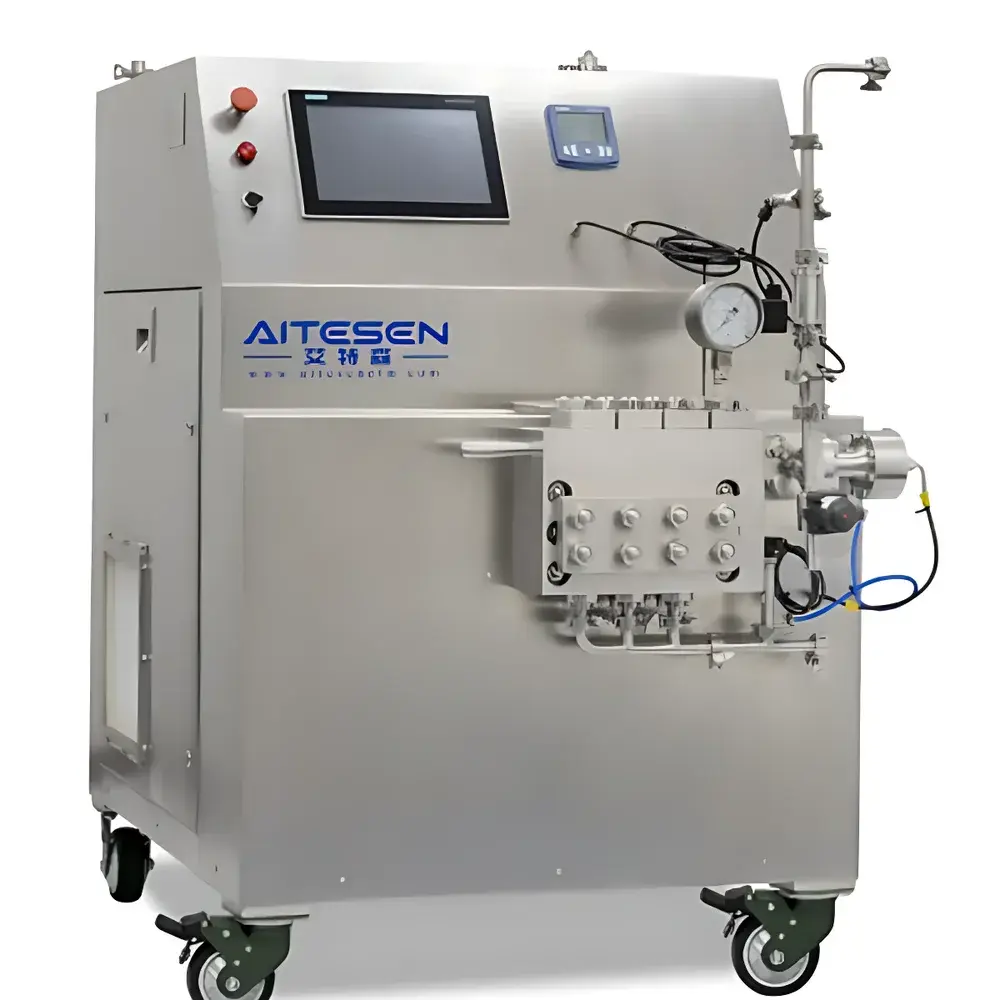
Aitesen HPH-P Series Production-Scale High-Pressure Homogenizer
| Brand | Aitesen |
|---|---|
| Origin | Jiangsu, China |
| Manufacturer Type | Authorized Distributor |
| Country of Origin | China |
| Model | HPH-P Series |
| Instrument Type | High-Pressure Cell Disruptor |
| Flow Rate | 80–2000 L/h |
| Operating Pressure | 800–1500 bar |
| Construction Material | SAF2507 Super Duplex Stainless Steel |
| Control Interface | Touchscreen Panel with Real-Time Pressure Monitoring & Data Export Capability |
| Optional Systems | Variable-Frequency Flow Control, Automated Pressurization, PLC Integration, Temperature Control, Multi-Stage Homogenization, Closed-Loop Circulation, Sample Preconditioning Module |
Overview
The Aitesen HPH-P Series is a production-scale high-pressure homogenizer engineered for robust, repeatable, and scalable cell disruption and nano-emulsification in regulated biopharmaceutical and advanced material manufacturing environments. Based on the principle of controlled fluid shear, cavitation, and impact-induced mechanical lysis, the system subjects process streams to precisely regulated pressures (up to 1500 bar) across a hardened SAF2507 stainless steel homogenization valve assembly. Its modular, split-head pump architecture ensures thermal stability, minimal metal leaching, and long-term operational integrity under continuous duty cycles—critical for GMP-aligned processes involving sensitive biologics, lipid nanoparticles (LNPs), and sterile injectables.
Key Features
- Split-head high-pressure pump design with integrated cooling jacket compatibility for thermal management during extended operation
- SAF2507 super duplex stainless steel wetted parts—resistant to chloride-induced stress corrosion cracking and compatible with aggressive solvents, buffers, and low-pH formulations
- Manually or pneumatically adjustable homogenization pressure via calibrated handwheel; real-time digital pressure display with ±1.5% full-scale accuracy
- Touchscreen HMI interface supporting parameter logging (pressure, time, temperature), CSV export via USB, and user-defined safety interlocks (e.g., max pressure limit, overtemperature shutdown)
- Modular scalability: base configuration supports single-stage homogenization; optional multi-stage valve kits enable sequential pressure reduction for improved particle size distribution control
- Compliance-ready architecture: designed to support validation protocols including IQ/OQ/PQ documentation, traceable calibration records, and audit trails for critical parameters
Sample Compatibility & Compliance
The HPH-P Series accommodates aqueous, organic, and mixed-phase suspensions across viscosity ranges typical of microbial lysates (e.g., E. coli, yeast), lipid dispersions (liposomes, LNPs), and nanomaterial colloids (graphene oxide, cellulose nanocrystals). It meets mechanical and materials requirements referenced in ISO 13485:2016 (medical device QMS) and supports alignment with USP particulate matter testing workflows. While not intrinsically certified to FDA 21 CFR Part 11, its data export functionality and configurable user access levels facilitate implementation of electronic record controls per GLP/GMP Annex 11 guidelines when integrated into validated manufacturing execution systems (MES).
Software & Data Management
The embedded controller logs timestamped pressure, runtime, and operator ID (where enabled) to internal memory (≥10,000 event capacity). Data export is supported via USB mass storage mode in comma-separated values (CSV) format, enabling integration with LIMS or statistical process control (SPC) platforms. Optional PLC integration (Siemens S7-1200/1500 or Allen-Bradley CompactLogix) allows centralized supervision, alarm forwarding to SCADA, and synchronization with upstream/downstream unit operations such as buffer preparation or sterile filtration.
Applications
- Biopharmaceutical processing: Gram-negative and gram-positive bacterial lysis, inclusion body solubilization, viral vector purification feedstock conditioning
- LNP and mRNA formulation: Primary emulsification of ionizable lipids, cholesterol, DSPC, and PEG-lipids at production scale; narrow polydispersity index (PDI) control via multi-pass homogenization
- Parenteral nutrition and complex injectables: Sterile-grade fat emulsion (e.g., Intralipid®-type) manufacturing, nano-suspension stabilization for poorly soluble APIs
- Advanced materials synthesis: Exfoliation of 2D nanomaterials (graphene, MXenes), dispersion of carbon nanotubes in polymer matrices, nano-cellulose fibrillation
- Functional food and cosmeceutical development: Stabilized bioactive ingredient emulsions (curcumin, resveratrol), nanostructured lipid carriers (NLCs), and microencapsulated actives
FAQ
What is the maximum allowable operating temperature for continuous processing?
The standard configuration supports inlet temperatures up to 60 °C; optional jacketed homogenizer blocks extend this to 85 °C for thermosensitive formulations requiring elevated viscosity control.
Can the HPH-P series be validated for GMP manufacturing?
Yes—the system’s mechanical design, material certifications (EN 10204 3.1), and data logging architecture are compatible with equipment qualification protocols (IQ/OQ/PQ) when supported by site-specific risk assessments and vendor-supplied validation documentation packages.
Is remote monitoring or Ethernet connectivity available?
Standard units include RS485 Modbus RTU; Ethernet/IP or OPC UA interfaces are available as factory-installed options upon request.
What maintenance intervals are recommended for the homogenization valve assembly?
Under typical bioprocess conditions (1200–1500 bar, aqueous buffers), valve seat and impact ring replacement is advised every 500–800 operational hours, depending on abrasive load and cleaning protocol adherence.
Does the system support sterile processing requirements?
The wetted path complies with ASME BPE-2022 surface finish standards (Ra ≤ 0.4 µm electropolished); SIP compatibility requires integration with external steam supply and validated cycle parameters—supporting documentation is provided for clean-in-place (CIP) and steam-in-place (SIP) validation planning.





