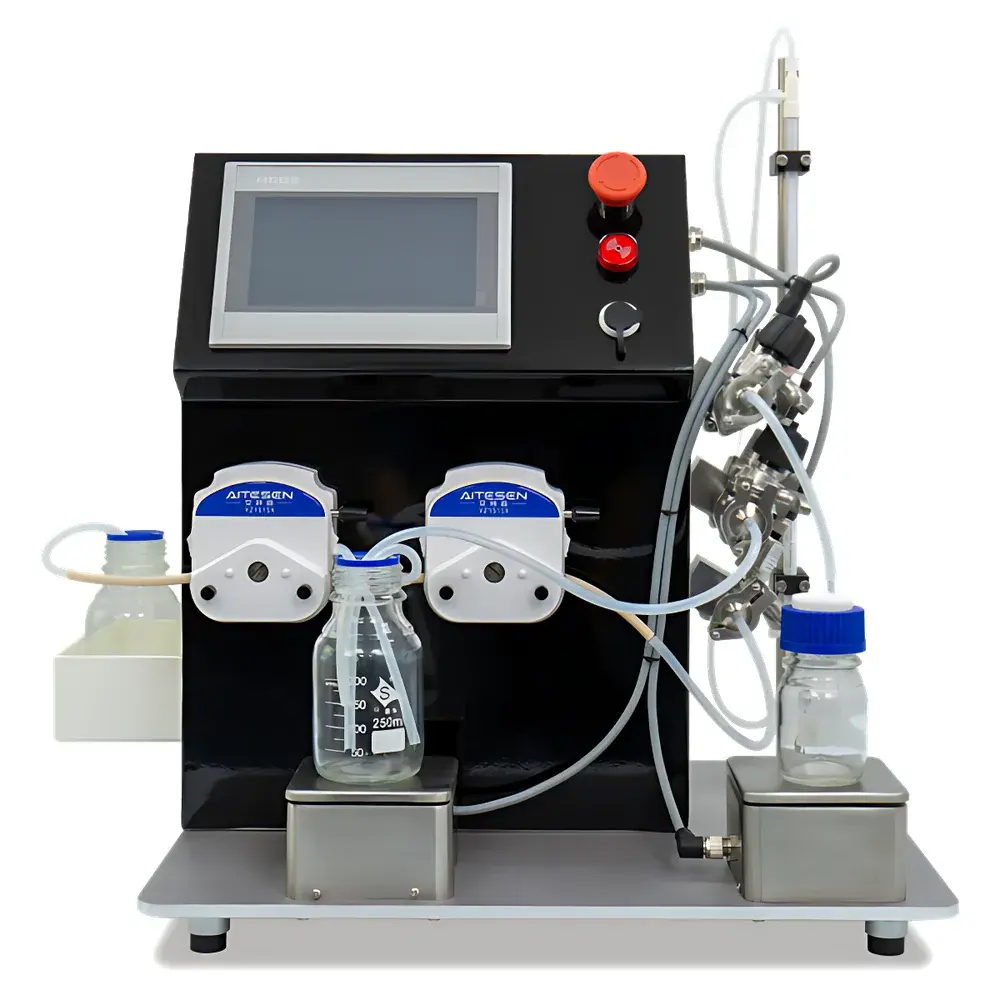
Aitesen LDS-L1 Laboratory-Scale Tangential Flow Filtration (TFF) System for Liposome and mRNA-LNP Processing
| Brand | Aitesen |
|---|---|
| Origin | Jiangsu, China |
| Manufacturer Type | Authorized Distributor |
| Product Category | Domestic |
| Model | LDS-L1 |
| Pricing | Upon Request |
| Minimum Sample Volume | ≤30 mL |
| Pressure Range | −1 to 5 bar |
| Max Flow Rate | ≥2200 mL/min |
| Weight Capacity | 0–4100 g |
| Weighing Accuracy | ±0.5% |
| Measured Parameters | Pf (Feed Pressure), Pr (Retentate Pressure), Pp (Permeate Pressure), TMP (Transmembrane Pressure), ΔP (Pressure Drop) |
| Compatible Membranes | PES and Cellulose-based Cassettes & Hollow-Fiber Modules |
| MWCO Range | 5–1000 kDa |
| Effective Membrane Area | 0.01–0.1 m² |
Overview
The Aitesen LDS-L1 is a laboratory-scale, fully integrated tangential flow filtration (TFF) system engineered for process development and small-batch validation in biopharmaceutical and nanomedicine manufacturing. It operates on the fundamental hydrodynamic principle of cross-flow membrane separation: feed solution is continuously recirculated parallel to the membrane surface under controlled pressure, minimizing concentration polarization and fouling while enabling high-flux, reproducible separation based on molecular size exclusion. Unlike dead-end filtration, TFF maintains stable permeate flux over extended operation—critical for processing sensitive biomolecules such as lipid nanoparticles (LNPs), liposomes, plasmid DNA, monoclonal antibodies (mAbs), and siRNA formulations. The LDS-L1 supports buffer exchange, diafiltration, concentration, clarification, and desalting across diverse aqueous and low-viscosity organic-aqueous systems—serving as a scalable bridge between benchtop feasibility studies and clinical- or commercial-scale production.
Key Features
- Integrated PLC-based control architecture with 7-inch industrial touchscreen HMI for intuitive, parameter-driven workflow execution
- Real-time monitoring and logging of five critical hydraulic parameters: feed pressure (Pf), retentate pressure (Pr), permeate pressure (Pp), transmembrane pressure (TMP), and pressure drop (ΔP)
- High-precision gravimetric module (±0.5% accuracy, 0–4100 g range) enabling closed-loop concentration control and automated endpoint detection
- Modular pump design supporting flow rates up to 2200 mL/min, compatible with both peristaltic and diaphragm pumping configurations for shear-sensitive applications
- Full compliance with FDA 21 CFR Part 11 requirements: electronic signatures, audit trail generation, user access levels, and immutable data export (CSV/Excel)
- Chemically resistant wetted path constructed from USP Class VI-certified materials; all fluid-contact components meet ISO 10993 biocompatibility standards
Sample Compatibility & Compliance
The LDS-L1 accommodates a broad spectrum of biologically relevant samples—including mRNA-LNP complexes, doxorubicin hydrochloride liposomes, irinotecan HCl liposomes, daunorubicin liposomes, polymer nanoparticles, plasmid DNA, and clarified cell culture harvests. Its membrane interface supports standard PES and regenerated cellulose cassettes (0.01–0.1 m² active area) and hollow-fiber modules across MWCOs from 5 kDa to 1000 kDa. All operational protocols adhere to ICH Q5A(R2), Q5D, and ISO 20369-1 guidelines for nanomaterial characterization and purification. The system’s mechanical and software architecture is validated for GLP/GMP-aligned environments, with documented IQ/OQ protocols available upon request.
Software & Data Management
The embedded Aitesen TFF Control Suite provides deterministic sequence programming, real-time curve visualization (pressure vs. time, weight vs. volume), and automated event triggering (e.g., endpoint concentration, diafiltration cycle completion). All raw sensor data—including timestamps, operator IDs, and parameter setpoints—are stored locally with SHA-256 hashing and exported via encrypted USB or network transfer. Audit trails record every configuration change, manual override, and calibration event—fully traceable to individual users and compliant with regulatory submissions under EMA Annex 11 and FDA Part 11. Software updates are delivered through secure, digitally signed firmware packages with version rollback capability.
Applications
- Buffer exchange and formulation optimization for LNP-mRNA vaccine candidates
- Concentration and purification of siRNA-loaded lipid vesicles prior to sterile filtration
- Downstream processing of plasmid DNA post-alkaline lysis and RNase treatment
- Clarification and harvest of CHO-derived mAb supernatants
- Desalting and solvent exchange in polymer nanoparticle synthesis workflows
- Process characterization studies supporting QbD (Quality by Design) frameworks for regulatory filings
FAQ
What membrane formats are supported by the LDS-L1?
The system accepts commercially available flat-sheet cassettes (e.g., Sartorius Vivaflow, Repligen KrosFlo) and hollow-fiber modules (e.g., Spectrum Labs, Pall) with nominal MWCOs from 5 to 1000 kDa and effective areas ranging from 0.01 to 0.1 m².
Can the LDS-L1 be used for GMP-compliant process validation?
Yes—the hardware meets ASME BPE-2023 surface finish and weld quality criteria for pharmaceutical fluid systems, and the software includes full 21 CFR Part 11 functionality required for Stage 1–3 process validation studies.
Is remote monitoring or integration with MES/LIMS possible?
The system features Modbus TCP and OPC UA interfaces for seamless integration into existing manufacturing execution systems (MES) or laboratory information management systems (LIMS); custom API wrappers are available under NDA.
What is the minimum viable sample volume for method development?
The LDS-L1 achieves reliable TFF performance with feed volumes as low as 30 mL, making it suitable for early-stage candidate screening where material is highly constrained.
Does the system support temperature-controlled operation?
While the base configuration operates at ambient temperature, optional jacketed reservoirs and inline heat exchangers (−5°C to 40°C range) can be integrated to maintain thermolabile formulations during extended diafiltration cycles.