
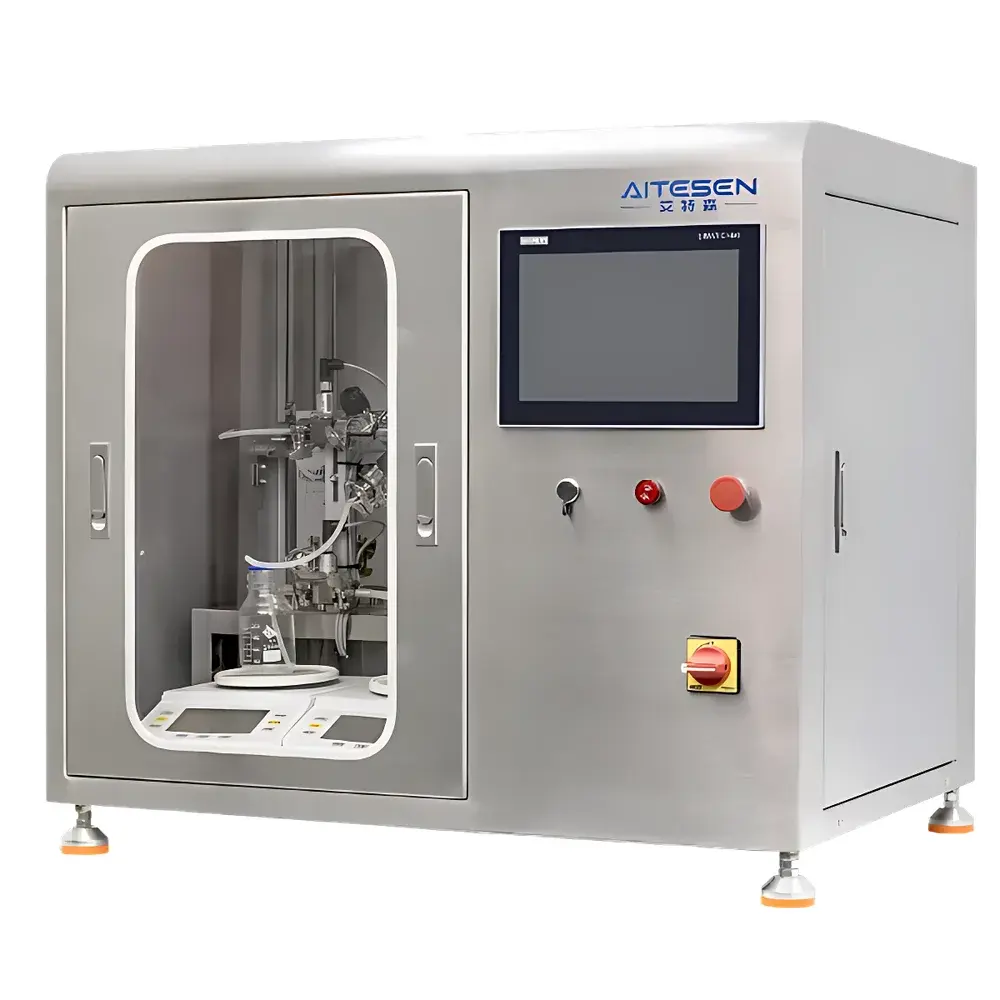
Aitesen LDS-L2 Laboratory-Scale Tangential Flow Filtration (TFF) System
| Brand | Aitesen |
|---|---|
| Origin | Jiangsu, China |
| Manufacturer Type | Authorized Distributor |
| Country of Origin | China |
| Model | LDS-L2 |
| Pricing | Available Upon Request |
| Minimum Sample Volume | 30 mL |
| Pressure Range | −1 to 5 bar |
| Flow Rate Range | 1–2200 mL/min |
| Weight Capacity | 0–4100 g |
| Measurable Parameters | Pf (Feed Pressure), Pr (Retentate Pressure), Pp (Permeate Pressure), TMP (Transmembrane Pressure), ΔP (Pressure Drop) |
| Operation Mode | Fully Automated |
| Compatible Vessels | Glass & Stainless Steel Containers |
| Membrane Formats | PES & Cellulose-Based Cassettes, Hollow Fiber Modules |
| MWCO Range | 5–1000 kDa |
| Effective Membrane Area | 0.01–0.1 m² |
Overview
The Aitesen LDS-L2 is a fully automated, benchtop-scale tangential flow filtration (TFF) system engineered for precision process development in biopharmaceutical and advanced therapeutic research. It operates on the principle of cross-flow membrane separation, where feed solution flows parallel to the membrane surface—minimizing fouling and enabling sustained flux during concentration, diafiltration, buffer exchange, endotoxin removal, and purification of sensitive biomolecules. Unlike dead-end filtration, TFF maintains consistent permeate rates across variable sample viscosities and particulate loads by continuously sweeping the membrane surface with recirculating retentate. This architecture supports robust scalability from lab-scale parameter optimization to pilot- and manufacturing-scale process transfer, particularly for complex modalities including liposomal drug products (e.g., doxorubicin HCl liposomes, irinotecan liposomes), lipid nanoparticle (LNP)-formulated nucleic acid therapeutics (mRNA-LNP, siRNA-LNP), monoclonal antibodies, recombinant proteins, viral vectors, and whole-cell suspensions.
Key Features
- Fully automated operation with real-time digital monitoring of critical process parameters—including feed pressure (Pf), retentate pressure (Pr), permeate pressure (Pp), transmembrane pressure (TMP), and pressure drop (ΔP)—via integrated high-accuracy pressure transducers and load cell-based mass tracking.
- Wide operational flexibility: accommodates sample volumes as low as 30 mL and up to 4100 g; supports flow rates from 1 to 2200 mL/min; operates across a pressure range of −1 to +5 bar (vacuum-assisted to positive-pressure driven).
- Modular membrane compatibility: accepts standard PES and regenerated cellulose cassettes (0.01–0.1 m² active area) and hollow fiber modules with molecular weight cut-offs (MWCO) spanning 5 kDa to 1000 kDa.
- Chemically resistant fluid path constructed from pharmaceutical-grade stainless steel (316L) and borosilicate glass components; compliant with USP Class VI and ISO 10993-5 material safety standards.
- Intuitive human-machine interface (HMI) with touchscreen control, programmable multi-step protocols (e.g., hold-concentrate-diafilter-wash), and automatic endpoint detection based on target volume, conductivity, or pressure trend thresholds.
Sample Compatibility & Compliance
The LDS-L2 is validated for processing a broad spectrum of biologics and nanocarrier formulations under controlled, reproducible conditions. It supports GMP-aligned process development workflows for liposomes, LNPs, plasmid DNA, viral particles, and cell lysates without compromising structural integrity or biological activity. All wetted materials comply with FDA-recommended extractables and leachables (E&L) guidelines. The system meets core requirements for GLP/GMP documentation: audit-trail-enabled data logging (timestamped, user-ID tagged), electronic signature support per 21 CFR Part 11, and exportable CSV/Excel reports traceable to individual runs. While not certified as a GMP production system, its design adheres to ASTM F2874-21 (Standard Guide for Process Development of TFF in Biopharmaceutical Manufacturing) and ISO 21501-4 (for particle size distribution validation in downstream analytics).
Software & Data Management
The LDS-L2 is equipped with embedded firmware supporting protocol-driven automation and full data capture. All process variables—including real-time weight change, pressure differentials, flow dynamics, and temperature (optional sensor integration)—are recorded at user-configurable intervals (1–60 sec). Data is stored locally on internal flash memory and exportable via USB or Ethernet to LIMS or ELN platforms. Software architecture includes built-in calculation engines for TMP normalization, flux decay analysis, and recovery yield estimation. For regulated environments, optional software validation packages (IQ/OQ documentation, traceability matrices, and 21 CFR Part 11 compliance modules) are available upon request.
Applications
- Concentration and buffer exchange of liposomal formulations prior to sterilization and fill-finish.
- Diafiltration of mRNA-LNP complexes to remove unencapsulated RNA, ethanol residues, and free lipids post-formulation.
- Clarification and fractionation of microbial or mammalian cell culture harvests—removing host cell proteins, DNA, and debris while retaining intact extracellular vesicles or virus-like particles.
- Endotoxin reduction in protein therapeutics using ultrafiltration membranes with tight MWCO control.
- Process characterization studies for scale-up modeling, including flux profiling, fouling resistance quantification, and shear stress evaluation.
- Development of continuous or semi-continuous TFF strategies compatible with integrated bioprocessing platforms.
FAQ
What types of membranes are compatible with the LDS-L2?
The system supports commercially available PES and regenerated cellulose tangential flow cassettes (flat-sheet and spiral-wound), as well as standard hollow fiber modules with effective areas between 0.01 and 0.1 m² and MWCOs ranging from 5 to 1000 kDa.
Can the LDS-L2 be integrated into existing laboratory automation frameworks?
Yes—via Modbus TCP or RS-485 communication protocols, the LDS-L2 can interface with SCADA systems, robotic liquid handlers, and centralized data acquisition platforms.
Is validation support provided for GxP-regulated environments?
Aitesen offers optional IQ/OQ documentation packages, risk assessments (FMEA), and 21 CFR Part 11-compliant software validation kits tailored to client-specific quality systems.
Does the system support temperature-controlled operation?
While the base configuration operates at ambient temperature, optional jacketed vessel clamps and external chiller integration (−5°C to +40°C) are available for thermally sensitive samples such as cryo-LNPs or enzyme-containing formulations.
How is cleaning-in-place (CIP) performed on the LDS-L2?
The fluid path is designed for full CIP using NaOH (0.1–0.5 M), sodium hypochlorite, or citric acid solutions; all wetted surfaces are accessible for validation of cleaning efficacy per ICH Q5A and PDA TR45.





