
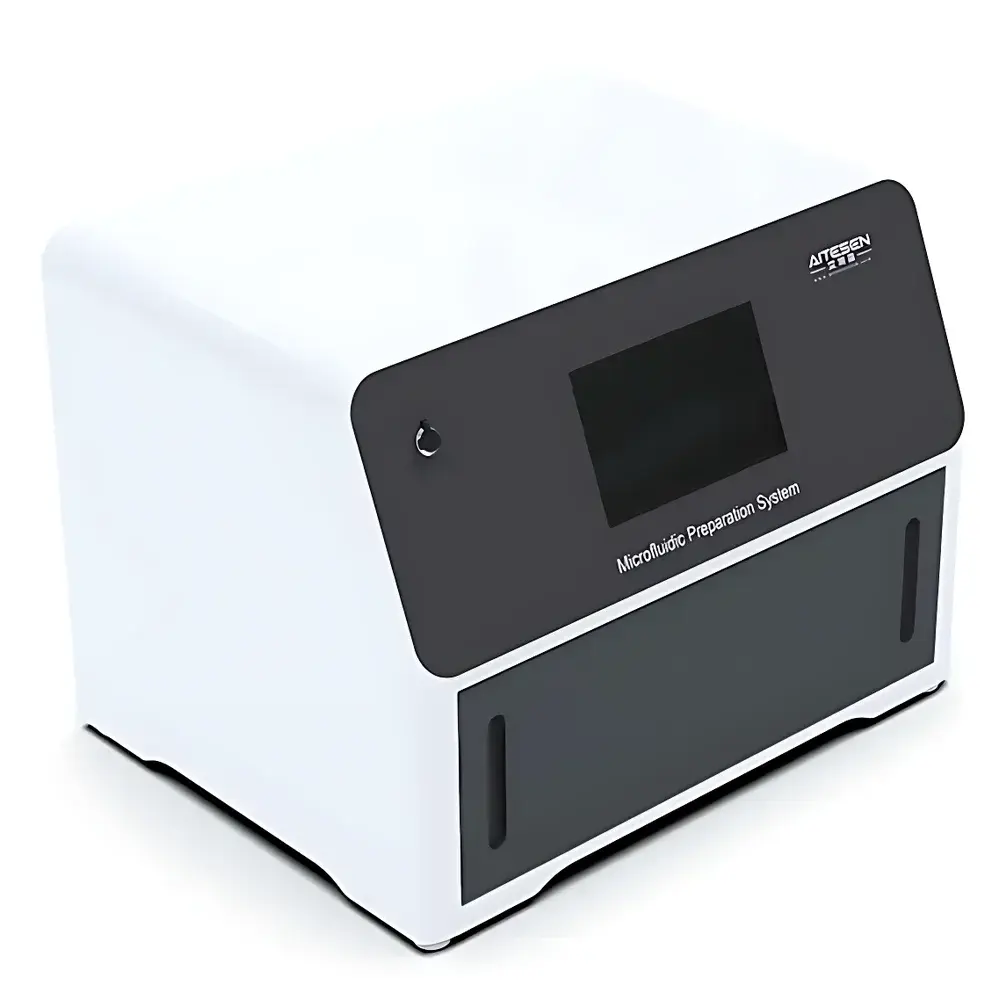
Aitesen MPE-P1 Pilot-Scale Microfluidic Preparation System
| Brand | Aitesen |
|---|---|
| Origin | Jiangsu, China |
| Manufacturer Type | Authorized Distributor |
| Country of Origin | China |
| Model | MPE-P1 |
| Chip Material | Stainless Steel 316 (SS316) |
| Control Interface | Integrated Industrial Touchscreen HMI |
| Data Management | Batch Logging, CSV Export, Audit-Trail-Ready Configuration |
| Flow Rate Range | Up to 50 mL/min per inlet (system-dependent) |
| Operating Pressure | ≤ 120 bar |
| Chip Compatibility | Custom SS316 microfluidic chips with asymmetric staggered herringbone or hydrodynamic focusing geometries |
Overview
The Aitesen MPE-P1 Pilot-Scale Microfluidic Preparation System is an engineered platform for reproducible, scalable synthesis of sub-100 nm to micrometer-scale colloidal drug delivery systems. It operates on the principle of controlled hydrodynamic flow focusing and rapid mixing within precision-machined stainless steel microchannels—enabling precise manipulation of interfacial energy, supersaturation kinetics, and nucleation dynamics during nanoparticle formation. Unlike benchtop syringe-pump-based microfluidic setups, the MPE-P1 integrates high-pressure fluid delivery, real-time process monitoring, and GxP-aligned data handling into a single compact unit. Designed specifically for translational development—from early formulation screening to clinical batch production—the system bridges the critical gap between lab-scale feasibility studies and commercial manufacturing readiness. Its architecture supports continuous and semi-batch operation modes, facilitating direct correlation between microfluidic process parameters (e.g., total flow rate, flow rate ratio, mixing time) and final particle attributes including polydispersity index (PDI), encapsulation efficiency, and colloidal stability.
Key Features
- Robust SS316 microfluidic chip interface with standardized Luer-lock or Swagelok®-compatible connections for rapid chip exchange and cleaning-in-place (CIP) compatibility
- High-pressure dual-channel precision pumping system capable of stable operation up to 120 bar, enabling formulation of viscous lipid mixtures and high-concentration polymer solutions
- Integrated industrial-grade touchscreen HMI with intuitive workflow navigation, pre-loaded SOP templates, and configurable parameter locking for operator-defined process boundaries
- Real-time logging of all critical process variables—including individual inlet pressures, total flow rates, temperature (via optional external probe integration), and timestamped batch identifiers
- Modular chip design support: accommodates custom SS316 chips optimized for specific applications such as T-junction, Y-junction, multi-inlet vortex, or serpentine diffusion-limited mixing architectures
- Compliance-ready architecture: firmware supports user-level access control, electronic signatures (per FDA 21 CFR Part 11 Annex 11 guidelines), and audit-trail generation for GLP/GMP-aligned environments
Sample Compatibility & Compliance
The MPE-P1 demonstrates broad compatibility across lipid-, polymer-, and surfactant-based nanocarrier systems. Validated use cases include cationic and ionizable lipid formulations for mRNA/siRNA encapsulation; PEGylated phospholipid bilayers for liposomal doxorubicin or irinotecan; PLGA/PEG-PLGA nanoparticles for sustained release; oil-in-water emulsions for vaccine adjuvants (e.g., MF59 analogues); and inorganic colloids such as citrate-stabilized gold nanoparticles. All contact surfaces are electropolished SS316, compliant with ISO 10993-5 (cytotoxicity) and USP Class VI biocompatibility standards. The system meets mechanical safety requirements per IEC 61010-1 and electromagnetic compatibility per EN 61326-1. Documentation packages include IQ/OQ protocols and traceable calibration records for pressure transducers and flow sensors.
Software & Data Management
The embedded control software provides deterministic execution of predefined preparation protocols with automatic versioning and metadata tagging. Each batch generates a structured CSV file containing synchronized timestamps, raw sensor outputs, and user-entered annotations (e.g., lot numbers, operator ID, environmental conditions). Optional cloud synchronization enables secure remote review via encrypted HTTPS endpoints. For regulated environments, the software supports role-based permissions (administrator, technician, reviewer), electronic signature capture with PKI-based authentication, and immutable audit logs that record every parameter change, login event, and export action—fully aligned with ALCOA+ principles (Attributable, Legible, Contemporaneous, Original, Accurate, Complete, Consistent, Enduring, Available).
Applications
- Preclinical and Phase I–II clinical batch production of LNP-formulated nucleic acid therapeutics
- Rapid screening of lipid molar ratios, solvent selection, and aqueous phase pH for liposome optimization
- Scale-down modeling for tech transfer to sterile-fill manufacturing lines using identical mixing physics
- Development of complex multi-component systems such as hybrid lipid-polymer nanoparticles or stimuli-responsive micelles
- Process characterization studies supporting Quality-by-Design (QbD) frameworks per ICH Q5A–Q5E and Q8–Q9 guidelines
- Stability-indicating method development for accelerated degradation testing under controlled shear and thermal stress
FAQ
What types of microfluidic chips are compatible with the MPE-P1?
The system accepts custom-machined SS316 chips with standard port configurations (¼”-28 UNF or M6×1). Chip geometry must be validated for pressure integrity at ≤120 bar and thermal stability up to 60°C.
Can the MPE-P1 be integrated into a cleanroom environment?
Yes—its sealed electronics enclosure meets IP54 rating, and surface finish complies with ISO 14644-1 Class 7 requirements when installed with appropriate HVAC and static-dissipative flooring.
Is remote monitoring supported?
Remote diagnostics and batch status viewing are available via optional Ethernet/WiFi module with TLS 1.2–secured web interface.
Does the system support automated cleaning cycles?
While not fully automated, the MPE-P1 includes programmable flush sequences and pressure-relief routines compatible with common CIP solvents (e.g., 70% ethanol, 0.1N NaOH, purified water).
How is process reproducibility verified across different operators?
Built-in parameter locking, mandatory electronic sign-off for protocol changes, and synchronized timestamping ensure operator-independent execution fidelity—validated per ASTM E2500-13 for equipment qualification.




