
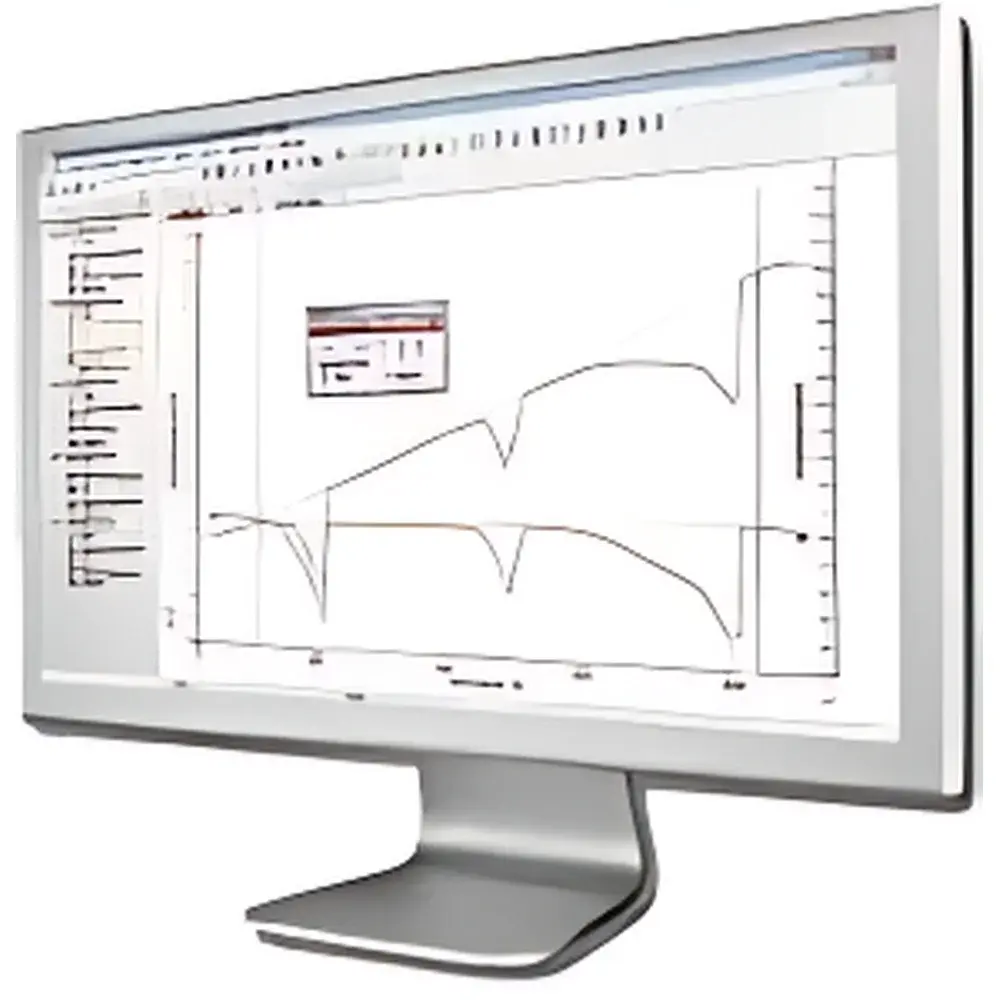
AKTS CALISTO Thermal Analysis Software Suite
| Brand | AKTS |
|---|---|
| Origin | Switzerland |
| Model | CALISTO Thermal Kinetics Software |
| Software Modules | CALISTO Acquisition (instrument control for SETARAM systems) & CALISTO Processing (vendor-agnostic data analysis) |
| Compliance | Designed for GLP/GMP environments with audit trail readiness |
| Data Handling | Supports DSC, TGA, and calorimetry datasets from multiple manufacturers |
| Key Mathematical Capabilities | Heat capacity determination, peak deconvolution, inverse filtering, glass transition analysis, decay modeling, custom equation fitting, advanced baseline construction, solid/liquid ratio calculation, reaction kinetics profiling, baseline subtraction, normalization, numerical integration, TMA alpha-point extraction (true α, mean α), temperature calibration correction, mass loss quantification, tare compensation, derivative computation (with configurable filter types), Gaussian & Savitzky–Golay filtering, curve segmentation, slope correction, natural logarithm transformation, inflection point detection, spike removal |
| Output Formats | Native .cali project files, export to PDF, PNG, SVG, CSV, and Word-compatible vector graphics (auto-resized for optimal print/display resolution) |
Overview
AKTS CALISTO is a modular, vendor-agnostic thermal analysis software platform engineered for rigorous quantitative interpretation of differential scanning calorimetry (DSC), thermogravimetric analysis (TGA), and isothermal/non-isothermal calorimetry data. Unlike monolithic instrument-bound packages, CALISTO separates acquisition and processing into two interoperable components: CALISTO Acquisition—exclusively designed for real-time control and data acquisition from SETARAM thermal analysis instruments—and CALISTO Processing, a standalone analysis engine compatible with exported datasets from diverse manufacturers (e.g., TA Instruments, Netzsch, PerkinElmer, Mettler Toledo). Its architecture follows ISO/IEC 17025-aligned principles for measurement traceability, supporting method validation, parameter locking, and version-controlled workflow templates. The software implements physically grounded mathematical models for kinetic and thermodynamic parameter extraction, enabling reproducible derivation of activation energies, reaction orders, enthalpies of transition, and heat capacity profiles across heterogeneous sample matrices.
Key Features
- Advanced Baseline Construction: Employs adaptive polynomial and spline-based algorithms coupled with user-defined constraint regions to generate physically meaningful baselines—critical for accurate integration of endothermic/exothermic events in DSC and precise mass-loss onset determination in TGA.
- Peak Deconvolution Engine: Applies iterative constrained least-squares fitting using customizable peak shape models (Gaussian, Lorentzian, Voigt) to resolve overlapping thermal events, enabling discrete quantification of multi-step decomposition or sequential phase transitions.
- Vendor-Neutral Data Import: Accepts ASCII, Q20, NETZSCH ASC, and other standardized thermal data formats; preserves original metadata (temperature ramp rate, purge gas flow, sample mass) during import for full metrological traceability.
- Automated Specific Heat Calculation: Implements ASTM E1269-compliant dual-step method (baseline subtraction + normalization against sapphire reference) with automated drift correction and uncertainty propagation reporting.
- Configurable Derivative & Filtering: Offers selectable differentiation orders (1st–3rd) with integrated Savitzky–Golay or Gaussian convolution filters to suppress high-frequency noise while preserving inflection point fidelity for Tg and decomposition onset identification.
- Export-Ready Visualization: Generates publication-grade vector graphics (SVG/PDF) and Word-embeddable EMF objects with automatic DPI scaling, axis label localization, and customizable legend positioning—fully compliant with journal submission requirements.
Sample Compatibility & Compliance
CALISTO Processing supports datasets derived from polymeric melts, pharmaceutical APIs, inorganic hydrates, battery electrode materials, and composite formulations—provided raw signal integrity meets minimum SNR thresholds (≥40 dB recommended). The software adheres to regulatory expectations for analytical instrument software under FDA 21 CFR Part 11 (electronic signatures, audit trail logging, role-based access control), EU Annex 11 (data integrity ALCOA+ principles), and ISO 13485 (for medical device material qualification). All processing steps—including baseline selection, peak integration limits, and filter parameters—are recorded in immutable audit trails with timestamps, operator IDs, and change justification fields.
Software & Data Management
Data integrity is enforced via hierarchical user permissions (Administrator, Analyst, Reviewer), encrypted project file (.cali) storage with SHA-256 checksum verification, and optional integration with enterprise LIMS via RESTful API. CALISTO Processing includes built-in validation protocols for linearity (NIST-traceable reference standards), precision (repeatability assessment across ≥5 replicate runs), and robustness (parameter sensitivity testing per ICH Q2(R2)). Raw and processed data exports comply with FAIR principles (Findable, Accessible, Interoperable, Reusable), including embedded metadata compliant with ISA-Tab specifications.
Applications
- Pharmaceutical solid-state characterization: Polymorph screening, amorphous content quantification, excipient compatibility assessment, and stability-indicating assay development per USP & ICH guidelines.
- Materials science: Curing kinetics of thermosets, oxidative induction time (OIT) evaluation, thermal degradation mechanisms in composites, and crystallinity evolution in semi-crystalline polymers.
- Energy storage R&D: Solid-electrolyte interphase (SEI) formation analysis, cathode/anode thermal runaway onset prediction, and binder decomposition profiling in Li-ion battery slurries.
- Food science: Glass transition mapping in amorphous carbohydrates, lipid oxidation onset detection, and moisture-induced phase behavior in freeze-dried matrices.
- Academic research: Model-free kinetic analysis (Friedman, Ozawa–Flynn–Wall), isoconversional methods, and thermodynamic parameter estimation for solid-state reactions.
FAQ
Is CALISTO Acquisition compatible with non-SETARAM instruments?
No—CALISTO Acquisition is exclusively licensed for real-time communication with SETARAM thermal analyzers (e.g., Sensys Evo, Setsys Evolution, BT2.15). For data acquisition from other vendors, users must employ the native instrument software and export results to CALISTO Processing.
Does CALISTO support automated method transfer between laboratories?
Yes—CALISTO Processing allows full method serialization (including baseline rules, peak fit constraints, and report templates) as portable .calimethod files, enabling cross-site reproducibility under controlled validation protocols.
Can audit trails be exported for regulatory submission?
Yes—audit logs are exportable as timestamped, digitally signed PDF reports containing all user actions, parameter modifications, and system events, formatted per FDA eCTD Module 5.3.5.2 requirements.
What operating systems does CALISTO support?
CALISTO Acquisition requires Windows 10/11 (64-bit) with .NET Framework 4.8 and dedicated USB/RS-232 drivers for SETARAM hardware. CALISTO Processing supports Windows 10/11 and Windows Server 2019/2022.
Is cloud deployment supported?
CALISTO Processing may be installed on virtualized Windows environments (VMware/Hyper-V) within validated private clouds; public cloud hosting (e.g., AWS, Azure) is not certified due to data residency and encryption key management constraints.



