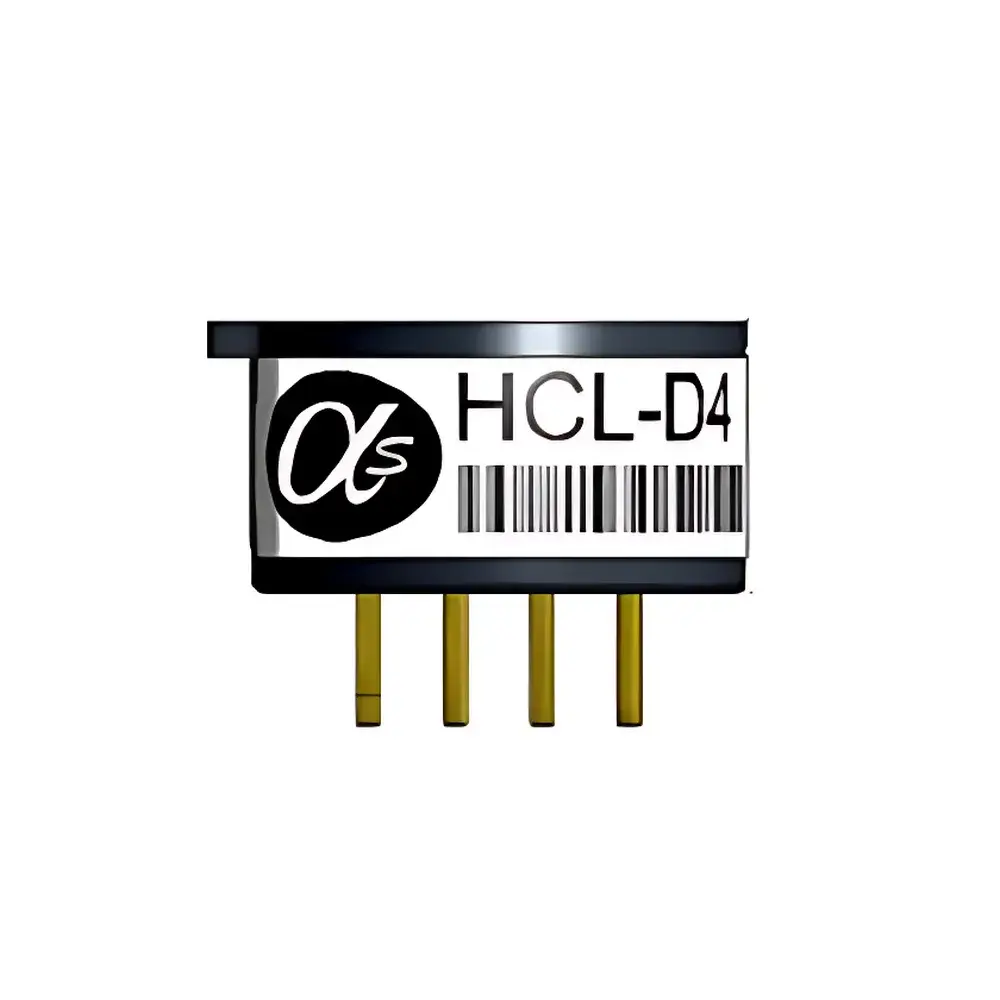
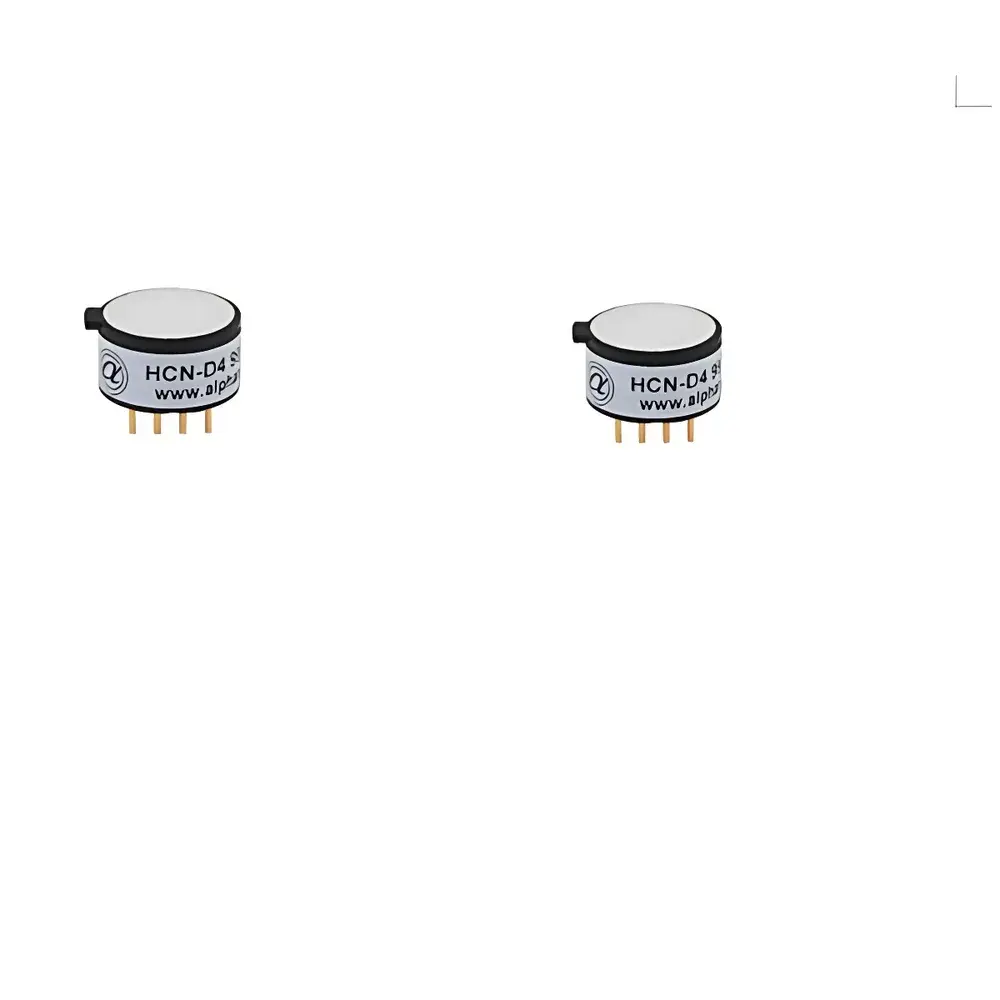
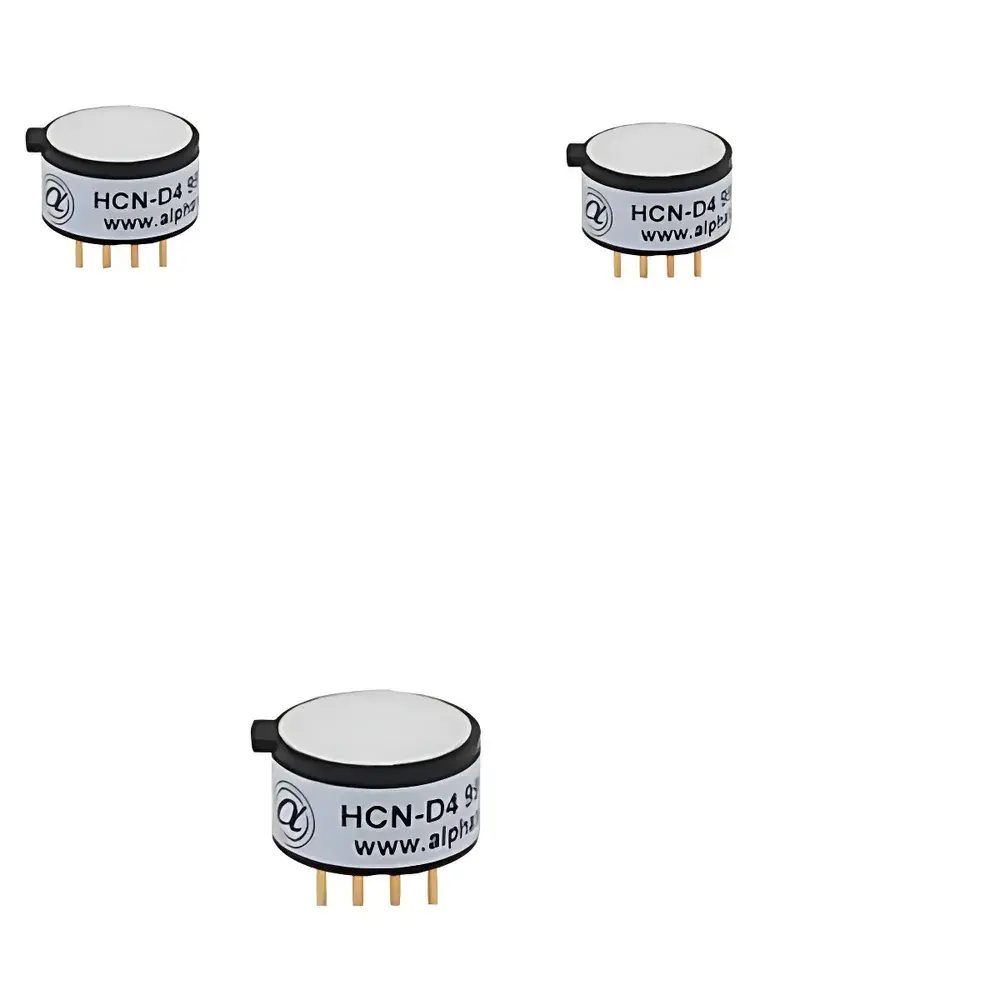
Alphasense HCL-D4 Electrochemical Hydrogen Chloride (HCl) Gas Sensor
| Brand | Alphasense (UK) |
|---|---|
| Origin | United Kingdom |
| Model | HCL-D4 |
| Sensitivity | 100–200 nA/ppm |
| Response Time (t₉₀) | ≤250 s |
| Resolution | <0.1 ppm |
| Zero Current | <3 ppm |
| Measurement Range | 0–50 ppm |
| Overload Capacity | 100 ppm |
| Load Resistance | 10–33 Ω |
| Diameter × Height | Φ14.5 × 8.3 mm |
| Sensor Type | Three-Electrode Electrochemical |
Overview
The Alphasense HCL-D4 is a precision-engineered, three-electrode electrochemical sensor designed for the selective and stable detection of hydrogen chloride (HCl) gas in ambient air or process streams. Operating on the principle of amperometric electrochemistry, the sensor generates a current proportional to HCl concentration via controlled oxidation at the working electrode within an aqueous electrolyte matrix. Its robust design incorporates a hydrophobic membrane that regulates gas diffusion while rejecting particulates, moisture, and interfering species—ensuring long-term baseline stability and minimal cross-sensitivity to common gases such as SO₂, NO₂, Cl₂, and CO. The HCL-D4 is optimized for fixed-system integration in continuous emission monitoring (CEM), industrial hygiene, fenceline monitoring, and laboratory safety applications where regulatory-grade reliability and trace-level detection are required.
Key Features
- Three-electrode architecture with dedicated reference and counter electrodes for enhanced zero stability and reduced drift over time
- High selectivity for HCl supported by proprietary catalyst formulation and diffusion-limiting membrane
- Low detection limit (<0.1 ppm) and linear response across the full 0–50 ppm measurement range
- Fast t₉₀ response time of ≤250 seconds under standard conditions (23°C, 50% RH)
- Compact cylindrical form factor (Φ14.5 × 8.3 mm) compatible with OEM gas detection modules and multi-gas instrument platforms
- Optimized for operation with external load resistance between 10 Ω and 33 Ω, enabling flexible signal conditioning interface design
- Factory-calibrated with documented calibration certificate traceable to NIST-standard HCl reference standards
Sample Compatibility & Compliance
The HCL-D4 is intended for use in clean, non-condensing gaseous environments with operating temperature range of −20°C to +50°C and relative humidity from 15% to 90% (non-condensing). It is not suitable for direct exposure to liquid HCl, high-concentration acid mists, or strongly oxidizing atmospheres exceeding 100 ppm. The sensor complies with key international performance benchmarks for electrochemical gas sensors, including IEC 60079-29-1 (Explosive Atmospheres – Gas Detectors) and EN 45544-1 (Workplace Atmospheres – Electrical Apparatus for Detection of Toxic Gases). While not intrinsically safe on its own, it is widely integrated into ATEX- and IECEx-certified analyzers when paired with appropriate barrier circuits. Its design supports GLP-aligned deployment in environmental and occupational health monitoring programs requiring auditable sensor performance records.
Software & Data Management
As a transducer-level component, the HCL-D4 outputs a raw analog current signal (nA) requiring external signal conditioning—including low-noise amplification, temperature compensation, and analog-to-digital conversion. When integrated into systems compliant with FDA 21 CFR Part 11, the host analyzer firmware must implement audit-trail functionality for calibration events, zero adjustments, and sensor replacement logs. Alphasense provides comprehensive technical documentation—including cross-sensitivity matrices, temperature compensation coefficients, and shelf-life guidance—to support validation protocols under ISO/IEC 17025 and EU GMP Annex 15 frameworks. Sensor diagnostics (e.g., reference electrode potential monitoring) may be enabled via compatible OEM electronics to support predictive maintenance scheduling.
Applications
- Continuous monitoring of HCl emissions from waste incineration, chemical synthesis, and semiconductor etching processes
- Occupational exposure assessment in chlor-alkali plants, PVC manufacturing, and metal pickling facilities
- Fenceline and community air quality monitoring networks targeting acid gas dispersion modeling
- Portable and transportable multi-gas detectors used by industrial hygienists and emergency response teams
- Research-grade atmospheric chemistry instrumentation requiring validated, field-deployable HCl sensing capability
FAQ
What is the expected operational lifetime of the HCL-D4 sensor under typical indoor conditions?
The nominal service life is 24 months from date of manufacture when stored and operated within specified environmental limits; actual field lifetime depends on cumulative HCl exposure, temperature cycling, and humidity history.
Does the HCL-D4 require periodic zero and span calibration?
Yes—routine calibration is essential for maintaining accuracy. Alphasense recommends zero calibration every 30 days and span calibration every 90 days using certified HCl gas standards at concentrations traceable to national metrology institutes.
Can the HCL-D4 be used in high-humidity or condensing environments?
No—it must be protected from condensation and prolonged exposure to >90% RH; use of sample conditioning (e.g., Nafion dryers or permeation dryers) is advised in humid applications.
Is the HCL-D4 compatible with common data acquisition systems?
Yes—its low-impedance current output interfaces directly with standard transimpedance amplifier circuits found in most industrial gas analyzers and DAQ hardware supporting 4–20 mA or 0–5 V analog inputs.
How does the HCL-D4 handle interference from chlorine gas (Cl₂)?
It exhibits moderate cross-sensitivity to Cl₂ (~15–20% relative response); users deploying in mixed halogen environments should apply correction algorithms or employ optical interference filters upstream of the sensor.