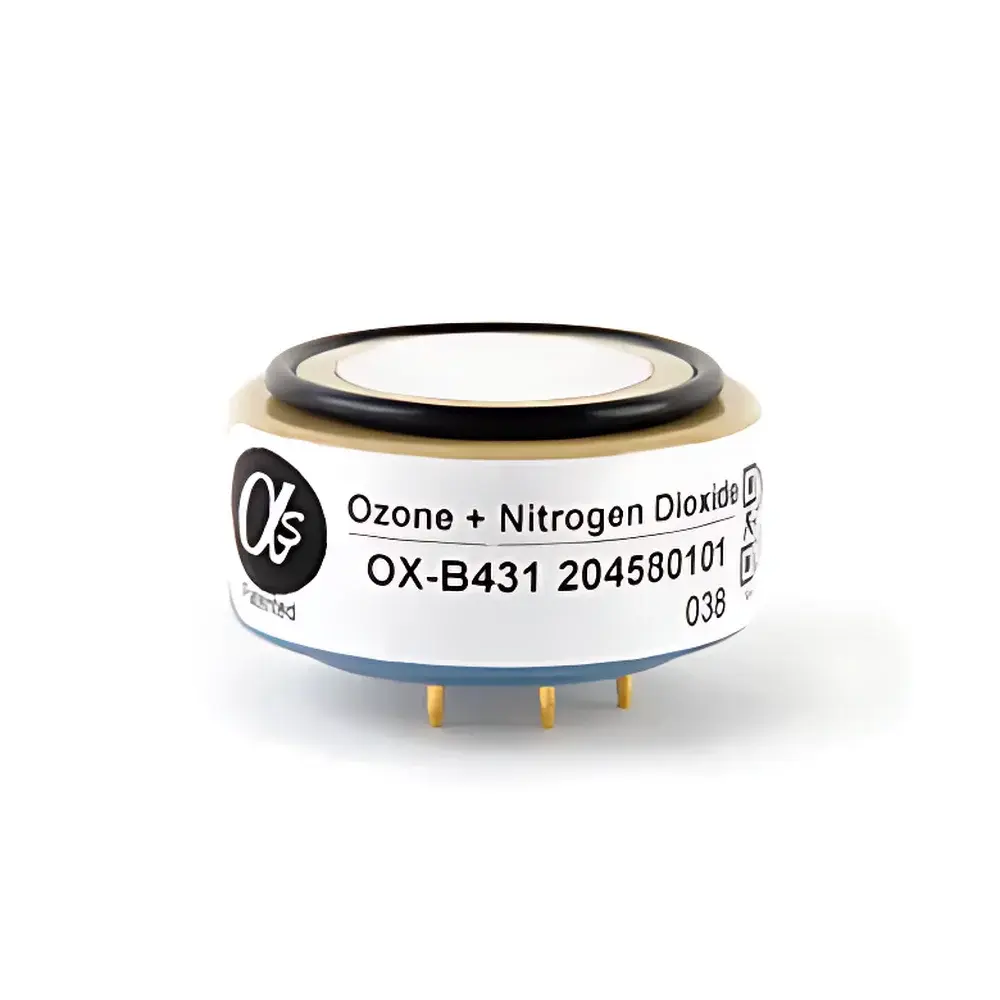
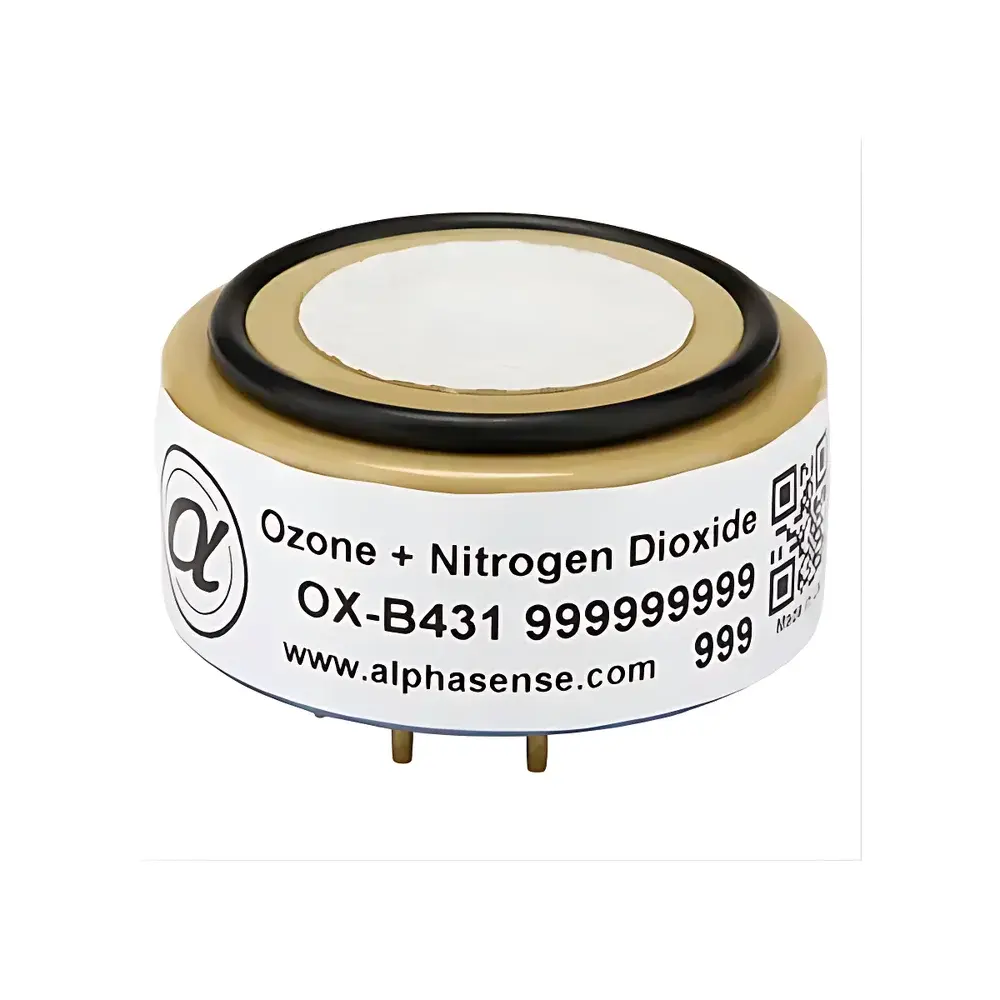
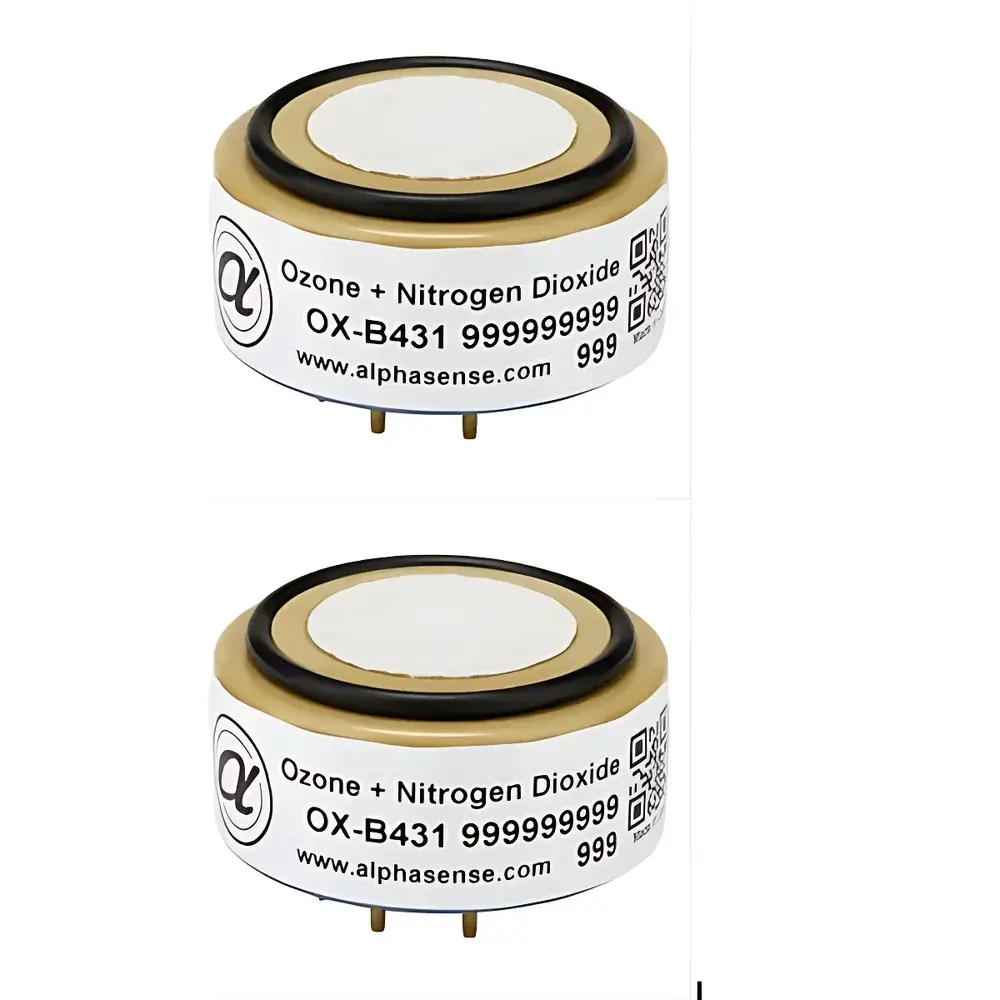
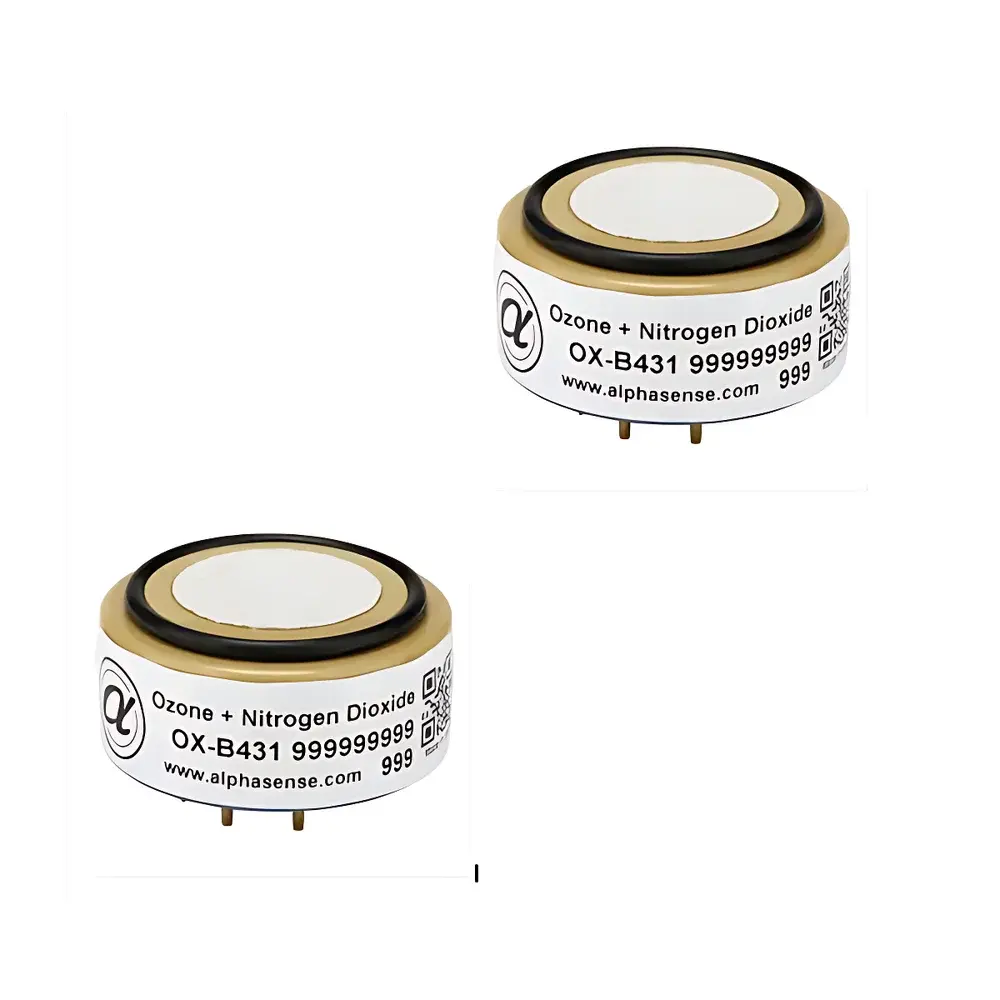
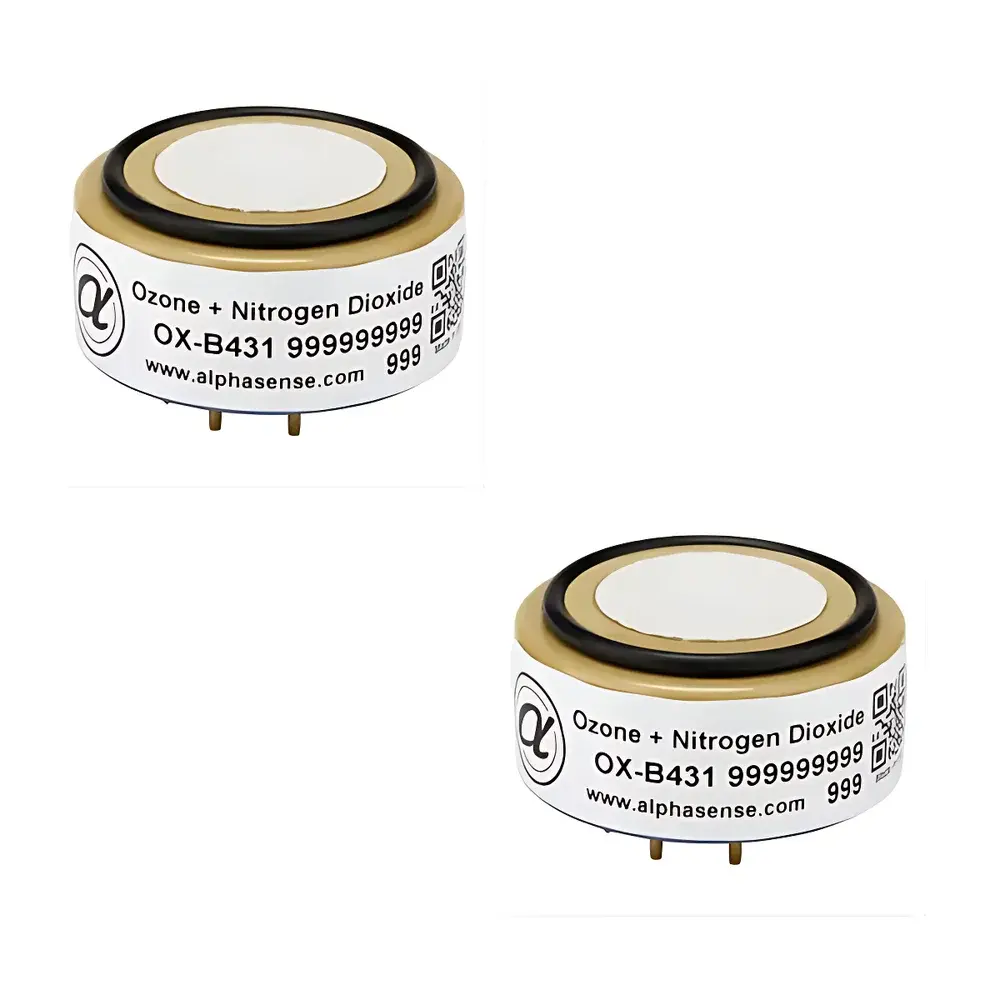
Alphasense OX-B431 Electrochemical Gas Sensor for Ozone (O₃) and Nitrogen Dioxide (NO₂)
| Brand | Alphasense (UK) |
|---|---|
| Origin | United Kingdom |
| Model | OX-B431 (Successor to OX-B421) |
| Detection Principle | Potentiostatic 3-Electrode Electrochemical |
| Target Gases | O₃ and NO₂ |
| O₃ Range | 0–20 ppm (50 ppm overload) |
| NO₂ Range | 0–20 ppm (50 ppm overload) |
| Response Time (t₉₀) | <80 s for both gases |
| Sensitivity (O₃) | −225 to −750 nA/ppm |
| Sensitivity (NO₂) | −250 to −750 nA/ppm |
| Dimensions | Ø32.3 × 16.5 mm |
| Operating Temperature | −30 °C to +50 °C |
| Operating Humidity | 15–90 % RH (non-condensing) |
| Lifetime | ≥24 months (typical, dependent on exposure conditions) |
| Compliance | CE-marked, RoHS-compliant, designed per IEC 60079-29-1 for use in gas detection systems |
Overview
The Alphasense OX-B431 is a high-stability, potentiostatically controlled three-electrode electrochemical sensor engineered for selective and reliable detection of ozone (O₃) and nitrogen dioxide (NO₂) in ambient air and industrial process environments. As the designated successor to the widely deployed OX-B421, the OX-B431 incorporates refined electrode formulations and optimized membrane diffusion characteristics to deliver improved baseline stability, reduced zero drift, and enhanced long-term reproducibility—critical attributes for continuous air quality monitoring and regulatory-grade instrumentation. The sensor operates on the principle of amperometric current generation proportional to target gas concentration at the working electrode, with integrated temperature compensation and low-noise signal conditioning architecture. It is not intended for standalone use but functions as a core transduction element within certified gas analyzers, fixed monitors, and portable detection platforms compliant with EN 50194, ISO 12039, and EPA Method TO-11A for oxidant gas measurement.
Key Features
- Dual-gas capability: Simultaneous electrochemical response to both O₃ and NO₂ within a single compact housing (Ø32.3 × 16.5 mm)
- Enhanced stability: Reduced zero drift and improved sensitivity consistency over time compared to OX-B421, extending calibration intervals in field-deployed systems
- Fast dynamic response: t₉₀ ≤ 80 seconds for both O₃ and NO₂ under standard conditions (23 °C, 50 % RH), enabling real-time tracking of transient pollutant events
- Robust environmental tolerance: Rated for operation from −30 °C to +50 °C and 15–90 % RH (non-condensing), supporting deployment across diverse climatic zones
- Interference mitigation design: Optimized electrolyte composition and filter layer reduce cross-sensitivity to common interferents including CO, SO₂, and Cl₂ (cross-sensitivity data available in Alphasense Technical Note TN-012)
- Plug-compatible upgrade path: Mechanical and electrical pinout identical to OX-B421, permitting seamless integration into legacy instrument designs without hardware modification
Sample Compatibility & Compliance
The OX-B431 is validated for use in ambient air, indoor air, and low-particulate industrial exhaust streams. It requires no sample conditioning beyond particulate filtration (e.g., PTFE membrane filter, pore size ≤ 5 µm) and optional hydrophobic barrier for high-humidity applications. For quantitative O₃ measurement in mixed-gas environments containing NO₂, Alphasense recommends co-deployment with the NO₂-B43F sensor to enable real-time two-point compensation via firmware-based algorithmic correction—fully supported in Alphasense’s A4 Series transmitter modules and third-party OEM platforms implementing the documented I²C/UART interface protocol. The sensor complies with EU RoHS Directive 2011/65/EU and carries CE marking under the Electromagnetic Compatibility (EMC) Directive 2014/30/EU. While not intrinsically safe on its own, it is approved for incorporation into ATEX/IECEx-certified gas detection systems when used with appropriate barrier circuits per IEC 60079-29-1.
Software & Data Management
Raw output is a temperature-compensated analog current signal (nA range), digitized externally via precision low-noise transimpedance amplifiers. Alphasense provides full technical documentation—including calibration certificates traceable to NPL (UK), sensitivity matrices, temperature/humidity compensation coefficients, and aging profiles—for integration into validated software environments. When paired with Alphasense’s A4 or B4 series intelligent transmitters, the OX-B431 supports digital diagnostics (e.g., electrode health status, electrolyte depletion warning), automatic zero/span validation logs, and audit-trail-enabled configuration storage compliant with FDA 21 CFR Part 11 requirements for regulated air quality networks. Firmware updates and sensor-specific calibration files are distributed through Alphasense’s secure customer portal, requiring authenticated access and version-controlled release notes.
Applications
- Ambient air quality monitoring networks (AQMS) adhering to EU Directive 2008/50/EC and US EPA National Ambient Air Quality Standards (NAAQS)
- Indoor air quality (IAQ) systems in healthcare facilities, schools, and office buildings where O₃ from UV sterilization or NO₂ from combustion appliances must be quantified
- Industrial hygiene monitoring in semiconductor fabrication cleanrooms, water treatment plants using ozone disinfection, and municipal wastewater ozonation units
- Mobile pollution mapping platforms and low-cost sensor networks requiring metrologically traceable reference-grade electrochemical nodes
- OEM integration into portable multi-gas detectors (e.g., for occupational safety compliance with OSHA PELs and ACGIH TLVs)
FAQ
Can the OX-B431 distinguish between O₃ and NO₂ without additional hardware?
No. The sensor produces a combined current response to both gases. Accurate speciated measurement requires either sequential zero-air purging (for lab-based batch analysis) or concurrent use of a dedicated NO₂-B43F sensor for real-time compensation.
What is the recommended calibration frequency for continuous monitoring?
Initial calibration is required prior to deployment. Field recalibration is advised every 3–6 months depending on operating environment; accelerated drift may occur in high-ozone or high-NO₂ exposure scenarios.
Is the OX-B431 compatible with existing OX-B421 socketed instruments?
Yes—identical footprint, pinout, and electrical interface ensure drop-in replacement without firmware or mechanical modification.
Does the sensor require external temperature or humidity compensation?
The OX-B431 includes an onboard thermistor; however, optimal accuracy demands external RH measurement and application of Alphasense’s published humidity correction algorithm.
What is the expected operational lifetime under typical urban ambient conditions?
Minimum 24 months when operated within specified environmental limits and protected from condensation, H₂S, and high-concentration acidic vapors.