
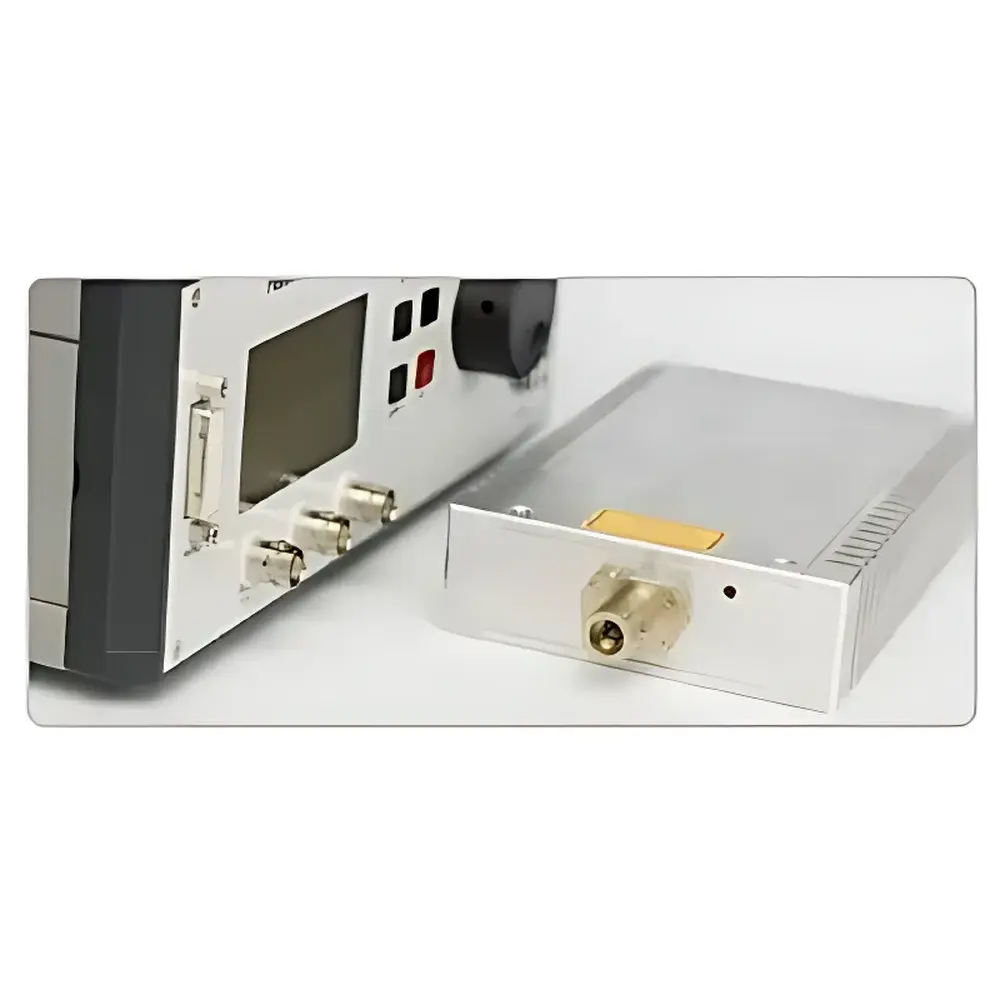
ALS Pilas Series Picosecond Semiconductor Laser System
| Origin | Germany |
|---|---|
| Manufacturer Type | Authorized Distributor |
| Origin Category | Imported |
| Model | Pilas |
| Price Range | USD 7,000 – 14,000 |
| Core Components | Semiconductor laser diode module with integrated driver, thermal management, and precision timing electronics |
Overview
The ALS Pilas Series Picosecond Semiconductor Laser System is a high-performance, turnkey pulsed laser source engineered for demanding time-resolved optical applications requiring sub-nanosecond temporal precision. Based on advanced gain-switched or mode-locked semiconductor laser diode technology, the system delivers transform-limited optical pulses with durations as short as 20 ps (FWHM), enabling ultrafast photoluminescence lifetime measurements, time-correlated single-photon counting (TCSPC), pump-probe spectroscopy, and fluorescence correlation spectroscopy (FCS). Its broad spectral coverage—from 375 nm in the near-UV to 2000 nm in the short-wave infrared—supports multi-wavelength experimental flexibility across materials science, biophotonics, and quantum optics laboratories. The laser operates with exceptional timing stability: jitter between electrical trigger input and optical pulse output is specified at ≤3 ps RMS, ensuring synchronization fidelity critical for gated detection and lock-in acquisition schemes.
Key Features
- Ultra-short pulse width: 20–200 ps FWHM, selectable per model and configurable via driver settings
- Wide wavelength range: 375–2000 nm, including discrete standard wavelengths (e.g., 405, 635, 850, 1064, 1310, 1550 nm) and narrow-linewidth DFB variants (±2 nm tolerance, <0.5 nm spectral width)
- Flexible repetition rate: adjustable from single-shot (externally triggered) up to 120 MHz, supporting both burst-mode and continuous pulsing
- High pulse-to-pulse stability: <0.5% RMS power fluctuation over 24-hour operation, validated under constant-temperature conditions
- Robust mechanical design: compact, dust-resistant housing with integrated thermoelectric cooling (TEC) and feedback-controlled temperature stabilization (±0.1 °C)
- Multi-trigger capability: supports TTL/LVDS external triggering and internal clock generation with programmable delay (0–100 ns, 10 ps resolution)
- Plug-and-play operation: factory-aligned, pre-calibrated, and supplied with USB/RS-232 interface for remote control via ASCII command set
Sample Compatibility & Compliance
The Pilas laser system is compatible with standard free-space optical paths and fiber-coupled configurations (FC/PC or SMA905 connectors, optional). It meets IEC 60825-1:2014 Class 4 laser safety requirements when operated above 500 mW peak power; lower-power variants are classified as Class 3B. All models comply with CE marking directives (EMC Directive 2014/30/EU and Low Voltage Directive 2014/35/EU) and RoHS 2011/65/EU. For regulated environments—including GLP-compliant analytical labs and ISO/IEC 17025-accredited testing facilities—the system supports audit-ready operation through optional firmware logging (timestamped trigger events, temperature history, and output power diagnostics), aligning with data integrity expectations under FDA 21 CFR Part 11 when paired with validated host software.
Software & Data Management
The Pilas platform includes ALS Control Suite—a cross-platform application (Windows/macOS/Linux) offering real-time parameter monitoring, pulse train visualization, and script-based automation via Python SDK. All configuration changes are logged with UTC timestamps and user identifiers. Export formats include CSV (for pulse energy, repetition rate, and thermal status) and HDF5 (for synchronized multi-channel TCSPC datasets). Optional integration with third-party platforms—including National Instruments LabVIEW, MATLAB Instrument Control Toolbox, and Becker & Hickl SPCM software—is supported through documented SCPI-like command protocols. Firmware updates preserve calibration constants and retain user-defined presets across revisions.
Applications
- Time-resolved photoluminescence (TRPL) of perovskites, quantum dots, and 2D materials
- Fluorescence lifetime imaging microscopy (FLIM) using hybrid scanning or widefield TCSPC detectors
- Pump-probe transient absorption spectroscopy with optical parametric amplification (OPA) seeding
- Optical time-domain reflectometry (OTDR) for fiber fault localization and dispersion analysis
- Calibration of streak cameras, SPAD arrays, and fast photodiodes (e.g., rise time verification)
- Quantum key distribution (QKD) testbeds requiring deterministic, low-jitter photon sources
FAQ
What is the typical pulse-to-pulse timing jitter specification?
The RMS jitter between the rising edge of an external TTL trigger and the optical pulse output is ≤3 ps for all standard Pilas models under stable thermal conditions.
Can the pulse width be adjusted dynamically during operation?
Pulse width is fixed per model variant (e.g., PiL085X = <50 ps); however, selectable pulse compression or broadening can be achieved externally using grating or prism compressors—ALS provides dispersion-compensated collimation options upon request.
Is fiber coupling included as standard equipment?
Free-space output is standard; FC/PC or SMA905 fiber coupling is available as a factory-installed option with AR-coated collimators and guaranteed coupling efficiency (>65% for SMF-28 at 850 nm).
Does the system support synchronization with other lasers or detectors?
Yes—via programmable trigger delay (0–100 ns, 10 ps step), LVDS-compatible sync outputs, and phase-lockable reference clock inputs (10 MHz or user-defined frequency).
What maintenance is required after installation?
None—no consumables, no alignment adjustments, and no periodic recalibration. The sealed, convection-cooled enclosure and solid-state architecture ensure maintenance-free operation for ≥50,000 hours MTBF.



